


Karma Yoga : Escape Scarcity: Master the Art of Living in Sacred Reciprocity
If you have not already done so, I would request you to review the Chapter 2, Sankhya Yoga before studying chapter 3 as that would help set the right context.
You can find the explanation of the previous set of shlokas from chapter (3.10 to 3.11) here. Please go through that to get a better understand and maintain continuity in your learning.
You can also listen to all the episodes through my Spotify Portal, Apple Podcast, and on YouTube as well.
You can find below the condensed gist of the narrative. For the complete expanded narrative, look below the verses.
To achieve a life of true fulfillment, one must master Yajna – the science of living in sacred reciprocity. This is not merely a philosophical idea but a technical blueprint for how to align with natural laws. In the Bhagavad Gita, Krishna explains that the universe is a web of cosmic interdependence.
When we ignore Yajna – the science of living in sacred reciprocity, we become like a “thief” who takes without giving. By practicing Yajna – the science of living in sacred reciprocity, we transform our consumption into a sacred exchange.
This is the ancient wisdom for modern abundance that allows us to thrive by contributing to the whole.
The Mechanics of Abundance Understanding what is the meaning of Yajna in the Gita is essential for overcoming the scarcity mindset. Many people struggle because they do not realize that Yajna – the science of living in sacred reciprocity is the engine of prosperity.
When we focus on purifying action through selfless service, we engage the spiritual law of giving. This is the secret of divine partnership: as we nourish the cosmic forces, they nourish us. By applying Yajna – the science of living in sacred reciprocity, we ensure that our efforts are backed by the all-pervasive Brahman. This spiritual ecology is the only way to maintain balance in our lives and the world.
Sacred Work and Daily Life
Applying Gita teachings to daily work begins with the shift of living as a caretaker not an owner. Every project and every meal is an opportunity for Yajna – the science of living in sacred reciprocity. If you have wondered how can I live in harmony with the universe, the answer is to treat every breath as Yajna – the science of living in sacred reciprocity.
This practice clarifies how selfless service leads to prosperity, as it removes the ego-driven obstacles to success. By centering your existence on Yajna – the science of living in sacred reciprocity, you participate in the same sacred exchange that keeps the stars in place and the rains falling.
Through Yajna – the science of living in sacred reciprocity, our actions become a gift to the Imperishable. Embracing Yajna – the science of living in sacred reciprocity is the final step in overcoming the scarcity mindset and entering a life of grace.
Keywords: Yajna – the science of living in sacred reciprocity, cosmic interdependence, spiritual law of giving, sacred exchange, how to align with natural laws, ancient wisdom for modern abundance, applying Gita teachings to daily work, the secret of divine partnership, what is the meaning of Yajna in the Gita, how does selfless service lead to prosperity, how can I live in harmony with the universe, overcoming the scarcity mindset, living as a caretaker not an owner, purifying action through selfless service, spiritual ecology.
Verses 3.12 – 3.15
इष्टान्भोगान्हि वो देवा दास्यन्ते यज्ञभाविता: |
तैर्दत्तानप्रदायैभ्यो यो भुङ्क्ते स्तेन एव स: || 12||
iṣhṭān bhogān hi vo devā dāsyante yajña-bhāvitāḥ
tair dattān apradāyaibhyo yo bhuṅkte stena eva saḥ
इष्टान् (iṣṭān) – desired; भोगान् (bhogān) – enjoyments; हि (hi) – indeed; वो (vo) – to you; देवा (devā) – the gods; दास्यन्ते (dāsyante) – will give; यज्ञभाविताः (yajñabhāvitāḥ) – being pleased by sacrifices; तैर्दत्तान् (tairdattān) – with those given; अप्रदायैभ्यः (apradāyaibhyaḥ) – without offering (to those); यो (yaḥ) – who; भुङ्क्ते (bhuṅkte) – enjoys; स्तेन (stena) – thief; एव (eva) – indeed; स: (saḥ) – he.
The Gods, indeed, will give you the desired enjoyments, being pleased by sacrifices. He who enjoys these gifts, without offering (in return) to those (Gods), is indeed a thief.
यज्ञशिष्टाशिन: सन्तो मुच्यन्ते सर्वकिल्बिषै: |
भुञ्जते ते त्वघं पापा ये पचन्त्यात्मकारणात् || 13||
yajña-śhiṣhṭāśhinaḥ santo muchyante sarva-kilbiṣhaiḥ
bhuñjate te tvaghaṁ pāpā ye pachantyātma-kāraṇāt
यज्ञशिष्टाशिन: (Yajna-shishta-ashinah) – Those who eat the remnants of sacrifices; सन्तो (Santo) – The saints; मुच्यन्ते (Muchyante) – Are released; सर्वकिल्बिषै: (Sarva-kilbishaih) – From all sins; भुञ्जते (Bhunjate) – They enjoy; ते (Te) – Those; त्वघं (Tv agham) – But sins; पापा (Papa) – Sinners; ये (Ye) – Who; पचन्त्यात्मकारणात् (Pachantyatma-karanat) – Cook for their own sake.
The saints who eat the remnants of sacrifices are released from all sins, but the sinners who cook for their own sake, they indeed eat sin.
अन्नाद्भवन्ति भूतानि पर्जन्यादन्नसम्भव: |
यज्ञाद्भवति पर्जन्यो यज्ञ: कर्मसमुद्भव: || 14||
annād bhavanti bhūtāni parjanyād anna-sambhavaḥ
yajñād bhavati parjanyo yajñaḥ karma-samudbhavaḥ
अन्नाद्भवन्ति (Annad bhavanti) – From food life springs forth; भूतानि (Bhutani) – The living beings; पर्जन्यादन्नसम्भव: (Parjanyad anna-sambhavah) – From rain food is produced; यज्ञाद्भवति (Yajnad bhavati) – From sacrifice arises rain; पर्जन्यो (Parjanyo) – The rain; यज्ञ: (Yajnah) – Sacrifice; कर्मसमुद्भव: (Karma-samudbhavah) – Is born of action.
From food, life springs forth, and from rain, food is produced. Rain itself arises from sacrifice, and sacrifice is born of performing duties without attachments.
कर्म ब्रह्मोद्भवं विद्धि ब्रह्माक्षरसमुद्भवम् |
तस्मात्सर्वगतं ब्रह्म नित्यं यज्ञे प्रतिष्ठितम् || 15||
karma brahmodbhavaṁ viddhi brahmākṣhara-samudbhavam
tasmāt sarva-gataṁ brahma nityaṁ yajñe pratiṣhṭhitam
कर्म (Karma) – Action; ब्रह्मोद्भवं (Brahmodbhavam) – is originated from Brahman; विद्धि (Viddhi) – Know; ब्रह्माक्षरसमुद्भवम् (Brahmakshara-samudbhavam) – Brahman is based on the imperishable; तस्मात्सर्वगतं (Tasmat sarvagatam) – Therefore, the all-pervasive; ब्रह्म (Brahma) – Brahman; नित्यं (Nityam) – Always; यज्ञे (Yajne) – In sacrifice; प्रतिष्ठितम् (Pratishthitam) – Is established.
Know that action originates from Brahman, which is based on the imperishable. Therefore, the all-pervasive Brahman is always established in sacrifice.
Attitude of gratitude
Shri Krishna makes a striking claim to Arjuna in these verses. The devas, the cosmic forces that preside over natural phenomena, nourished by yajña, will grant the enjoyments we desire. And whoever receives those gifts without offering anything in return is nothing less than a stena, a thief.
This is a moral diagnosis. And the emotional stake is real for Arjuna. He is afraid that action will bind him. He is afraid that desire will hijack him. He is afraid that participation in the world will trap him. Shri Krishna answers by revealing a deeper law that runs through the world, through society, and through the mind. When we live as givers inside the whole, the whole supports us. When we live as takers inside the whole, the mind contracts, fear rises, and conflicts arise.
The reciprocity of yajña and Living in Sacred Reciprocity
Taken literally, Shri Krishna’s teaching about devas sounds like a transaction with celestial beings. Studied more carefully, devas can be understood as the luminous intelligences and powers that operate the cosmos and the human system. The sun that ripens food. The rains that nourish crops. The subtle order that keeps the body breathing and healing. The intelligence that coordinates digestion, sleep, memory, and recovery.
We can call these devas. We can call them laws of nature. We can call them cosmic forces. Doesn’t matter, because the point stays the same. Life is structured as an exchange within a living ecosystem.
No human designed the water cycle that brings rain. No human designed the body that converts food into energy. All of it was here before we arrived, and it will continue after we leave. The question Shri Krishna is really raising is whether we recognize this or not.
When we do, we stop approaching life as consumers and begin participating in it as contributors.
Yajña is our participation in that exchange. It may include ritual, yet it is larger than ritual. It is the inner mindset that says our life is part of a living ecosystem. We take what is needed, we offer before consuming, and we keep the energy flowing.
Shri Krishna uses a strong word for the one who takes without offering. He calls that person a thief. He is naming a psychological reality. A person that receives without gratitude, without responsibility, without service, becomes habituated to entitlement. Entitlement strengthens ahaṃkāra, the sense of separateness, the sense that life owes us.
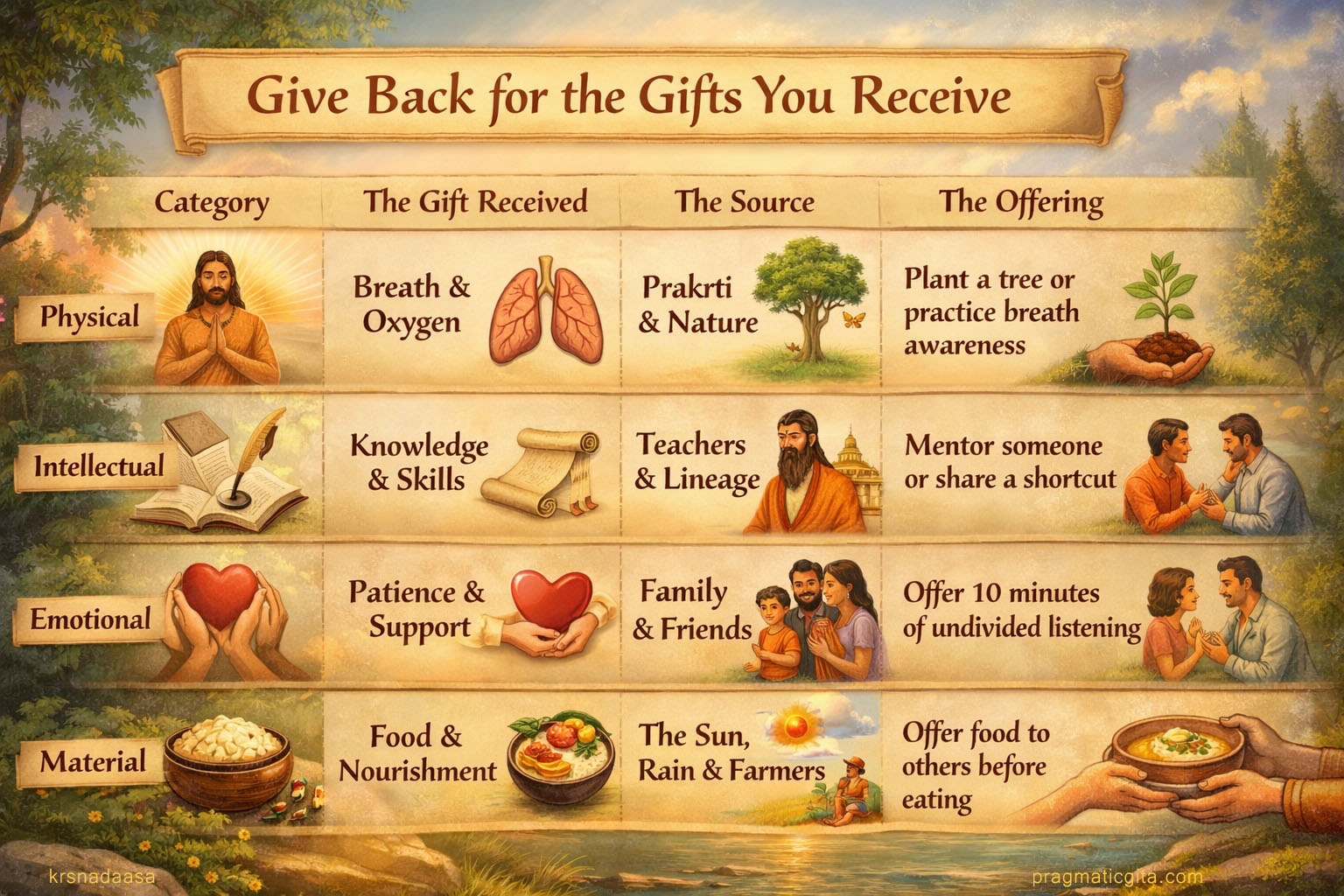
The solution is gratitude. This is the concept of offering prasādam to Bhagavān that our ancestors have practiced for ages. What we are doing there is an act of thanksgiving for what we have received. The food we eat, the air we breathe, the water we drink are all gifts given by Bhagavān, and we need to express our gratitude for these. Otherwise we are exactly what Shri Krishna describes. Thieves.
In the material plane, we know that we cannot use anything that belongs to someone else without either taking their permission or paying for it. The same principle applies at the cosmic level. We should not take for granted all the innumerable things we use on this planet to support our existence. We should recognize that ultimately whatever we are and whatever we have belongs to Bhagavān, and so we need to constantly pay back with our gratitude.
As one great mystic once said, if the only prayer you ever say in your entire life is thank you, it will be enough.
There is a story that brings this home with simplicity. An old businessman falls very sick and gets admitted to the hospital. They keep him there for three days and hook him up to an oxygen tank to help him breathe. On the fourth day, the doctor tells him he has recovered and is being discharged. The doctor hands him a bill of ten thousand dollars. The old man starts crying. The doctor asks him, why are you crying? are you not able to afford this bill? The old man says, I do not have a problem paying the bill. However, I just realized something.
You have handed me a bill of ten thousand dollars for three days of oxygen. I am seventy years old, which means I have lived for over 25,000 days, and in all those days, Bhagavān has provided me with free oxygen, and I have not even said a simple thank you for it.
That is the lesson Shri Krishna is teaching. We always need to cultivate an attitude of gratitude. That gratitude is our offering to Bhagavān, and that is what keeps returning to us as blessings. This is not merely a Vedāntic principle. It is echoed in many other spiritual traditions around the world, including what is sometimes called the law of attraction.
When this teaching is practiced, eating becomes sacred. Earning becomes sacred. Using resources becomes sacred. Relationships become sacred. The question changes from, what can we take, to, what can we contribute.
The meaning of prasāda and the purification of receiving
Shri Krishna deepens the teaching when he speaks of those who eat the remnants of yajña, called yajña-śiṣṭa. They are freed from all kilbiṣa, all impurity.
In traditional language, this is the eating of prasāda, what has been offered and returned as grace.
The concept of yajña-śiṣṭa is strongly interconnected with the philosophy of karma, ahiṃsā, and vairāgya. By offering food and everything else we consume first to Bhagavān, we are not only expressing gratitude but also acknowledging our role as caretakers of our bodies. This is a very important concept. We are not our bodies. We are not owners of our bodies.
We are caretakers of these bodies, which have been gifted to us by Prakṛti, to be used for spiritual evolution leading to God-Realization. When this understanding settles in the mind, the entire relationship with the body changes. We stop treating it as a pleasure machine. We stop treating it as a source of identity. We begin treating it as a sacred instrument, and we begin feeding it accordingly.
The Vedas prescribe a vegetarian diet for spiritual progress, and this is not without reason. However, even plants, vegetables, grains, and fruits contain life. If we eat them solely for our own enjoyment, we become bound in the karmic reactions of destroying life, because violence is caused unknowingly to living entities in the process of cooking.
This is where the offering makes a big difference. When food is first offered to Bhagavān, it is sanctified. The karmic residue of that violence is dissolved because the act is no longer driven by selfish consumption. It becomes an act of worship, and what returns is prasāda, the grace of Bhagavān.
Shri Krishna says that if we eat food as remnants of yajña offered to Bhagavān, our consciousness rises. We then acknowledge that this body also belongs to Bhagavān, and we are eating this food to nourish this body which we want to use for serving the divine. We consume the sanctified food with thanks and gratefulness.
In the traditional context, after food was offered into the sacred fire, whatever remained was distributed and eaten. That food was considered purified precisely because it had first been given away. It had passed through the act of offering before it came back. The principle at work here is that what returns to us after an act of generosity is qualitatively superior to what we selfishly hoard.
A point to be noted is that pure devotees and saints will never consume or accept anything that is not yajña-śiṣṭa. This applies not just to food but to everything that is consumed in some manner. The clothes we wear, the house we live in, the vehicle we drive, all should be offered to Bhagavān before we consume or enjoy them. This may sound extreme to an untrained mind, but the principle is one of consistent remembrance. Every act of use becomes an act of gratitude. Every moment of enjoyment becomes an acknowledgment of the source.
The opposite is also stated plainly. Those who cook only for themselves, those who live only for their own mouth and their own status, accumulate paapa, or sin. Shri Krishna uses the phrase ātma-kāraṇāt to describe this. The word ātma here does not mean the true Self, the Ātman of Vedānta. Here it points to the small self, the ego-driven self, the one that asks “what do I get?” but never realizes that it has to also give.
Even in modern society, income for which we have not paid taxes is called black money, and income for which we have paid taxes is called white money. The money is the same. However, the act of paying or not paying taxes makes it either black or white. Similarly, anything we consume without offering to Bhagavān becomes impure. When we offer it first, however briefly, however simply, the same food, the same object, the same experience becomes prasāda, which means the mercy of God. Let us always remember this and cultivate the habit of saying a quick thanks to Bhagavān and mentally offering the food to Bhagavān before we start eating.
In many parts of India, as soon as the food is cooked, the lady of the house will offer a small part of it to the crows. In some families there is a tradition of feeding a small part of the food to the cows. In some families there is a tradition of giving a small part of the food to someone in need. All of these practices are in alignment with Shri Krishna’s message from verse 3.13. These days many modern families have forgotten this teaching, and it would be good for us to help keep this tradition alive.
Saint Rāmdās was a great saint who lived during the 1600s and achieved enlightenment at the age of twenty-four. He was one of the earliest proponents of equality for women. He composed a beautiful prayer in Marathi that gives thanks for the food we eat, and it captures the essence of this teaching with remarkable simplicity.
वदनी कवल घेता नाम घ्या श्रीहरीचे ।
सहज हवन होते नाम घेता फुकाचे ॥
जीवन करी जीवित्वा अन्न हे पूर्णब्रह्म ।
उदरभरण नोहे जाणिजे यज्ञकर्म ॥
vādanī kaval ghetā nām ghyā śrī harice
sahaj havan hote nām ghetā phukāce
jīvan karī jīvitva anna he pūrṇa brahma
udarā bharaṇ nohe jāṇije yajña karma
While taking a mouthful of food, take the name of God. Chanting the name of the Almighty makes digestion, here called havan, easy. There is immense power in the divine name, such that even uttering it makes the assimilation of food easier. Food brings life to life, and therefore it is compared to pūrṇa brahma, the fullness of Brahman itself. And eating is not merely filling the belly. It is yajña karma, a sacred act of offering to the fire that keeps us alive.
This prayer turns every meal into worship. A beautiful rendition of this mantra can be listened to daily as a way of keeping this spirit of gratitude alive: https://www.youtube.com/watch?v=tTN-MhLenzE.
The cosmic economy of food, rain, action, and law
Shri Krishna then explains the cycle beautifully in 3.14.
अन्नाद्भवन्ति भूतानि पर्जन्याद अन्नसम्भव: |
यज्ञाद्भवति पर्जन्यो यज्ञ: कर्मसमुद्भव: || 14||
annād bhavanti bhūtāni parjanyād anna-sambhavaḥ
yajñād bhavati parjanyo yajñaḥ karma-samudbhavaḥ
From food, life springs forth, and from rain, food is produced. Rain itself arises from sacrifice, and sacrifice is born of performing duties without attachments.
Let us look at each link in this chain carefully.
अन्नाद्भवन्ति भूतानि, annād bhavanti bhūtāni, means that all beings come into existence from food. Food here is representative of nourishment and sustenance. The idea is that all life forms depend on some form of sustenance for their existence and growth.
पर्जन्याद अन्नसम्भवः, parjanyād anna-sambhavaḥ, tells us that food is produced from rain. This highlights the role of nature, specifically the rain cycle, in producing the food that nourishes all beings.
यज्ञाद्भवति पर्जन्यो, yajñād bhavati parjanyo, tells us that rain is produced from yajña. Yajña here does not only refer to the literal fire sacrifices often associated with the term. It refers also to the performance of one’s duties and responsibilities. This is a representation of the concept of cause and effect, of karma.
यज्ञः कर्मसमुद्भवः, yajñaḥ karma-samudbhavaḥ, tells us that yajña arises from karma, from action. Here karma refers to prescribed duties, to dharma.
This is a map of interdependence. It is an ecology of consciousness. Each element in this cycle depends on every other element. And the critical link in the chain is yajña, the willingness to give, to participate, to contribute. Yajña is the key to harmony.
The word parjanya in Shri Krishna’s teaching refers specifically to rain, but it also has a wider meaning. In Vedic thought, rain was not just water falling from the sky. It was the visible sign of cosmic generosity, the sky offering itself to the earth without hesitation. We can hear this environmentally, as a reminder that nature responds to how we participate. We can also hear it inwardly, as a reminder that the rains of clarity, energy, and emotional resilience respond to how we live. When we practice offering, our inner weather changes. The mind becomes less drought-prone.
Shri Krishna is also teaching social responsibility without slogans. Rain depends on yajña. The cycle he describes is a natural law of reciprocity, and it holds whether we are speaking about the outer world or the inner one. If humans stop performing yajña, it will disrupt the cycle, and it will be very harmful for the sustenance of life on this planet.
The teaching in these verses focuses squarely on the relationship between selflessness and sustainability. By performing our duties without selfish motives, we contribute to the cycle of life, ensuring the welfare of all beings and the natural world.
The Taittirīya Upaniṣad 2.2 offers a teaching that runs directly parallel to Shri Krishna’s words.
अन्नाद्भूतानि जायन्ते
जातान्यन्नेन वर्धन्ते ।
अद्यतेऽत्ति च भूतानि
तस्मादन्नं तदुच्यत इति ॥
annād bhūtāni jāyante
jātāny annena vardhante
adyate’tti ca bhūtāni
tasmād annaṁ tad ucyata iti
From food all beings are born. Having been born, they grow by food. Food is consumed by beings, and food consumes beings. Therefore it is called anna.
The Upaniṣad points to the same circular truth. Food sustains life, and life ultimately returns to become food again. The whole thing is a loop. The moment we try to step outside it, to take without giving, to consume without contributing, we are breaking that sacred cycle.
Akṣara as the ultimate ground
The final verse in this sequence takes the teaching to its ultimate depth. Shri Krishna says that karma arises from Brahman, which here implies the Vedas, the body of sacred knowledge and dharma, the guiding intelligence of right action. And the Vedas themselves arise from the akṣara, the Imperishable. Therefore, the all-pervading Brahman is eternally established in yajña.
Akṣara literally means “that which does not perish.” Shri Krishna is anchoring the whole cycle of yajña in the unchanging ground of reality itself. This means yajña is a direct expression of Brahman in the field of action. The unchanging expresses itself as order. Order expresses itself as reciprocity. Reciprocity expresses itself as yajña.
Many minds assume spirituality begins when we withdraw from the exchanges of life. Shri Krishna places spirituality inside those exchanges, inside relationships, inside the ordinary cycles of giving and receiving. That is why this matters to Arjuna. He is standing on a battlefield, and his mind wants an escape. Shri Krishna offers a different kind of freedom. Freedom through alignment.
The Muṇḍaka Upaniṣad 1.1.7 offers a vivid image that illuminates this point.
यथोर्णनाभिः सृजते गृह्णते च
यथा पृथिव्यामोषधयः सम्भवन्ति ।
यथा सतः पुरुषात्केशलोमानि
तथाक्षरात् सम्भवतीह विश्वम् ॥
yathorṇanābhiḥ sṛjate gṛhṇate ca
yathā pṛthivyām oṣadhayaḥ sambhavanti
yathā sataḥ puruṣāt keśalomāni
tathākṣarāt sambhavatīha viśvam
As a spider sends forth and draws back its thread, as herbs grow on the earth, as hair grows from a living person, so from the Imperishable arises everything in this world.
The same word appears in both texts. Akṣara. From the Imperishable, the entire visible and invisible universe emerges. The cycle Shri Krishna describes, from action to yajña to rain to food to beings, is not floating in empty space. It is grounded in Brahman, the unchanging reality. Every act, when performed in the spirit of yajña, is rooted in that imperishable Brahman.
The Taittirīya Upaniṣad, in the Bhṛgu Vallī (3.1.1), gives a sweeping statement about origin that helps us feel this depth even further.
यतो वा इमानि भूतानि जायन्ते ।
येन जातानि जीवन्ति ।
यत्प्रयन्त्यभिसंविशन्ति ।
तद्विजिज्ञासस्व तद्ब्रह्मेति ॥
yato vā imāni bhūtāni jāyante
yena jātāni jīvanti
yat prayanty abhisaṃviśanti
tad vijijñāsasva tad brahmeti
From which these beings are born. By which, once born, they live. Into which they enter upon departing. That is to be known. That is Brahman.
This verse gives us humility. We are born from a source. We live by a source. We return to a source. Yajña is the daily remembrance of this. We did not author ourselves. We do not sustain ourselves alone. We do not own what flows through our hands. When we remember this, our actions become purer.
This also addresses Arjuna’s fear. His mind is stuck in personal consequence, personal guilt, personal entanglement. Shri Krishna is lifting him into a wider truth. Action is happening inside a cosmic field. The key is alignment. When action is aligned with dharma and yajña, it becomes part of the cosmic flow. When it is aligned with craving and ego, it becomes part of the consuming flow.
The devas as inner faculties and life-supporting forces
Let us come back to devas for a moment, because this is where modern listeners often stumble. If devas are perceived as external beings who can be bribed, the teaching loses its impact. If devas are perceived as the living powers that make life possible, the teaching deepens the impact.
In our own body, there are devas. The power of speech is vāk. The power of sight is cakṣuḥ. The power of digestion is agni. The power of mental clarity is buddhi. Each is a faculty. Each is supported by the whole. When we live in a way that nourishes these faculties, they thrive. When we abuse them, they degrade. This is yajña in psychological language.
The mouth that eats with gratitude, moderation, and awareness stays healthier. The same mouth that eats with compulsion becomes a doorway for diseases. The mind that speaks truthfully and kindly creates trust and support. The same mind that speaks with manipulation creates fear and isolation. The law is consistent. What we nourish, nourishes us.
Yajña as the bridge between the terrestrial and the celestial
Yajña is also the link between the terrestrial and the celestial. It connects human action to cosmic order. It connects our daily effort to the forces that sustain the universe. In this sense, the best form of yajña is that of buddhi yoga, performing our duties and sacrificing the results, while remaining grateful for whatever we consume and offering it to Bhagavān before consuming. This is the yajña that Shri Krishna taught is in the famous shloka 2.47.
Alongside this, Shri Krishna will later emphasize japa yajña, the chanting of the holy name of Bhagavān, as another powerful form of offering. In japa, the mind itself becomes the altar. The name becomes the offering. And awareness becomes the sacrificial fire. Japa yajña does not require external instruments. It requires only a willing mind and a sincere heart. It is a form of offering that can be practiced at any time, in any place, by anyone.
These two forms of yajña, the offering of action through buddhi yoga and the offering of attention through japa, together cover the entirety of human life. One sanctifies what we do. The other sanctifies what we think.
Yajña is also how relationships thrive. Every relationship is a circuit. Attention is offered, patience is offered, honesty is offered, time is offered. When that offering stops, the relationship dries up. When offering is one-sided, resentment grows. Shri Krishna is showing that this is not merely personal psychology. It is an expression of ṛta.
The two birds and the shift from taking to witnessing
The Muṇḍaka Upaniṣad 3.1.1 offers an image that is remarkably relevant to this teaching, because it shows both participation and freedom.
द्वा सुपर्णा सयुजा सखाया समानं वृक्षं परिषस्वजाते ।
तयोरन्यः पिप्पलं स्वाद्वत्त्यनश्नन्नन्यो अभिचाकशीति ॥
dvā suparṇā sayujā sakhāyā samānaṃ vṛkṣaṃ pariṣasvajāte |
tayor anyaḥ pippalaṃ svādv atty anaśnann anyo abhicākaśīti ||
Two birds, united companions, sit on the same tree. One eats the sweet fruit. The other watches without eating.
The eating bird is our participating self, the jīva moving through karma and experience. The watching bird is the witnessing presence, the sākṣī, the light of awareness that remains untouched. Shri Krishna’s yajña teaching supports both birds. It purifies the eating bird. It makes participation clean and harmonious. It also prepares the mind to recognize the watching bird. Because when the mind is no longer running behind selfish objectives, it calms down and then is able to notice and turn towards the watching bird, the witness bird. Which is what is called our ‘higher self’.
The psychological resistance to yajña
The fundamental question then becomes “Why is this teaching so hard for the mind to absorb and internalize?”.
The answer lies in the structure of ahaṃkāra, the “I-maker,” the mechanism in us that constantly generates a sense of separateness. Ahaṃkāra does not operate on logic. It operates on fear. At its root is a deep conviction that we are isolated, insufficient, and always at risk of losing what we have. This is where the scarcity mindset originates. It is not just a modern psychological concept. It is the ancient vāsanā, the deep groove in consciousness, that convinces us there is never enough. Never enough money, never enough love, never enough recognition, never enough time.
When ahaṃkāra is running the show, every interaction becomes an opportunity to either gain or lose. The idea of giving freely, without calculation, feels genuinely threatening to this part of the mind. It triggers the very survival instincts that ahaṃkāra feeds on. We might admire the ideal of yajña intellectually, and still find that when it comes to actually letting go of something we value, the resistance is very strong.
There is also a subtler resistance. Ahaṃkāra wants ownership. It wants to be the sole doer and the sole owner. Yajña asks for shared belonging. It asks us to see ourselves as instruments inside a larger movement. Even when we say we want spiritual growth, the ego often wants spiritual growth as a possession. It wants to collect progress, collect admiration, collect knowledge. Yajña dismantles that collection habit by placing our actions back into the whole.
The mind also resists yajña because yajña asks us to trust something we cannot see. The cycle Shri Krishna describes, from action to rain to food to life, is not something we can see clearly. It asks us to trust that giving will not leave us empty. That contribution will not deplete us. That what we release will come back in forms we may not recognize.
For a mind trained in calculation and ownership, this feels very risky. The ego prefers contracts. It prefers exchanges where both sides are visible and measurable. Yajña, by contrast, asks us to offer without knowing exactly what will return, or when, or whether it will return at all in any form we expect. This is profoundly uncomfortable for a mind shaped by transactional thinking.
We are habituated to evaluating every commitment through the question “what’s in it for me?” Yajña reverses that question entirely. And the mind, conditioned by lifetimes of self-protective patterning, struggles to accept and follow.
Here is the psychological paradox. When we live as isolated owners, we feel chronically unsafe. We hold tightly, yet the heart stays tense. Whereas, when we live as participants, we feel supported. We give more, yet the heart relaxes. That’s kind of the difference between a book store and a public library.
We need to then understand that the deep root of this resistance of the mind is what is termed as vāsanā, the stored impressions that push us toward old habits. A lifetime of selfish acts and thoughts create deep grooves, create deep samskaras. Shri Krishna is prescribing a new groove. Offer first. Receive second. Circulate what comes. Trust the cycle. Over time the vāsanā changes. The mind starts to feel safe in giving.
A second psychological layer is guilt and compensation. Many of us carry a quiet sense of unworthiness. When that sense is active, we often overcompensate through acquisition. We seek status, security, approval, and control, because control makes us feel worthy.
Yajña offers a holistic solution. It builds inner worth through contribution. Contribution has a unique psychological effect. It tells the psyche, we matter, because we can serve. When this becomes stable, the hunger for constant validation reduces.
A third layer is the fear of being taken advantage of. Many people have given and been hurt. So the heart learns to bargain with life. It gives only when there is a guaranteed return. Shri Krishna is not asking for naive giving. He is teaching alignment with dharma. Yajña is intelligent offering. It is offering in the right place, at the right time, in the right measure, to the right recipients. It includes discernment. It includes buddhi.
Yajna in modern work
Let us bring this into the mix of modern life, because this teaching becomes real there. Consider how it shows up in the workplace. Someone might hoard information. They know something useful, a process, a shortcut, a key contact, and they keep it to themselves because sharing it might reduce their perceived value.
This is the stena principle in action. The knowledge they hold came from somewhere. Someone taught them, or they learned through experiences made possible by countless others. Withholding that knowledge breaks the cycle of yajña. The entire team becomes less effective, trust erodes, and eventually the person who hoards finds that others begin withholding from them in return.
The scarcity mindset becomes a self-fulfilling prophecy. What begins as a strategy for self-protection creates the very isolation it was trying to prevent. Sharing that knowledge freely, on the other hand, sets a different cycle in motion. It builds trust, invites reciprocity, and returns to the giver in unexpected ways.
Many of us live inside work systems that are built around deadlines, competition, metrics, performance identity, social comparison. Scarcity mindset thrives in such environments. The mind starts to believe that worth equals output, and safety equals being ahead. Shri Krishna’s teaching introduces yajña as an inner operating system where work becomes an offering of capability.
It becomes a contribution to a larger outcome. Even in a competitive industry, this changes the quality of our day. We still aim for excellence. We still hold standards. Yet the inner posture shifts from fear-driven proving to value-driven offering. That shift alone reduces burnout, because the nervous system no longer treats every task as a survival fight.
Yajña in relationships and emotional life
The same dynamic appears in our personal relationships. Many conflicts come from invisible accounting. Who gave more. Who received more. Who owes whom and what. This accounting intensifies when the scarcity mindset is active. The heart fears that it will be deprived, so it keeps score. Yajña shows the way. We offer attention, honesty, and care because that is what sustains the bond. We also communicate needs without manipulation. We respect boundaries without punishment. We learn to offer without using the offering as a chain to tie down the person who is receiving.
When we approach a relationship with the spirit of offering, the relationship itself changes in quality. It becomes lighter, more generous, more spacious. And in that spaciousness, we often receive far more than we would have through careful accounting. This does not mean accepting mistreatment or ignoring healthy boundaries. It means the primary impulse is contribution, not calculation.
In family life, yajña looks like taking responsibility for the emotional climate of the home. A home is also a system of devas, living forces. The force of calm. The force of encouragement. The force of humor. The force of steadiness. When these are nourished, the home supports everyone. When they are starved, the home becomes tense.
Small daily offerings matter. Putting the phone away for a conversation. Listening without planning the next argument. Apologizing when we make a mistake. These are yajña actions. They purify. They create prasāda, a sense of grace that returns to everyone.
There is also a version of this teaching that applies directly to our relationship with the natural world, and it is urgently relevant. We are living through a time when the consequences of taking without giving back are becoming impossible to ignore. We extract from the earth, from forests, from oceans, and from the atmosphere, with very little attention to what we are returning.
Shri Krishna’s image of the cycle, from yajña to parjanya to anna to life, is an ecological principle. Every living system depends on reciprocity. When more is taken than returned, the system degrades. When we approach the natural world with the understanding that we are participants in a living cycle rather than owners, our decisions about consumption, waste, and care for the land begin to change positively.
The closing sense of the teaching
Shri Krishna is offering Arjuna a way to act without shrinking. He is giving him a law that is both cosmic and intimate. Life sustains life through reciprocal movement. When our actions become offerings aligned with dharma, the very structure of life supports us.
This teaching leaves us with a quiet reflection. When we look at our day, where does the circuit feel clean? Where does it feel one-sided? Where does giving feel joyful and natural? Where does giving feel fearful?
Yajña is a gentle remedy. It does not demand dramatic change. It asks for a steady change of mindset.
We enter the day as participants. We offer what we can. We receive as prasāda. We keep the cycle going. Over time, this becomes a living proof that we belong to the whole, and the whole is not separate from us.
kṛṣṇadaasa
Servant of Krishna