 Pragmatic Gita
Karma Yoga : Escape Scarcity: Master the Art of Living in Sacred Reciprocity
If you have not already done so, I would request you to review the Chapter 2, Sankhya Yoga before studying chapter 3 as that would help set the right context.
You can find the explanation of the previous set of shlokas from chapter (3.12 to 3.15) here. Please go through that to get a better understand and maintain continuity in your learning.
You can also listen to all the episodes through my Spotify Portal, Apple Podcast, and on YouTube as well.
You can find below the condensed gist of the narrative. For the complete expanded narrative, look below the verses.
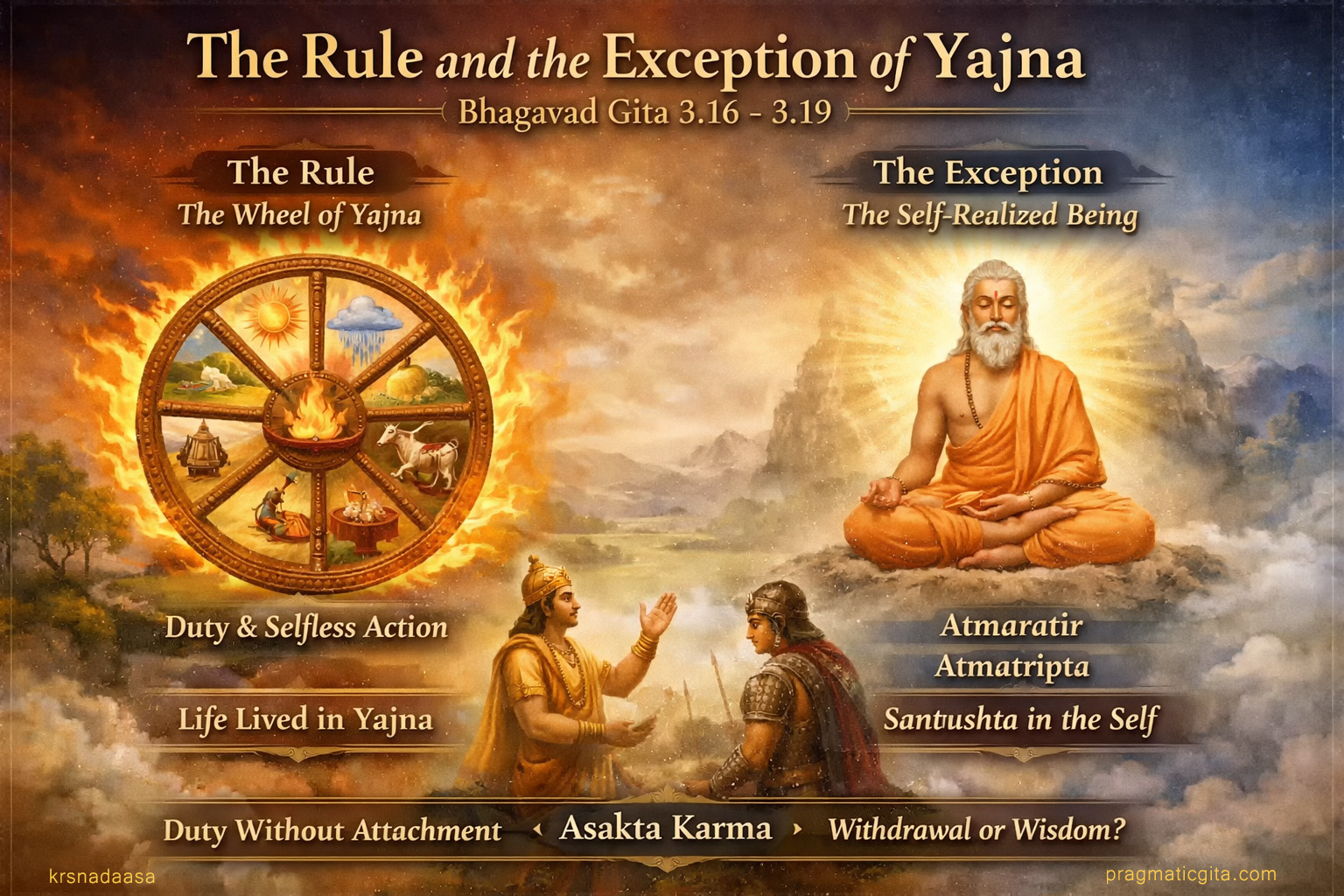
The Sacred Wheel of Yajna and Its Only Exception. Bhagavad Gita 3.16 to 3.19
In four extraordinary verses of the Bhagavad Gita, Shri Krishna reveals the sacred wheel of yajna and its only exception, laying out one of the most complete frameworks for understanding duty, detachment, and liberation in the entire scripture. The sacred wheel of yajna is not a metaphor for a single ritual. It is the living, breathing cycle of reciprocity that sustains all existence. And the only exception to this wheel belongs to a very rare class of beings whose inner life has been permanently transformed.
Why Refusing the Sacred Wheel of Yajna Leads to a Life Lived in Vain
Verse 3.16 opens with a stark declaration. The person who does not follow the sacred wheel of yajna lives mogham, which means in vain. Shri Krishna does not simply call this person sinful. He calls their entire existence meaningless. The word He uses is indriyarama, describing someone whose whole orientation revolves around sense pleasure, comfort, and ego gratification. This is the life of extraction, taking from the web of existence without contributing anything back to it.
The sacred wheel of yajna operates on a simple but profound principle. Life sustains itself through offering. The sun offers heat. The earth offers food. Rivers offer water. Trees receive carbon dioxide and return oxygen. Parents offer care. Teachers offer knowledge. When any part of this cycle stops giving and only takes, the wheel stutters.
Shri Krishna is telling Arjuna that the person who lives purely for sensory indulgence has removed themselves from this sacred wheel of yajna and chosen a path that accumulates only negative karma and spiritual bondage.
This teaching on the sacred wheel of yajna and its only exception carries enormous relevance for modern life. We live inside systems that train us to think in terms of extraction. What can we get from this relationship. What can we gain from this job. What can this moment do for our mood. Shri Krishna diagnoses this orientation as spiritually miserly and a product of scarcity thinking, even when material abundance surrounds us.
Those who do not participate in the yajna cycle become slaves of their senses, and their existence becomes steeped in papa.
The Only Exception to the Wheel of Yajna. The Self-Realized Soul
Immediately after establishing the universal rule of the sacred wheel of yajna, Shri Krishna names its only exception. Verses 3.17 and 3.18 describe the being who is atmaratir, delighted entirely in the Self. This person is atmatripta, completely satisfied within. And santushta, content in the Atman alone. For this self-realized soul, no duty remains. No action serves a further purpose. No being in all of creation is needed for any object or any reason.
This is the only exception to the sacred wheel of yajna, and it rests on a very specific inner condition. The exception does not apply to anyone who is tired, confused, emotionally overwhelmed, or looking for a spiritual excuse to avoid responsibility.
The only exception belongs to those who have passed through all five koshas of consciousness, from Annamaya through Pranamaya, Manomaya, Jnanamaya, and finally Anandamaya, arriving at the atman itself, which is not a sheath at all but the reality shining behind every sheath.
The tension between verse 3.16 and verses 3.17 to 3.18 is deliberate and brilliant. Refusing to participate in the sacred wheel of yajna is declared empty and wasted. And yet the self-realized being has no obligation at all. These teachings are not contradictory.
The difference lies entirely in where the stillness comes from. When we withdraw because we are afraid or protecting our ego, that is avoidance pretending to be vairagya. When a person has genuinely realized the true Self, the sense of separateness has dissolved, and their action or inaction flows from purnata, from fullness and clarity rather than confusion.
Shri Krishna is showing Arjuna that two kinds of people step back from the world. One has transcended the need to act. The other is running away. And Arjuna, at this moment in the Mahabharata, is dangerously close to the second. His desire to withdraw looks compassionate on the surface, but it is driven by moha, by delusion, not by Self-realization.
The Practical Path. Asakta Karma and the Spirit of Yajna
Having established the sacred wheel of yajna and its only exception, Shri Krishna delivers the practical instruction that applies to everyone still walking the path. Verse 3.19 is direct and powerful. Therefore, always perform rightful actions as duties without attachments. That way, one attains the Supreme.
The word asakta is central to understanding the sacred wheel of yajna and how we participate in it. Asakta means unattached, inwardly free, not clinging to outcomes. It does not mean indifference. It does not mean half-hearted effort. It means pouring full skill, care, and energy into action while releasing the psychological demand that results must validate who we are. This is karma yoga in its most essential form.
Shri Krishna’s prescription for moksha through the sacred wheel of yajna rests on three integrated principles. The first is Duty, the performance of svadharma. The second is Detachment, the release of ownership over outcomes. The third is Devotion, the offering of the entire process to Bhagavan so that action becomes sacred. Together these three movements transform ordinary human activity into a genuine path toward liberation.
The Isha Upanishad captures this beautifully. Tena tyaktena bhunjitha. Enjoy through renunciation. We renounce ownership, not enjoyment. The world becomes more available to us when we stop clutching at it possessively. This is the living spirit of the sacred wheel of yajna, participation without possession, engagement without enslavement.
Why This Teaching Matters Now
The sacred wheel of yajna and its only exception is not an abstract philosophical concept. It addresses the exact inner struggle that most people face today. We feel torn between engagement and withdrawal. We confuse burnout with detachment. We mistake spiritual language for spiritual attainment. Shri Krishna cuts through all of this with surgical honesty.
For those who have not yet reached complete Self-realization, the path is clear. Participate in the sacred wheel of yajna. Perform your duties fully. Release attachment to results. Offer your action to the Divine. This practice gradually weakens the vasanas, the deep grooves of habit that keep us reactive and bound. Over time, compulsion loosens, the mind becomes lighter, and a new spaciousness appears in how we relate to life.
The sacred wheel of yajna and its only exception teaches us that freedom is not found by escaping life but by entering it completely, with open hands and a steady heart. And from that steadiness, very quietly, the path toward the Self begins to reveal itself.
Keywords: The Sacred Wheel of Yajna and Its Only Exception, yajna cycle Bhagavad Gita, selfless action and detachment in Gita, atmaratir self-realized soul, karma yoga without attachment, wheel of yajna Krishna teaching, who is exempt from duty in Bhagavad Gita, what does mogham mean in the Gita, indriyarama life of sense pleasure.
difference between avoidance and detachment, how to act without attachment Gita 3.19, five koshas and self-realization, asakta karma meaning and practice, why Krishna says life lived in vain, Bhagavad Gita chapter 3 verses 16 to 19 explained, kritagyata and the vedic cycle of offering, what happens when you refuse yajna
Verses 3.16 – 3.19
एवं प्रवर्तितं चक्रं नानुवर्तयतीह य: |
अघायुरिन्द्रियारामो मोघं पार्थ स जीवति || 16||
evaṁ pravartitaṁ chakraṁ nānuvartayatīha yaḥ
aghāyur indriyārāmo moghaṁ pārtha sa jīvati
एवं (Evam) – Thus; प्रवर्तितं (Pravartitam) – Set in motion; चक्रं (Chakram) – This cycle; नानुवर्तयतीह (Na anuvartayati iha) – Does not follow here; य: (Yah) – Who; अघायुरिन्द्रियारामो (Aghayur indriya-aramo) – Living a life full of sins, indulging in the senses; मोघं (Mogham) – Uselessly; पार्थ (Partha) – O son of Pritha (Arjuna); स (Sa) – He; जीवति (Jivati) – Lives.
O Partha (Arjuna), he who does not follow this cycle thus set in motion, and indulges in the senses, living a life full of sins, lives in vain.
यः तु आत्मरतिः एव स्यात् आत्मतृप्तः च मानवः |
आत्मनि एव च सन्तुष्टः तस्य कार्यम् न विद्यते || 17||
yas tvātma-ratir eva syād ātma-tṛiptaśh cha mānavaḥ
ātmanyeva cha santuṣhṭas tasya kāryaṁ na vidyate
यस्त्वात्मरतिरेव (Yastvatma-ratir eva) – But one who rejoices in the self; स्यादात्मतृप्तश्च (Syad atma-triptascha) – And is satisfied with the self; मानव: (Manavah) – Such a person; आत्मन्येव (Atmanyeva) – In the self alone; च (Cha) – And; सन्तुष्टस् (Santushtas) – Is content; तस्य (Tasya) – For him; कार्यं (Karyam) – Duty; न (Na) – Not; विद्यते (Vidyate) – Exists.
But those who are delighted in the Atman, satisfied in the Atman, and find joy in the Atman alone, for them, no duty exists.
न एव तस्य कृतेन अर्थः न अकृतेन इह कश्चन |
न च अस्य सर्वभूतेषु कश्चित् अर्थव्यपाश्रयः ||18||
naiva tasya kṛitenārtho nākṛiteneha kaśhchana
na chāsya sarva-bhūteṣhu kaśhchid artha-vyapāśhrayaḥ
नैव (Naiva) – Neither; तस्य (Tasya) – His; कृतेन (Krtena) – By performing; अर्थो (Artho) – Purpose; न (Na) – Nor; अकृतेन (Akritena) – By not performing; इह (Iha) – In this world; कश्चन (Kaschana) – Any; न (Na) – Nor; च (Cha) – And; अस्य (Asya) – His; सर्वभूतेषु (Sarvabhuteshu) – Among all beings; कश्चित् (Kaschit) – Any; अर्थव्यपाश्रय: (Arthavyapasrayah) – Dependence on any purpose.
Such self-realized souls have nothing to gain or lose either in discharging or renouncing their duties. Nor do they need to depend on other living beings for any object to serve any purpose.
तस्मात् असक्तः सततम् कार्यम् कर्म समाचर |
असक्तः हि आचरन् कर्म परम् आप्नोति पूरुषः || 19||
tasmād asaktaḥ satataṁ kāryaṁ karma samāchara
asakto hyācharan karma param āpnoti pūruṣhaḥ
तस्मादसक्त: (Tasmadasaktah) – Therefore, being unattached; सततं (Satatam) – Always; कार्यं (Karyam) – Duty; कर्म (Karma) – Action; समाचर (Samachara) – Perform; असक्तो (Asakto) – Unattached; ह्याचरन्कर्म (Hyacharan karma) – Performing action; परमाप्नोति (Param apnoti) – Attains the Supreme; पूरुष: (Purushah) – Man.
Therefore, always perform rightful actions as duties without attachments. That way, one attains the Supreme.
The Consequence of Refusing the Wheel of yajna
Shri Krishna has just described the great cakra of yajna, this living wheel of reciprocity that connects offering, rainfall, food, and the sustenance of all beings. And having laid that out, he turns to what happens when someone refuses to be part of it. The person who lives absorbed in sense pleasure, that person lives a life that is mogham (in vain).
Shri Krishna does not merely say “sinful.” He says “in vain.” Such a person’s whole life passes without real meaning.
He calls such a person indriyārāma, one who is always engaged in sense pleasures. Their entire mindset revolves around what feels good right now, what flatters the ego, what offers a quick high of comfort or illusion of control. This person lives inside a very small circle, taking from the web of life without ever returning anything to it.
Those who do not perform yajna as prescribed become slaves of their senses, and their existence becomes steeped in pāpa, in actions that accumulate negative karma and pull the jīva further and further into lower levels of consciousness. Those who follow this sacred law, on the other hand, become pure at heart and free from material contamination. What Shri Krishna is presenting here is a clear choice.
And we should remember why this matters so deeply. The purpose of human life, as the tradition holds, is to serve Bhagavān, to purify ourselves, and to walk the path toward mokṣa. If instead of that we spend our life incurring pāpa and turning away from the Divine, this entire life is wasted.
On the surface, Arjuna’s desire to withdraw from the battlefield looks compassionate, even noble. But Shri Krishna is showing him something uncomfortable. Withdrawal motivated by moha is not virtuous. It is another form of sensory self-protection. Arjuna is not seeking truth in this moment so much as he is seeking relief. And relief, when it comes at the cost of abandoning one’s role in the larger order (svadharma), only generates negative karma that creates bondage.
Kritagyata and the Teachings of God
Shri Krishna also establishes that the concept of karma arises from the Vedas, and the Vedas have come directly from Brahman himself. So when we understand and follow the spirit of kritagyata (gratefulness) and yajna as Shri Krishna has explained them, we are in fact living according to the teachings of the Vedas, and the teachings of the Vedas are the teachings of Bhagavān himself.
kritagyata is not a personality trait or a self-improvement technique. It is alignment with the fundamental structure of reality as revealed by God. To live in gratefulness is to live in accordance with the Vedas. And to live selfishly and as a slave of our senses, is to live against the very order that sustains us.
The Wheel of yajna
The image of the cakra matters here because Shri Krishna is not describing a single ritual or mantra. He is describing a living cycle, something continuously in motion. Life is sustained because everything participates in offering. The sun gives heat. Rivers give water. Earth gives food. Trees give oxygen. Parents give care. Teachers give knowledge.
When Shri Krishna says that the one who does not follow this wheel lives mogham, he is diagnosing a form of alienation or sense of separation. That’s the reason we see many people who have pleasure, power, visibility, and comfort, and still feel lonely and lost, because they have disconnected themselves from this reciprocal cycle of the cosmos.
Shri Krishna teaches us how through participation and rightful action, we can express kritagyata. Through such action, we can uphold relationships, we can refine the ego and we can evolve.
This has a very modern relevance. We live in systems that train us to think first in terms of extraction. What can we get from this relationship? What can we gain from this job? What can this moment do for our mood? What is the quickest way to secure our comfort? This mindset feels efficient on the surface, but spiritually it is miserly and a manifestation of the scarcity mindset.
In this mindset, offering can make us feel insecure. Sevā feels like loss. Responsibility feels like exploitation. kritagyata feels just emotional. Shri Krishna is teaching us that when we live in harmony with yajna, we are entering life’s actual abundance. It is the giving and receiving that keeps the wheel of life moving. Our personal ego does not create that abundance. It only depletes it.
The Distinction between Withdrawal and Freedom
What follows in verses 3.17 and 3.18 is one of the most important clarifications provided in this chapter. Shri Krishna has just said that refusing to participate in the wheel of yajna leads to a wasted life. And now, immediately, he names the one exception.
यः तु आत्मरतिः एव स्यात् आत्मतृप्तः च मानवः |
आत्मनि एव च सन्तुष्टः तस्य कार्यम् न विद्यते || 17||
yas tvātma-ratir eva syād ātma-tṛiptaśh cha mānavaḥ
ātmanyeva cha santuṣhṭas tasya kāryaṁ na vidyate
But those who are delighted in the Atman, satisfied in the Atman, and find joy in the Atman alone, for them, no duty exists.
The person who is ātmaratir, who delights entirely in the Self (atman). The person who is ātmatṛpta, completely satisfied in the Self. And santushta, content in the Self alone. For this person, nothing remains to be done. No duty binds. No action serves a further purpose. This person depends on no being for anything.
Verse 3.18 deepens this further.
न एव तस्य कृतेन अर्थः न अकृतेन इह कश्चन |
न च अस्य सर्वभूतेषु कश्चित् अर्थव्यपाश्रयः ||18||
naiva tasya kṛitenārtho nākṛiteneha kaśhchana
na chāsya sarva-bhūteṣhu kaśhchid artha-vyapāśhrayaḥ
Such self-realized souls have nothing to gain or lose either in discharging or renouncing their duties. Nor do they need to depend on other living beings for any object to serve any purpose.
These two verses, placed right after the stern warning of 3.16, create a remarkable tension. Refusing to participate is declared empty and wasted. And yet the realized being has no obligation to act at all. As with many of the verses in the Bhagavad Gita, these may seem contradictory but they are not.
The difference lies in where the stillness comes from. When we pull back because we are afraid, overwhelmed, or protecting our ego, that is avoidance that is pretending to be vairagya. Whereas, when a person has genuinely realized the true Self, the sense of separateness or ego has dissolved, and action or inaction for that being comes from pūrṇatā (fullness) and from clarity rather than confusion.
What Shri Krishna is showing Arjuna is that two kinds of people step back from the world. One has transcended the need to act. The other is running away. And Arjuna, at this moment, is dangerously close to the second.
Here we see the fundamental difference between a spiritualist and a materialist. The materialist seeks pleasure externally. The spiritualist seeks it internally, in the ātman. Shri Krishna has been reiterating for the benefit of all humanity the importance of doing our duties without attachment to results, and the importance of yajna.
And now he shifts gears and says that there are some exceptional people who do not need to follow these prescriptions at all. These are the ātmaratir, people who have realized the atman, delighted in the atman, satisfied in the atman. They have already been liberated (jeevanmuktas) and risen above these rules.
The Five Koshas and Levels of Consciousness
People pass through many levels of consciousness before reaching self realization.
First is Annamaya kosha – those indulging purely in sensory pleasures like eating whatever they want, being lazy, etc.
Then comes Pranamaya kosha – these are people who are always restless and have to keep doing something. They derive pleasure based on just keeping themselves busy regardless of what they are actually doing.
After that comes Manomaya kosha – these are people who derive enjoyment from activities of the mind. These are usually the artists, singers, painters etc. They are reserved in nature and they cherish relationships. They also tend to be moody in nature.
Then comes Jnanamaya kosha – these are people who take pleasure in utilizing their intellect. They are the philosophers and the deep thinkers. They are so engrossed in their thoughts that they many times forget themselves, they are the type of people who can forget to have their food or comb their hair.
After all this comes Anandamaya kosha. This is what is termed by Shri Krishna as atmaratir. People who derive enjoyment only from the Atma.
People who are self realized find pleasure only in the Atman and for them, there is no joy that can come from material or external things. The goal of the Vedas is to help the soul realize its true nature. Once the soul achieves that goal, the rules of the Vedas, which were meant to guide the soul to reach that destination, no longer apply.
This progression helps us understand that the movement toward Self-realization is gradual. Each Kosha represents a subtler, more inward source of satisfaction. The seeker moves from identification with body to energy to mind to intellect to bliss, until arriving at the source itself, the ātman, which is not a sheath at all but the reality shining behind every sheath.
The word atmaratir itself reveals something beautiful about this realization. Rati means delight, the kind of deep pleasure that draws us back again and again. When this word is joined with ātma, it means that delight has found its true home. The seeker who has realized the Self discovers that what was being sought in every pleasure, in every object, in every experience, was already present within.
The Taittirīya Upaniṣad 2.7.1 expresses this with remarkable directness.
रसो वै सः । रसं ह्येवायं लब्ध्वानन्दी भवति ।
raso vai saḥ rasaṃ hy evāyaṃ labdhvānandī bhavati
He, Brahman, is verily rasa, the very essence of delight. Having obtained this rasa, one becomes filled with bliss.
Brahman is rasa. It is the source of every joy we have ever experienced. Like the sweetness in food, the melody in music, the warmth in love, all of it was always a reflection of this rasa. The ātmaratir has found the source of all joy, the root from which every lesser joy was flowing all along.
That is why Shri Krishna says with such confidence that this person needs nothing from anyone. Their deepest desire has been fulfilled. Santushṭi, true contentment, is the discovery that what we truly wanted was always there within us, closer than anything we ever chased on the outside.
This is inner pūrṇatā (fullness). The usual hunger that drives action has become quiet because the deepest hunger has been satiated. And we should see clearly what that means. We suffer not only because life is difficult. We also suffer because we expect objects, roles, victories, and relationships to make us feel complete, and they simply cannot do that. Its like expecting the raindrops to make the ocean feel full.
We should understand that Shri Krishna says all of this to encourage humanity toward the goal of Self-realization. He is showing us the possibility, and hinting at the direction of our travel.
The Bṛhadāraṇyaka Upaniṣad 2.4.5 puts this with unforgettable clarity. In the famous dialogue between yajnavalkya and Maitreyī, the sage reveals the deepest motive behind all love and attachment.
आत्मनस्तु कामाय सर्वं प्रियं भवति ।
ātmanas tu kāmāya sarvaṃ priyaṃ bhavati
It is entirely for the sake of the Self (atman) that all things becomes dear.
Everything we chase is inherently connected to the longing for fullness, peace, and wholeness. We think we want the object by itself, but in truth we want the state of being full and complete that we imagine the object will provide. Until the Self is known as the real source of fulfillment, nothing can make us feel that fullness.
So when the Bhagavad Gita describes one who is content in the Self, it is naming the end of dependence. The jñānī still breathes, walks, speaks, and acts. What ends is the old psychological drama that says, I act and I seek so that I may finally become full, and complete.
There Is No Excuse to Avoid Duties
Shri Krishna knows that many people will hear the teaching of verse 3.17 and use it as an excuse. They will avoid their duties and claim to be Self-realized ātmaratirs who have no obligation to act. And so Shri Krishna provides essential context in verses 3.18 and 3.19 that closes this escape door firmly.
He says in verse 3.18 that Self-realized beings have neither āsakti nor aversion toward performing their duties. They are not dependent on anyone for anything. This is a crucial detail and one we should not take lightly.
It may seem paradoxical. That the genuinely Self-realized person will never refuse to perform any duties, in spite of not having to perform them. That is because they have no attachments or aversion either.
If someone is avoiding responsibility and calling it liberation, the very avoidance reveals they have not arrived at what they claim. True freedom from obligation looks like effortless willingness, not resistance dressed up in spiritual language. The realized being may act or may not act, but there is no running away from life either way.
Shri Krishna is making absolutely sure that Arjuna does not latch onto verse 3.17 and use it to justify refusing to fight. Arjuna is not yet an ātmaratir. He is confused, grief-stricken, and looking for a way out.
Even for those who have reached pūrṇatā, Shri Krishna does not recommend withdrawal. The wise act from wholeness. And this is important because the same external action can arise from bhaya, lobha, vanity, etc. as well.
In verse 3.19, Shri Krishna gives a very practical instruction.
तस्मात् असक्तः सततम् कार्यम् कर्म समाचर |
असक्तः हि आचरन् कर्म परम् आप्नोति पूरुषः || 19||
tasmād asaktaḥ satataṁ kāryaṁ karma samāchara
asakto hyācharan karma param āpnoti pūruṣhaḥ
Therefore, always perform rightful actions as duties without attachments. That way, one attains the Supreme.
The word tasmāt, “therefore,” carries the weight of everything that came before it. Because the wheel of yajna sustains the world. Because most of us have not become ātmaratirs. Therefore, act. Act fully, and let go of the result.
One way to understand Shri Krishna’s prescription for mokṣa here is through three principles that together capture the whole movement.
The first is Duty, the performance of svadharma, the actions that life and our role demand of us.
The second is Detachment, the release of sense of ownership over phala, over outcomes.
The third is Devotion, the offering of the entire process to Bhagavān, so that action becomes sacred.
This is the true path of karma yoga. One can consider karma sannyāsa, the complete renunciation of action, only after reaching Self-realization. Until then, duties must be performed without attachments. And Shri Krishna has already made clear that we can practice such karma yoga as gṛhasthas, as householders, leading regular lives in the world.
The word asakta is central here. It means unattached, free from sticking to outcomes. Please note the difference between Asakti and asakta. Āsakti means attachment, clinging, sticking, emotional dependence, or inner fixation. While Asakta means unattached, not clinging, inwardly free, not stuck.
The Īśā Upaniṣad, one of the most compressed and powerful of all the Upaniṣads, opens with a vision that gives us the metaphysical basis for everything Shri Krishna is teaching here. Verse 1 declares the foundation.
ईशावास्यमिदं सर्वं यत्किञ्च जगत्यां जगत् ।
तेन त्यक्तेन भुञ्जीथा मा गृधः कस्यस्विद्धनम् ॥
īśāvāsyam idaṃ sarvaṃ yat kiñca jagatyāṃ jagat
tena tyaktena bhuñjīthā mā gṛdhaḥ kasya svid dhanam
All this, whatever moves in this moving world, is pervaded by the Lord. Enjoy through renunciation. Do not covet, for whose is wealth?
Tena tyaktena bhuñjīthā. “Enjoy through tyāga.” This single phrase captures the entire spirit of what Shri Krishna is teaching Arjuna. We renounce ownership, not enjoyment. We release the claim that any of this belongs to us personally. And in that release, real enjoyment becomes possible because the grasping has stopped. The world becomes more available to us when we stop clutching at it possessively.
The Movement from Compulsion to Offering
The transition from verse to verse becomes clear once we see the structure underneath it. First Shri Krishna shows the sacred wheel. Then he shows the liberated being who no longer seeks completion through the wheel. Then he tells Arjuna to act anyway, without āsakti. These are not separate teachings. They are stages of one movement.
- At the beginning, we act selfishly and suffer.
- Then we begin acting in the spirit of yajna and become purified.
- Then jñāna deepens and the focus shifts inward.
- Finally, action continues as a transparent expression of dharma, and the outer motion may remain exactly as it was, but the inner mindset completely transforms.
This is why the Bhagavad Gita refuses to glorify premature tyāga. It is easy to imitate the outer stillness without the inner transformation that is required. Shri Krishna consistently moves away from such self-deception, because the seeker needs honesty above all.
Vāsanā and the Grooves of Habit
Vāsanās are the subtle tendencies left behind by repeated thoughts, actions, and emotional habits. Every time we act from kāma, bhaya, resentment, or vanity, we deepen those grooves. Then action becomes predictable. We react rather than respond. We become easy to trigger.
Vāsanā is the reason that understanding a teaching intellectually does not automatically change behavior. We can agree completely with Shri Krishna and still find ourselves getting attached to outcomes the very next minute. The understanding lives in the top layer of the mind. The vāsanā lives in a deeper layer. Yajna weakens the vāsanās.
Over time the mind becomes lighter. Compulsion loosens. A new dignity appears, a new spaciousness in how we relate to life.
The Yoga Vāsiṣṭha addresses this directly. Sage Vasiṣṭha teaches Rāma that vāsanās are the real chains binding the jīva, far more powerful than any external circumstance. The subtle impressions lodged in the mind create the appearance of a solid, separate world and a solid, separate self. When vāsanās thin out through right understanding and right action, the world does not disappear, but its power to bind dissolves.
The Yoga Vāsiṣṭha also warns that mere physical renunciation without inner clarity accomplishes nothing. A person can live in a cave and still be tormented by desire. A person can live in the middle of a city and be completely free. What matters is the inner condition, when action flows from understanding rather than compulsion.
The Kaṭha Upaniṣad 2.3.14 gives a decisive statement that confirms this.
यदा सर्वे प्रमुच्यन्ते कामा येऽस्य हृदि श्रिताः ।
अथ मर्त्योऽमृतो भवत्यत्र ब्रह्म समश्नुते ॥ १४॥
yadā sarve pramucyante kāmā ye’sya hṛdi śritāḥ .
atha martyo’mṛto bhavatyatra brahma samaśnute
When all the desires that dwell in the heart fall away, then the mortal becomes immortal. And here itself one attains Brahman.
How yajna Rewires the Inner Life
What happens psychologically when we practice yajna, even in small ways?
When we practice yajna, even in small ways, something begins to change inside us. Every time we give and see that giving does not make us smaller, the old fear of not having enough becomes a little weaker. Every time we do good work without constantly needing praise or recognition, the ego loosens its grip a little.
Our habits become strong when we keep repeating them. They become weaker when we start living differently. Yajna gives us those new experiences. Each action done without attachment creates a healthier inner pattern. Slowly, this new pattern starts to change the old one. The change is not sudden, but it is real.
Inwardly, yajna means offering:
- Offering our reactions into the fire of awareness.
- Offering our vanity into humility
- Offering our resentments into love
- Offering our fears into faith, and
- Offering our need to control everything into a deeper trust in life and in God.
Yes, something does have to be given up. What we give up is the false idea that everything revolves around us. What we give up is the demand that life must follow our personal script before we are willing to participate in it. When this offering becomes genuine, a different kind of strength begins to appear. We become less dramatic in our spiritual life and more steady in the way we live.
Detachment in the Middle of Real Work
Imagine a project at work that has consumed weeks of effort. The research is thorough. The presentation is polished. Then the meeting happens and the decision goes in an unexpected direction. The project is shelved. What happens inside? If we are honest, the first response is usually frustration, maybe anger. And beneath that, if we look carefully, there is often a sense of personal injury. “I put so much into this.” “They didn’t value what I did.”
That sense of injury comes directly from ahaṃkāra, from the identification of self-worth with outcome. The action had become evidence of who we are. When the result did not match our hopes, it felt like a commentary on our worth. Shri Krishna’s teaching is immediately practical here. The instruction is to notice the difference between the effort and the identity wrapped around it.
The effort was real. The skill was real. The care was real. Those do not disappear because the outcome changed. What we can release is the demand that external results validate who we are. Even beginning to notice the gap between “I did my best” and “I need this to succeed for me to feel okay” is significant. That gap is where freedom lives.
Many of us enter professional life with mixed motives. There is a real desire to contribute, to learn, to build, and to support those we love. And alongside that, there is also the subtle pressure to derive identity from performance. Every success inflates the ego a little. Every setback wounds it more. A good review feels like a much needed approval. A critical remark makes us feel like a lesser person.
The Bhagavad Gita asks us to live and act with more awareness. We can prepare thoroughly, act skillfully, care deeply, and still not be defined by the outcomes. We become more available to the task itself. We listen better. We recover faster. We stop turning every outcome into a verdict on our worth. Work becomes a disciplined offering. It still matters. It simply does not define us anymore.
Giving without Keeping Score
And in relationships, many of us carry an unconscious accounting book. We track what we have given and what we have received. When the balance tips too far, resentment builds. “I always do more.” “They never appreciate what I contribute.” “I message them everyday but they don’t “.
This book-keeping is a quiet form of transactional living. Love and generosity have been turned into a negotiation, and the moment something becomes a transaction, its capacity to nourish shrinks dramatically. We give, but with an expectation of receiving equal or more.
Shri Krishna’s model of yajna offers a different framework altogether. In yajna, we give because giving is what keeps the whole system alive. We are part of a cycle larger than any individual accounting. This does not mean accepting mistreatment or ignoring genuine lack of interest and care. It means beginning from a posture of offering rather than a posture of accounting.
What Remains When We Let Go
These four verses together form a complete arc.
- The refusal to participate in the sacred cycle leads to a life lived mogham.
- Full realization leads to spontaneous freedom, the freedom of one who is ātmatṛpta and santushta.
- And for everyone living this way, the path is asakta karma. Full engagement.
This is a demanding path. It is also a merciful one. It does not require perfect purity before we begin. It only asks for śraddhā and sthiratā, sincerity and steadiness.
We can begin where we are. With the next responsibility. The next conversation. The next anxious reaction. The next chance to contribute without self-display. The next moment in which we remember that we don’t truly own anything. Even our own body is a temporary gift from prakriti.
Then action changes. Then the heart changes. Then what once felt like burden slowly reveals itself as participation in something vast, intelligent, and sacred.
And from there, very quietly, we begin to understand why the one who is full in the Self can still act with such clarity.
In the next few verses, Shri Krishna will explain further why we should practice karma yoga rather than karma sannyāsa, bringing still more clarity to why action performed in the right spirit is the living path to freedom for those of us who have not yet arrived at complete Self-realization.
kṛṣṇadaasa
Servant of Krishna