

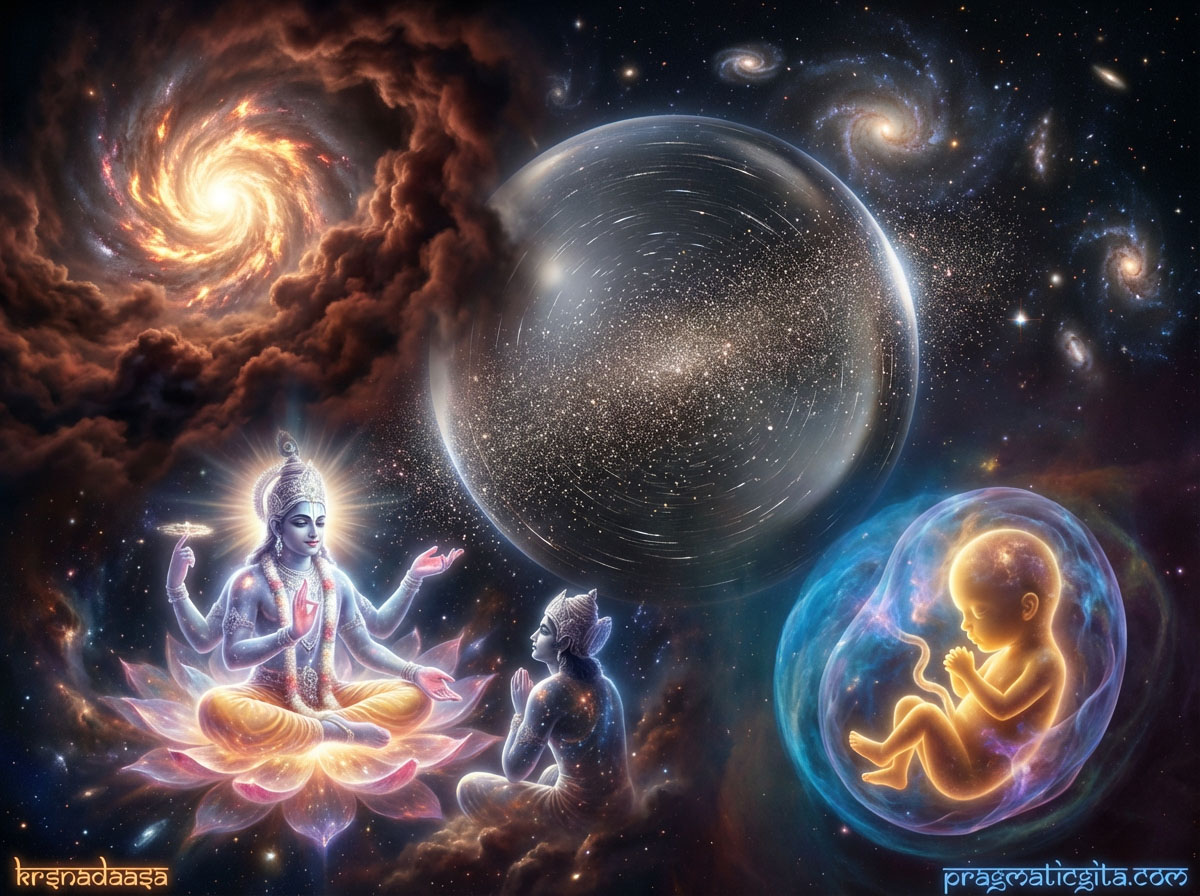

Karma Yoga : Freeing the Intellect from the Prison of Lust
If you have not already done so, I would request you to review the Chapter 2, Sankhya Yoga before studying chapter 3 as that would help set the right context.
You can find the explanation of the previous set of shlokas from chapter (3.32 to 3.35) here. Please go through that to get a better understand and maintain continuity in your learning.
You can also listen to all the episodes through my Spotify Portal, Apple Podcast, and on YouTube as well.
You can find below the condensed gist of the narrative. For the complete expanded narrative, look below the verses.
Key Terms Glossary
Kāma (काम)
Simple Definition: Intense, ego-driven desire or craving.
Deeper Meaning: Kāma here does not refer to all desire. The longing for truth, the aspiration to grow, the desire to serve, those are healthy. What Shri Krishna is naming is the compulsive, grasping kind of desire that arises from a sense of inner lack. It is the restless movement of the mind trying to feel complete through objects, outcomes, attention, or control. It is uncontrolled craving, not purposeful aspiration.
Modern Equivalent: Think of doom-scrolling, compulsive shopping, or obsessively refreshing your inbox for validation. It is that internal pressure that says “I must have this now to feel okay,” even when you already know it will not satisfy you for long.
Krodha (क्रोध)
Simple Definition: Anger or rage born from frustrated desire.
Deeper Meaning: Krodha is not a separate enemy. It is Kāma wearing a different mask. When the mind reaches out and says “this should happen,” and reality refuses to cooperate, the same energy that was craving returns as resentment, blame, or fury. The texture changes, but the source remains the same. Shri Krishna names them together because they are two phases of one force.
Modern Equivalent: Road rage when traffic blocks your schedule. The cold silence toward a partner who did not respond the way you expected. The bitterness that rises when someone else gets the recognition you felt you deserved
Rajo-guṇa (रजोगुण)
Simple Definition: The quality of nature (guṇa) associated with passion, restlessness, and ceaseless activity.
Deeper Meaning: Rajas is the force in nature that drives movement, ambition, and outward pursuit. Without it, nothing would get done. But when rajas is not guided by clarity (sattva), it becomes a fever. Action stops being service and becomes self-expansion. Even spiritual practice can turn rajasic, chasing experiences, status, or emotional highs under sacred names while remaining deeply bound.
Modern Equivalent: The hustle-culture mindset that glorifies busyness, the constant need to “optimize” and “perform,” or the drive to post spiritual content for likes rather than for genuine sharing.
Mahāśana (महाशन)
Simple Definition: All-devouring, insatiable.
Deeper Meaning: Shri Krishna uses this word to describe the bottomless appetite of ego-driven desire. Like fire fed with oil, giving desire what it wants does not put it out. It makes it grow hungrier. Each fulfillment only creates a need for more. This is why Kāma can consume not just things, but attention, peace, relationships, discernment, and sometimes entire years of a person’s life.
Modern Equivalent: The hedonic treadmill. The new car thrill that fades within weeks. The promotion that satisfies for a month before the next one becomes the new obsession. Subscription culture’s “always more” loop.
Vairiṇam (वैरिणम्)
Simple Definition: Enemy, adversary.
Deeper Meaning: Shri Krishna is not speaking loosely here. He deliberately names unchecked desire as the enemy of human life. The enemy outside, conflict, rivalry, struggle, was first operating inside as distortion. By calling it vairiṇam, He asks the seeker to take this inner force as seriously as one would take a genuine threat. Not something to flirt with, but something to clearly recognize and guard against.
Modern Equivalent: The way we talk about “self-sabotage” in modern psychology. The inner adversary that derails diets on day three, breaks resolutions by January 15, or undermines relationships through patterns we recognize but feel powerless to stop.
Śreya and Preya (श्रेय / प्रेय)
Simple Definition: Śreya is what is truly good for us. Preya is what is merely pleasant.
Deeper Meaning: Both paths appear before us constantly. The deeper problem is that preya never announces itself as the wrong choice. It feels natural, easy, obvious. Śreya, on the other hand, often feels hard, uncomfortable, and counterintuitive. This distinction, drawn from the Katha Upanishad, runs beneath Arjuna’s entire question. He is asking about the lived experience of watching yourself choose the pleasant over the good, knowing the difference, and feeling helpless.
Modern Equivalent: Choosing Netflix over the difficult conversation you need to have. Reaching for comfort food instead of going for the walk that would actually help. Saying “yes” to avoid discomfort when a loving “no” is what the moment requires.
Vāsanā (वासना)
Simple Definition: Deep-seated mental impressions or habitual tendencies formed by repeated experiences.
Deeper Meaning: Vāsanās are like grooves carved into the mind through repetition, sometimes over years, sometimes over lifetimes. They operate beneath conscious thought. A person may sincerely attend satsaṅga, feel inspired during meditation, and then repeat the exact same harmful pattern the next day. This is not hypocrisy. It is one layer of the mind having heard the teaching while a deeper layer remains untouched, still pulling toward the familiar.
Modern Equivalent: Muscle memory in relationships. The way you automatically reach for your phone the moment you feel bored or anxious. That voice inside that says “this is just who I am,” not because it is true, but because the pattern has become so familiar it feels like identity.
Buddhi (बुद्धि)
Simple Definition: The faculty of discernment, intelligence, and wise judgment.
Deeper Meaning: Buddhi is the one instrument we need to navigate all other problems. And that is exactly what makes desire so devastating. It covers buddhi itself. It is as if the only lamp you have to find your way through a dark room has been draped with cloth. Every confusion, every wrong decision, every failure to see clearly could be corrected if the intellect were uncovered. But when Kāma sits on top of buddhi, we are left trying to solve our problems with the very instrument that has been compromised.
Modern Equivalent: Confirmation bias on steroids. The way someone deep in an unhealthy situation can construct perfectly “logical” arguments for why they should stay. The mind becoming the lawyer for its own cravings.
Sādhana (साधना)
Simple Definition: Disciplined spiritual practice.
Deeper Meaning: Sādhana is the sustained inner work required to clear the coverings over wisdom. It is not a weekend retreat or a single insight. It is the slow, daily labor of choosing śreya over preya, of catching desire before it takes control, and of building the inner strength to not blindly obey every impulse. Prayer softens self-centeredness. Japa gathers the wandering mind. Sevā redirects energy from private obsession. None of them work magically in one stroke, but each one wipes a bit of dust from the mirror.
Modern Equivalent: Going to therapy consistently, not just when things feel unbearable. A daily meditation practice you maintain even when you do not feel like it. The slow, unsexy work of building better habits, one honest choice at a time.
Discussion Catalysts
Personal Reflection
Think of a moment in the past week when you clearly saw what was right — the kind thing to say, the healthier choice, the honest response — and yet you did something else. What did that inner pull feel like in your body and mind? And what story did your mind tell you to make it okay?
Philosophical Inquiry
Shri Krishna says that Kāma does not destroy wisdom — it covers it. If wisdom is always present underneath, merely obscured, what does that imply about human nature? Are we fundamentally flawed beings trying to become good, or fundamentally whole beings learning to see through the coverings?
Practical Application
Look at one recurring pattern in your life — a behavior you keep returning to even though it does not serve you. Using Shri Krishna’s three images (smoke over fire, dust on a mirror, embryo in a womb), diagnose which level of covering you are dealing with. Based on that diagnosis, what specific, calibrated practice could you commit to for the next 21 days?
Verses 3.36 – 3.38
अर्जुन उवाच |
अथ केन प्रयुक्तोऽयं पापं चरति पूरुष: |
अनिच्छन्नपि वार्ष्णेय बलादिव नियोजित: || 36||
arjuna uvācha
atha kena prayukto ’yaṁ pāpaṁ charati pūruṣhaḥ
anichchhann api vārṣhṇeya balād iva niyojitaḥ
अर्जुन उवाच (Arjuna Uvāca) – Arjuna said; अथ (Atha) – then; केन (Kena) – by what; प्रयुक्तोऽयं (Prayukto ‘yaṃ) – impelled; पापं (Pāpaṃ) – sin; चरति (Carati) – does commit; पूरुष: (Pūruṣaḥ) – a man; अनिच्छन्नपि (Anicchann api) – even unwillingly; वार्ष्णेय (Vārṣṇeya) – O descendant of Vrishni (Arjuna); बलादिव (Balād iva) – as if engaged by force; नियोजित: (Niyojitaḥ) – directed.
Arjuna asked: Why is a person impelled to commit sinful acts, even unwillingly, as if by force, O descendent of Vrishni (Krishna)?
श्रीभगवानुवाच |
काम एष क्रोध एष रजोगुणसमुद्भव: ||
महाशनो महापाप्मा विद्ध्येनमिह वैरिणम् || 37||
śhrī bhagavān uvācha
kāma eṣha krodha eṣha rajo-guṇa-samudbhavaḥ
mahāśhano mahā-pāpmā viddhyenam iha vairiṇam
श्रीभगवानुवाच (Śrī-bhagavān uvāca) – The Supreme Lord said; कामः (Kāmaḥ) – desire; एषः (Eṣaḥ) – this; क्रोधः (Krodhaḥ) – anger; एषः (Eṣaḥ) – this; रजोगुणसमुद्भवः (Rajo-guṇa-samudbhavaḥ) – born of the mode of passion; महाशनः (Mahāśanaḥ) – all-devouring; महापाप्मा (Mahā-pāpmā) – greatly sinful; विद्ध्य् (Viddhi) – know; एनम् (Enam) – this; इह (Iha) – in this world; वैरिणम् (Vairiṇam) – enemy.
It is lust (insatiable desire) alone, which is born of contact with the mode of passion, and later transformed into anger. Know this as the sinful, all-devouring enemy in the world.
धूमेनाव्रियते वह्निर्यथादर्शो मलेन च |
यथोल्बेनावृतो गर्भस्तथा तेनेदमावृतम् || 38||
dhūmenāvriyate vahnir yathādarśho malena cha
yatholbenāvṛito garbhas tathā tenedam āvṛitam
धूमेन (Dhūmena) – by smoke; आव्रियते (Āvriyate) – is covered; वह्निः (Vahniḥ) – fire; यथा (Yathā) – as; आदर्शः (Ādarśaḥ) – mirror; मलेन (Malena) – by dust; च (Ca) – and; यथा (Yathā) – as; उल्बेन (Ulbenā) – by the womb; आवृतः (Āvṛtaḥ) – is covered; गर्भः (Garbhaḥ) – embryo; तथा (Tathā) – so; तेन (Tena) – by that (lust); इदम (Idam) – this; आवृतम् (Āvṛtam) – is covered.
Just as fire is covered by smoke, as a mirror is covered by dust, or as the embryo is covered by the womb, so is this (wisdom) covered by that (lust).
The question Arjuna asks for all of us
Arjuna now asks a question that is so honest, so human, and so timeless that it could come from almost anyone sitting in front of us today. He is no longer asking only about duty, action, or knowledge. He is asking about that disturbing split inside us where one part knows what is right and another part still falls on the wrong side. He asks, अथ केन प्रयुक्तोऽयं पापं चरति पूरुष: (atha kena prayukto ‘yaṁ pāpaṁ carati pūruṣaḥ), “by what is a person impelled commit sinful acts,” anicchann api, “even without wanting to,” balādhiva niyojitaḥ, “as though pushed by some force.”
That is the pain in the question. Why do we do what we ourselves do not approve of? Why do we move toward what brings regret, even when some part of us knows very well.
And notice the name Arjuna uses here. He does not say Bhagavan or Keshava. He addresses Krishna as Vārshneya, descendant of the Vrishnis. This is not a random title. Shri Krishna was born in the Vrishni dynasty, the same lineage to which Arjuna’s own mother Kunti belonged. Shurasena of the Vrishni clan was the father of both Vasudeva, Krishna’s father, and Pritha, who became Kunti, Arjuna’s mother. So when Arjuna calls Shri Krishna “Varshneya” at this moment, there is a hidden appeal beneath the question. He is saying, in effect, we belong to the same family, so do not neglect me now when I am drowning in confusion.
It is the voice of someone who is not merely asking a philosophical question but crying out for personal help from one who is close enough to be obligated to answer. That intimacy matters. Arjuna is saying “help me understand what is destroying me from within”.
What Shri Krishna is correcting here is not just immoral conduct in some narrow sense. He is addressing the deeper bondage of the human mind. Each one of us has a good voice inside. We call it conscience. Whenever we are about to do something we know is wrong, that voice speaks clearly. And yet we go ahead and do it. We all know what it is to speak more harshly than we meant to. We know what it is to cling when we should release, to scroll when we should rest, to compare when we should stand in our own ground, to indulge an impulse that we already know will leave us weaker.
So this is not a question about “bad people.” It is a question about the strange weakness that seems to live within all of us. Something in us sees, and something else overrules what is seen. There seems to be a constant conflict between the soul’s divine nature and the material body’s lower nature.
This is what the tradition calls the tension between Shreya and Preya. Shreya is what is truly good for us. Preya is what is merely pleasant. Both appear before us, and the deeper problem is that Preya does not announce itself as the wrong choice. It feels natural, obvious, easy. Shreya, on the other hand, often feels hard, counterintuitive, and uncomfortable. So the question Arjuna is asking is not abstract philosophy. It is the lived experience of every person who has ever watched themselves choose the pleasant over the good, knowing the difference, and feeling helpless to do otherwise.
This matters because spiritual life cannot remain at the level of noble ideas. It is easy to speak of wisdom when the mind is quiet and conditions are favorable. The real test begins when the old pressure rises from within, when desire grips, when hurt becomes resentment, when fear begins to justify itself, when the ego says just this once, just a little, just for me. At that moment, we are put to test, to see if we have truly internalized the rightful knowledge or if it remains just theory.
Shri Krishna names the hidden enemy
Shri Krishna’s answer is direct and unsentimental. काम एष क्रोध एष रजोगुणसमुद्भव: (Kāma eṣa krodha eṣa rajo guṇa samudbhavaḥ, “it is desire, it is anger born of the guna of rajas.” Then He adds words that should make us stop and listen very carefully.
महाशनो (Mahāśanaḥ), “it is all-devouring.” महापाप्मा (Mahāpāpmā), “it is the great sinner,” or the great corrupter. विद्ध्येनमिह वैरिणम् (Viddhy enam iha vairiṇam), “know this to be the enemy here in human life.” He is telling Arjuna that the enemy outside was first inside. Before it appears as conflict in the world, it is operating as distortion within.
Now this has to be understood very carefully. Shri Krishna is not condemning every form of desire in a flat way. The desire to know truth, the desire to serve, the longing for God, the aspiration to grow, these are good to have. Here Kama means craving born of egoic attachments. It is the inner pressure that says I must have, I must control, I must secure, I must possess, I must be seen in a certain way, I must not be denied. This kind of desire does not arise from fullness. It arises from lack. It is the restless movement of the mind trying to complete itself through objects, roles, victories, attention, sensation, or emotional outcomes.
This is uncontrolled desire, not aspiration. And it is this uncontrolled desire that Shri Krishna is identifying as the root enemy of spiritual life.
And when that desire is not fulfilled, it becomes Krodha, anger. This is why Shri Krishna names them together. Anger is the outcome of unfulfilled or frustrated desire. First the mind reaches out and says this should happen. But in reality that doesn’t happen. A person does not respond as expected. A result does not arrive. Recognition goes to someone else. The body becomes tired. Then the same force that was desire returns as resentment, blame, or frustration. The energy is the same, the texture has become different.
The chain reaction Shri Krishna has already warned about
We should remember that Shri Krishna has already laid out this chain of destruction earlier in Chapter 2. When a person dwells on sense objects, attachment grows. From attachment, desire intensifies. From frustrated desire, anger arises. From anger comes delusion. From delusion, the memory of what is true becomes damaged. When memory fails, the capacity for intelligent discernment collapses. And when intelligence is lost, the person falls.
That sequence is not a theoretical model. It is a map of what happens inside us, sometimes over years, sometimes in the space of a single conversation. And now, in verse 37, Shri Krishna is pointing back to the very root of that entire chain. He is saying this is where it all begins. Kama. Uncontrolled desire. Everything else follows.
It is worth noting that nearly three thousand years after the Bhagavad Gita, Gautama Buddha arrived at a strikingly similar diagnosis. The Second Noble Truth identifies craving, Tanha, as the origin of suffering. The language is different, the framework is different, but the central insight is the same. Desire that arises from incompleteness and clings to impermanent things is the cause of human suffering.
This is why Shri Krishna says it is born of Rajas. Rajas is movement, projection, outward rush, agitation, hunger for becoming. It is the force in nature that keeps the mind leaning forward, chasing, reacting, constructing identity through activity and outcome. Rajas has its place in life. Without it, no work would be done. But when Rajas is not governed by clarity, it becomes Jvara (fever, we discussed this in 3.30). Then action is no longer service. It becomes self-expansion. Then even spirituality can become rajasic. One may seek experiences, status, superiority, or emotional intoxication under sacred names, and still remain deeply bound.
How desire hijacks the mind
There is a well-known story that captures this beautifully. A group of philosophers were once walking through a forest when they came upon a man lying beneath a tree. They could see that a large snake was coiled near his leg, ready to strike. A scorpion was approaching from the other side. Behind the tree, a hungry bear waited, ready to pounce. And yet the man was lying there with a smile on his face. The philosophers were astonished. What could possibly make this man so blissful in the presence of such danger?
Then they looked more carefully and realized that the man was gazing upward at the tree, dreaming about the ripe, juicy fruits hanging from its branches, imagining how sweet they would taste. He was so absorbed in his craving that he had become completely blind to the mortal dangers surrounding him.
That is exactly what desire does. It hijacks the mind so thoroughly that we lose awareness of the dangers and pitfalls right in front of us. We become so absorbed in what we want that we stop seeing what is actually happening. The snake of anger, the scorpion of jealousy, the bear of delusion, they are all right there. But the mind, fixated on the fruit of its craving, notices none of them. This is not stupidity. This is the power of Kama to narrow attention and filter out everything that does not serve its hunger.
If we look carefully at our own life, we can see how subtle this is. Desire appears dressed as reason, principle, efficiency, care, or even love. We say we only want what is best, but inwardly we are attached to being obeyed. We say we are just being responsible, but inwardly we cannot tolerate uncertainty. We say we are hurt because something was wrong, but inwardly the deeper wound is that our wish was not honored. This is why self-knowledge is indispensable.
Desire is rarely honest in its first appearance. It does not introduce itself by saying I am here to bind you. It comes saying this is necessary, this is harmless, this is justified, this is who you are.
The Katha Upanishad points to this outward-going tendency with great force. It says that the human senses are turned outward by default, and so we keep seeking completion outside ourselves.
पराञ्चि खानि व्यतृणत् स्वयम्भूस्तस्मात्पराङ् पश्यति नान्तरात्मन् । कश्चिद्धीरः प्रत्यगात्मानमैक्षदावृत्तचक्षुरमृतत्वमिच्छन् ॥
parāñci khāni vyatṛṇat svayambhūs tasmāt parāṅ paśyati nāntarātman | kaścid dhīraḥ pratyagātmānam aikṣad āvṛttacakṣur amṛtatvam icchan ||
The Self-existent turned the senses outward. Therefore one looks outward, not toward the inner Self. But some wise one, desiring immortality, turns the gaze inward and sees the inner Self.
This is from the Katha Upanishad (2.1.1), and it speaks directly to Shri Krishna’s point. When the senses and mind are habitually flowing outward, desire becomes the default mode of living. We do not pause to ask whether this movement is born of wisdom or restlessness. We simply feel a pull and call it life. Then the same outward current becomes frustration when the world refuses to cooperate.
How this enemy covers our clarity
In the next verse Shri Krishna deepens the diagnosis. He says, Just as fire is covered by smoke, as a mirror is covered by dust, or as the embryo is covered by the womb, so is this (wisdom) covered by that (lust).
Desire does not usually destroy wisdom at once. It covers it. That is a very important distinction. The truth may still be present, but it remains hard to see because of being covered.
And here is what makes this particularly devastating. The intellect is the very instrument we need to overcome ignorance of all kinds. If desire covered something else, we might use intelligence to work around it. But desire covers intelligence itself. It is as though the one lamp we have to find our way through a dark room has been covered by a cloth. Every other problem in our life, every confusion, every wrong decision, every failure of discernment, these could be addressed if the intellect were clear.
But when Kama sits on top of Buddhi itself, we are left trying to solve problems with the very thing that caused the problems in the first place. This is why Shri Krishna treats desire as the root enemy. It does not merely create problems. It disables the instrument we need to solve them.
These three images are not decoration. They are a precise diagnostic framework, and each one shows a different depth of covering that corresponds to a different condition of the seeker.
The first image is smoke covering fire. This is the lightest form of covering. The fire is still burning, still alive, still giving heat. The smoke does not destroy the fire. It only makes the flame hard to see clearly. This represents the condition of a predominantly Sattvic mind that has been temporarily clouded. We know what is right. Our conscience is active. Our discernment has not been damaged. And yet, there is a thin haze of desire that makes things just unclear enough that we hesitate, we rationalize, we delay doing what we already know we should do. We tell ourselves we will start tomorrow. We tell ourselves the situation is more complicated than it is. We feel the pull toward what is easy instead of what is correct.
But the fire of inner knowing has not gone out. It simply needs a small clearing of the air. A moment of genuine Satsanga, a word from a trusted friend, a quiet morning of honest reflection, and the smoke lifts. The clarity was never lost. It was only obscured. This is the condition where the least effort produces the most result, because the wisdom is right there, just waiting to be seen again.
The second image goes deeper. A mirror covered by dust. Here the covering is not something that drifts away on its own. Dust clings. It accumulates slowly, over time, layer after layer, so gradually that we barely notice it happening. One day we look and the mirror that once reflected clearly has become dim, coated, unreflective. This represents the condition of a predominantly Rajasic mind, where desires have been reinforced through repetition to the point that the person can no longer easily see themselves as they are.
The Vasanas have been building for years, sometimes for lifetimes. The habit of wanting, comparing, defending, and grasping has become so familiar that we can no longer separate these patterns from who we think we are. We say, “I have always had a temper,” or “I am just an anxious person,” or “That is simply how I am wired,” as though these patterns were part of our fundamental identity rather than layers of accumulated dust on a mirror that is, in its own nature, perfectly clear.
Cleaning this mirror is real work. It requires sustained effort, discipline, practice, and patient inner honesty. It does not happen through a single insight or a weekend retreat. It happens through the slow, daily labor of Sadhana, through repeatedly choosing Shreya over Preya when every Vasana in the body is pulling toward the familiar.
The third image is the most profound and the most sobering. An embryo enclosed within the womb. The covering here is total. The embryo has no independent capacity to free itself. It is completely contained within something larger. It cannot see the world outside. It does not even know there is a world outside. This represents the Tamasic condition, where Kama has so thoroughly taken hold that the person does not even recognize it as a problem.
They are not struggling against desire. They are not even aware that they are covered. The Jiva, the individual soul, is present and luminous in its own nature, but it is so deeply enveloped in ignorance that it does not seek liberation because it does not know it is in bondage. This is the most difficult condition of all, because the very first step toward freedom, which is recognizing that one is bound, has not yet been taken.
The person in this state tends to avoid Satsanga. They are fully identified with their cravings and see nothing unusual about being controlled by impulses. But even here, Shri Krishna’s analogy carries hope, because the womb does not last forever. The embryo grows. The time of birth arrives. Even the deepest enclosure eventually opens, and the being emerges into light.
What Shri Krishna is doing with these three images is teaching Arjuna to diagnose the condition, not merely condemn behavior. He is saying that the same force, Kama, operates differently depending on how deeply it has penetrated. And the response must be calibrated to the depth of the covering. Smoke needs a gentle whiff of air. Dust needs sustained wiping. The womb requires patience and the natural unfolding of readiness. One approach does not fit all conditions. This is why teachings without the guidance of a guru does not yield results.
If the person who needs a small clearing of smoke is given heavy disciplines meant for deep dust, there is a risk of the fire itself getting extinguished. If the person buried in Tamas is given subtle teachings meant for a Sattvic mind then it is like breathing into a mirror that is covered in multiple layers of sticky dust.
What the mind is doing when it knows better but still falls
At a psychological level, what Shri Krishna is exposing here is something we might call the weakness of borrowed clarity. And this is worth introspecting for a moment, because it explains so much of our frustration on the spiritual path. Many times we “know” something, but we know it only in a superficial way. We have heard the teaching. We have understood it intellectually. We may even be able to explain it to someone else. But the knowing has not gone deep enough to change the way we actually respond when life presents us with challenging situations.
For example, intellectually we agree that anger is destructive. However, when someone provokes us, we quickly give in to anger. Intellectually we understand that clinging to outcomes creates suffering. But when the outcome we wanted is taken away, we suffer exactly as we always have, as though the teaching had never entered us at all.
This is not because the teaching is false. It is because our understanding of it lives in one layer of the personality while the old Vasana lives in another, deeper layer, and the deeper layer has not yet been touched. This is why a person may sincerely attend Satsanga, read scripture with genuine interest, feel moved during meditation, and then repeat the very same harmful patterns that have made them fall time and again.
We look at this and call it hypocrisy, either in ourselves or in others, and that judgment only makes things worse. But very often it is not hypocrisy at all. It is something more subtle and more honest than that. One layer of the mind has genuinely heard the teaching and wants to follow it. Another layer is still hungry for the old satisfactions. A third layer is quietly frightened of what real change would actually require. And a fourth layer, perhaps the deepest, is protecting an old emotional wound that the person may not even be consciously aware of, a wound that makes the familiar pattern feel like safety even when it is clearly causing harm.
Until all of these layers are seen with patience and honesty, not judged but seen, we will keep being surprised by our own conduct. We will keep asking Arjuna’s question. Why do I do what I myself know not to do?
And then there is something even more subtle that the ego does, something we rarely catch in the act. It has a remarkable talent for turning desire into identity. Instead of observing clearly and saying, “There is craving arising in the mind right now,” we collapse the observation into a statement about who we are. We say, “This is just how I am.”
Instead of noticing that anger is rising because some hidden expectation has been blocked, we externalize it entirely and say, “Some kind of people always annoy me.” Instead of recognizing that the habit of comparison is slowly poisoning our peace, we reframe it as ambition and say, “I am only trying to improve myself.”
We get to feel good about ourselves and remain just as stuck as before. This is one of the deepest reasons why spiritual life feels so difficult. We are not only working against desire. We are working against the mind’s extraordinary talent for protecting desire through reinterpretation, through self-justification, through the constant weaving of stories that make bondage look like freedom.
There is another subtle thing happening here. Desire gives us temporary relief from the uneasiness of incompleteness. When the mind feels empty, uncertain, unseen, or inwardly restless, craving provides a direction. It says chase this, control this result. In that moment, desire can feel energizing. It gives the ego a project. But because the real issue was not the object but the underlying incompleteness, even fulfillment does not end the problem. Very soon another desire appears.
And let us remember what Shri Krishna has already taught in Chapter 2 about why desire can never be satisfied through fulfillment. Kama is like fire. When we try to satisfy it by giving it what it wants, it is like pouring oil into a flame. The fire does not go out. It grows bigger. And then it requires more fuel. And more. And more. That is why desire is called Mahaashana, all-devouring. It consumes not only objects. It consumes attention, peace, discrimination, and sometimes whole years of life. The more we feed it, the hungrier it becomes. This is the terrible paradox that most of us learn only through repeated pain.
The Katha Upanishad (2.3.14) gives the opposite picture, the state in which the tyranny of desire has been broken.
यदा सर्वे प्रमुच्यन्ते कामा येऽस्य हृदि श्रिताः ।
अथ मर्त्योऽमृतो भवत्यत्र ब्रह्म समश्नुते ॥
yadā sarve pramucyante kāmā ye ‘sya hṛdi śritāḥ
atha martyo ‘mṛto bhavaty atra brahma samaśnute
When all the desires lodged in the heart are released, then the mortal becomes immortal. Even here one attains Brahman.
The Upanishad does not say when all activity ends, or when all personality disappears, or when life becomes convenient. It says when the desires lodged in the heart are released. That is the inner revolution.
The game we are all playing
This worldly life is very much like a game of snakes and ladders. If we keep living blindly in ignorance, we keep getting caught by the snakes and falling to lower levels. It can feel like a never-ending game. We climb a little, we feel good, and then some snake of desire or anger pulls us right back down. The ladders look so inviting. A new achievement, a new relationship, a new possession, a new experience. We pray for the next ladder. But we forget that wherever there are ladders, there are also snakes waiting near the top.
The promotion arrives, and with it comes new stress, new pressures, new anxiety about losing the position. The new relationship happens, and with it comes new fear about being abandoned again. Every ladder seems to carry its own snake.
The wisdom of this teaching is that the goal is not to find a better ladder. The goal is to see through the game itself. And the way through is not by our own cleverness, because cleverness itself gets hijacked by desire.
That is why the way through is by surrendering to Bhagavan. He knows the way out of the game. Our job is to trust that guidance and not let attachment to outcomes, whether pleasant or painful, become the thing that keeps us playing endlessly.
What this teaching asks of us now
So what are we to do with this teaching? First, we must know the enemy. Shri Krishna is asking us to become clear about the mechanism of bondage. The problem is not that we have energy, emotion, or initiative. The problem is that the ego hijacks these and makes them serve itself. So the first step is honest observation. What repeatedly disturbs peace. What do we secretly believe we must have in order to feel whole. What obstructions make us frustrated. Where does disappointment become disproportionate? These are not small questions. They are doorways into real Sadhana.
Prayer helps because it softens self-centeredness. Japa helps because it gathers the wandering mind. Seva helps because it redirects energy away from private obsession. Self-observation helps because it catches desire before it takes control. Satsanga helps because it helps us learn by example. None of these work magically in one stroke. But each one wipes some dust from the mirror. Each one creates a little space between impulse and identification.
Third, and this may be the most important thing of all, we need a deeper replacement for desire, not mere suppression. The heart cannot live on negation alone. If worldly craving is reduced without devotion, meaning, or inner fullness, the mind will simply seek new objects. That is why the Bhakti traditions are so wise here. They do not merely say do not desire. They say let the heart be re-educated. Let longing be purified. Let love find its proper center. The only real way to handle the fire of Kama is by surrendering to Bhagavan and learning to substitute thoughts of material craving with thoughts of the Divine and service to the Divine.
When the heart begins to taste something higher, lower compulsions lose their glamour. This is the inner movement from Preya toward Shreya, not through force, but through a heart that has found something genuinely more fulfilling.
In the end, these verses are not here to make us feel guilty about being human. They are here to make us more humble, and more mindful and aware. Arjuna’s question is our question. Shri Krishna’s answer is also for us. There is something in us that runs outward, grasps, burns, and then suffers. And there is also something in us that can see all this, refuse to fall for it, and gradually become free. That freedom will not come from pretending desire is harmless, nor from dramatizing our weakness, nor from waiting for the mind to become pure on its own. It comes from clear seeing, patient discipline, honest prayer, and a growing love for what is real.
So when desire rises, the work is not to panic. It is to recognize. When anger rises, the work is not to justify. It is to inquire. What was I depending on. What did I demand from life just now. What in me felt threatened.
Done rightly, even these disturbances become teachers. They show us where the ego still seeks food. And every time we see that clearly and do not blindly obey it, something sacred happens. The enemy is not yet fully gone, but its authority weakens. The covering thins. The fire begins to show through.
Recap:
Why Your Best Judgment Keeps Failing You
You already know what is right. You have seen clearly, decided firmly, and promised yourself this time would be different. And then something inside you overpowered that clarity, as though an invisible hand shoved you off the path. In Bhagavad Gita 3.36 through 3.38, Arjuna asks Shri Krishna exactly this question. And Krishna’s response reveals that freeing the intellect from the prison of lust is not just a spiritual ideal. It is the central battle of human life.
The Enemy Krishna Names by Nature
Krishna does not soften His answer. The path to freeing the intellect from the prison of lust begins by naming the captor. He calls it Kāma, ego-driven desire born from rajas, the restless, outward-rushing mode of nature. He gives it three devastating titles. Mahāśana, all-devouring, because feeding it only makes it hungrier. Mahāpāpmā, the great corrupter. And Vairiṇam, the real enemy, because it operates from within, disguised as reason, as care, as “just who I am.” When this craving meets the wall of reality, it transforms into Krodha, anger.
They are not two enemies. They are one force in two costumes. And the chain of destruction Krishna maps, from craving to anger to delusion to collapsed discernment to downfall, begins right here.
How Desire Covers Wisdom Like Smoke Covers Fire
In verse 3.38, Krishna offers three images as a diagnostic tool. Fire covered by smoke represents a sattvic mind only temporarily clouded, needing just a gentle clearing. A mirror coated with dust represents years of accumulated craving that require sustained sādhana to wipe clean. And an embryo enclosed in the womb represents the deepest tamasic covering, where a person does not even know they are imprisoned. Each depth demands a calibrated response, which is why one-size-fits-all spirituality rarely frees anyone.
Freeing the Intellect From the Prison of Lust Begins With Seeing the Prison
Here is what makes Krishna’s teaching so devastating and so hopeful at the same time. Desire does not attack some secondary function. It covers Buddhi, the intellect itself, the one faculty we need to solve every other problem. It is as though the only lamp in a dark room has been draped with cloth. We try to think our way out of bondage using the very thinking that has been compromised. This is precisely why freeing the intellect from the prison of lust matters more than any other inner work. Until the intellect is uncovered, every other effort is filtered through a distorted lens.
So how do we begin freeing the intellect from the prison of lust? Not through suppression alone, because the heart cannot thrive on negation. Krishna’s path involves catching desire before it puts on its disguise, sustaining daily practice that slowly wipes the dust, seeking wise company that reminds us what clarity feels like, and redirecting the heart’s longing toward something genuinely higher. The Bhakti traditions understand this beautifully. They do not simply say “stop desiring.” They say “let your longing be purified, and give it a worthy home.”
Freeing the intellect from the prison of lust is not a single event. It is a daily clearing. Each time you see desire for what it is and choose not to blindly obey it, the covering thins and the fire of wisdom shows through. And every time someone asks why this teaching matters today, the answer is the same. Because every confused decision, every cycle of regret, every moment of acting against what you know to be true traces back to an intellect that has been covered by craving. Once you see that, you understand why freeing the intellect from the prison of lust is the master key.
The Question Worth Sitting With
The next time craving arrives wearing the costume of logic or necessity, will you pause long enough to ask what it really wants from you? That pause may feel small. But it is the first crack of light through the prison walls. And if these verses teach us anything, it is that the light was never destroyed. It was only covered. The work of freeing the intellect from the prison of lust begins the moment you see the covering for what it is.
kṛṣṇadaasa
Servant of Krishna