

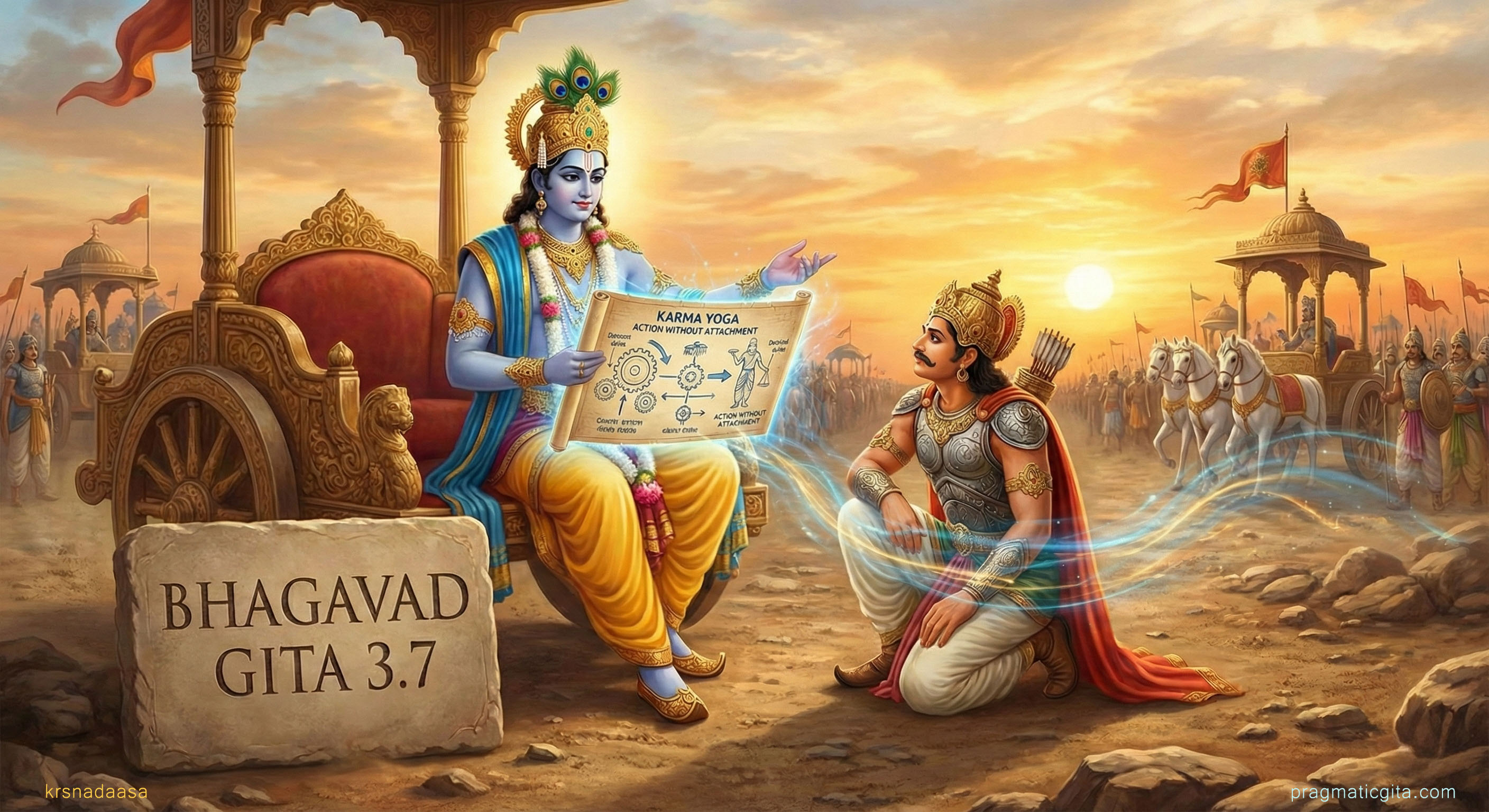

Karma Yoga : The Gist of Shlokas 3.7
If you have not already done so, I would request you to review the Chapter 2, Sankhya Yoga before studying chapter 3 as that would help set the right context.
You can find the explanation of the previous set of shlokas from chapter (3.3 to 3.6) here. Please go through that to get a better understand and maintain continuity in your learning.
You can also listen to all the episodes through my Spotify Portal. And here on YouTube as well.
You can find below the gist of the narrative. For the complete expanded narrative, look below the verses.
Mastering Action Without Attachment
We often believe that a sincere spiritual life demands a choice between two impossible extremes. We think we must either indulge in the world until we are completely lost in its noise or we must run away to a cave and violently suppress our nature. But in Bhagavad Gita Verse 3.7 Shri Krishna destroys this false dilemma and offers a third superior option. He hands us a blueprint for Action Without Attachment.
This is not merely religious advice or a set of moral rules. It is described in the text as an entire science of inner freedom and a precise architecture for living that allows you to move through the world without being captured by it.
Architecture Not Advice
Shri Krishna teaches that true superiority or being viśiṣyate is not defined by your external appearance. It is not about the robes you wear or the temples you visit. It is defined by the architecture of your internal world. The concept of Action Without Attachment requires us to become architects of our own minds. If we try to stop our senses through brute force suppression we are like a person trying to stop heavy city traffic by standing in the middle of an intersection and screaming. This approach only leads to chaos accidents and eventual road rage.
Instead the blueprint for Action Without Attachment requires us to design the flow of traffic. We must use the mind (manasā) to harness and guide the senses (indriyāṇi) rather than fighting a war against them.
Restraint vs Suppression
A critical component of Action Without Attachment is understanding the difference between niyama (restraint) and suppression. Suppression is the language of the jailer who hates the prisoner. Restraint is the language of the charioteer who respects the horsepower of his horses. When we practice Action Without Attachment we do not declare war on our senses. We understand that the senses are necessary for the journey of the body (śharīra-yātra). The problem is never the horses. The problem is when the horses run without a charioteer.
Action Without Attachment is the skill of holding the reins firmly but not rigidly. It is the art of using the senses to navigate the world while the mind remains the master of the direction.
The Sponge and The City
To truly master Action Without Attachment we must look at the nature of our intake. Our mind is like a sponge that is constantly absorbing the world around it. If that sponge is already saturated with the “muddy water” of unregulated sensory input it cannot absorb anything pure. Action Without Attachment involves a “filtering” process. We choose what the sponge absorbs. We design the city of the mind so that our attention flows toward what is nourishing and away from what is toxic.
This intelligent regulation allows us to live in the “metro city” of the modern world without being overwhelmed by its noise. It creates a stable foundation where Action Without Attachment becomes a natural state rather than a forced struggle.
Engaging Without Entanglement
The final pillar of this blueprint is asakti or freedom from clinging. This is the secret to engaging in the world without being bound by it. We deploy our “organs of action” (karmendriyas) fully. We use our speech and hands and skills to serve with excellence. But we keep the mind free from the desperate need for specific results. Action Without Attachment does not mean indifference. It means working like a mother caring for a sick child. She acts with total dedication and love but she does not calculate what she will get in return.
When we align our inner restraint with this kind of outer engagement we build a life that is both active and free. We have constructed the building using the blueprint of Action Without Attachment and we find that we can live in the world without belonging to it.
Keywords: Action Without Attachment, science of inner freedom, spiritual blueprint for life, detached engagement, yoga of action, inner architecture, freedom from bondage, niyamya vs suppression, how to live without entanglement, mastering the senses through the mind, difference between suppression and restraint, engaging organs of action, bhagavad gita verse 3.7 meaning, stopping the war with the senses
Verse 3.7
यस्त्विन्द्रियाणि मनसा नियम्यारभतेऽर्जुन |
कर्मेन्द्रियै: कर्मयोगमसक्त: स विशिष्यते || 7||
yas tvindriyāṇi manasā niyamyārabhate ’rjuna
karmendriyaiḥ karma-yogam asaktaḥ sa viśhiṣhyate
यस्त्विन्द्रियाणि (Yastvindriyāṇi) – But whoever controls the senses; मनसा (manasā) – with the mind; नियम्य (niyamya) – having restrained; अरभते (arabhate) – begins; अर्जुन (arjuna) – O Arjuna; कर्मेन्द्रियै: (karmendriyaiḥ) – with the organs of action; कर्मयोगम (karmayogam) – the yoga of action; असक्त: (asaktaḥ) – without attachment; स (sa) – he; विशिष्यते (viśiṣyate) – excels.
But whoever controls the senses with the mind, O Arjuna, and without attachment, engages the organs of action in the path of work, he is superior.
The Turning Point on the Chariot
Arjuna stands paralyzed between two seemingly impossible options. On one side lies the battlefield, soaked already in the karma of what is about to unfold. On the other side lies renunciation. But Shri Krishna has just taken away that option from Arjuna. The man who externally practices renunciation while his mind is clinging to material desires is a hypocrite, a mityachari.
So what remains?
If you cannot suppress the senses without creating a secret inner theater of indulgence, and if you cannot stop acting because prakṛti will act through you anyway, then where does a sincere human being stand?
Shri Krishna answers with verse 3.7 that contains an entire science of inner freedom:
But whoever controls the senses with the mind, O Arjuna, and without attachment, engages the organs of action in the path of work, he is superior.
Read this verse slowly. It is not advice. It is architecture. Shri Krishna is handing Arjuna the blueprint for a life that moves through the world without being captured by it.
As this is something that will directly help us all to lead our own lives without creating bondages, we will study this verse in detail.
Restraint That Is Not Violence
The first element is niyamya, restraint.
यस्त्विन्द्रियाणि मनसा नियम्यारभतेऽर्जुन |
yas tvindriyāṇi manasā niyamyā rabhate ’rjuna
But we must be careful here. The word does not mean suppression. It does not mean warfare against your own senses. The root is yam, which means to rein in, to guide, to harness. This is the language of the charioteer, not the jailer.
Think about what happens when you pull reins too hard on a horse. The horse rears. It panics. It fights you. And even if you overpower it temporarily, you have created an enemy that waits for the moment your grip weakens.
This is what most people do with their senses. They declare war. They grit their teeth. They brute force their way through temptation, building pressure behind a dam that will eventually break. And when it breaks, as it always does, they fall harder than if they had never tried at all. Then comes the shame. Then comes the conclusion that spirituality is not for them, that they are too weak, too worldly, too broken.
But Shri Krishna is not teaching this kind of restraint.
A skilled charioteer does not fight his horses. He understands them. He works with their energy, not against it. His reins are firm but not too forceful. His hands are steady but not rigid.
This is niyama. This is what it means to govern the senses through the mind.
The senses are like horses. They are powerful. They are necessary. Without them, the chariot does not move. The problem is never that you have horses. The problem is when horses run without control, when the charioteer has fallen asleep, when the charioter has forgotten that he is the one in control and not the horses.
Our senses are not the enemy. They are our horsepower. The question is: who is holding the reins? Is it the intellect aligned with dharma, or is it the unconscious momentum of craving and habit?
The Sponge and the City
Let me offer two images that may help you understand what is at stake in sense restraint.
The first image is a sponge.
Our mind is like a sponge. It absorbs. Every moment something is entering. Sounds. Sights. Textures. Tastes. Smells. But also subtler things like the tone of a conversation, the mood of a room, the silent judgment in someone’s glance. The mind soaks all of this up continuously, often without our awareness.
Now imagine a sponge that has been dipped into muddy water, then into ink, then into oil, then into some dirty sand. It becomes heavy. It becomes saturated. It cannot absorb anything clean because it is already full of contamination.
This is what happens to an uncontrolled, untrained mind. It becomes so full of impressions, so heavy with accumulated residue, that even simple tasks feel exhausting. You have not done much with your body, yet you feel exhausted. The sponge is filled with all the wrong substances.
Sense restraint is not about making the sponge dry and useless. It is about choosing what the sponge absorbs. It is about squeezing out the contamination regularly. It is about protecting your sponge so that what enters is nourishing and pure.
The second image is a city.
Our mind is not a quiet cave. It is more like a metro city. Thoughts are the buildings, constantly being constructed and demolished. Emotions are the weather, shifting from sunshine to storm at will. Memories are the old markets, some charming and some filthy. Desires are the merchants, loudly calling out to customers from every corner. And attention, our precious attention, is like the vehicles that flow through all of it.
Now imagine trying to stop all traffic in a major city by standing in the middle of the busiest intersection and shouting “Stop!” What happens? Chaos. Honking. Accidents. Road rage. The traffic does not stop. It backs up. And eventually it finds another route or runs you over.
This is what happens when we try to control the mind through brute force. You cannot stop the traffic of thought by yelling at it. We cannot suppress the flow of sensation by pumping our fists and holding your breath.
Shri Krishna’s approach is effective. He is teaching us to become the architect of the city. An architect of the city does not stand in intersections. He designs the roads. He creates the flow patterns. He builds highways that carry traffic where it needs to go and residential zones where it should go very slowly. He designs one way roads and no-entry roads. He places traffic signals at the right intersections to ensure smooth flow of vehicles. Over time, through intelligent design, the city functions smoothly. The traffic still moves, but it moves in harmony rather than chaos.
This is what mind training looks like. We do not try to stop thought. We redesign the channels through which thought flows. We create pathways toward what is beneficial and away from what is not. We build a city that serves its citizens rather than imprisoning them.
The Precision of Shri Krishna’s Instruction
Now look more closely at what Shri Krishna actually says.
He says indriyāṇi manasā niyamya: restrain the senses through the mind. And then he says karmendriyaiḥ karma-yogam ārabhate: engage in karma yoga through the organs of action.
There are two categories here that Indian psychology distinguishes with great precision.
The jñānendriyas are the five senses of perception: hearing (śrotra), touch (tvak), sight (cakṣu), taste (rasanā), and smell (ghrāṇa). These are the channels through which information about the world enters our awareness. They are the intake valves.
The karmendriyas are the five organs of action: speech (vāk), grasping (pāṇi), locomotion (pāda), excretion (pāyu), and generation (upastha). These are the channels through which we act upon the world. They are the output mechanisms.
Shri Krishna’s instruction operates on both, but in different ways.
For the jñānendriyas, he prescribes niyama, restraint through the mind. We cannot stop seeing, but we can choose what we look at. We cannot stop hearing, but we can choose what we listen to. We cannot stop the senses from functioning, but we can govern what they are exposed to and how deeply we engage with what they report.
For the karmendriyas, he prescribes ārambha, engagement in karma yoga. We do not withdraw the organs of action. We deploy them. We use our speech for dharma. We use our hands for service. We use our movement to fulfill our duties. The organs of action are not to be paralyzed. They are to be guided towards right actions.
It means the spiritual life is not about shutting down. It is about intelligent regulation and purification of input and output. We filter what enters us. We offer what leaves us.
If you think about your own life, you will notice how most suffering arises from the violation of this principle. Unregulated input like scrolling endlessly through content that agitates the mind, consuming news designed to trigger fear and outrage, surrounding yourself with conversations that reinforce negativity. Unconcentrated output like acting from impulse rather than intention, speaking without awareness of impact, working for ego gratification rather than genuine service.
The modern world has constructed an entire economy around capturing our jñānendriyas. Notifications, autoplay features, algorithmic feeds, sensational news, even fake news. These are not accidents. They are engineered to bypass our charioteer and speak directly to the horses. And when the horses are constantly being tempted and agitated by external forces, how can there be any inner peace?
That’s why Shri Krishna’s teaching is not outdated. It is more relevant and urgent than ever. The person who cannot regulate what enters through the senses will never have a stable mind. And without a stable mind, karma yoga is impossible. The foundation must be solid for the building to stand strong.
What the Commentators See
कर्मेन्द्रियै: कर्मयोगमसक्त: स विशिष्यते || 7||
karmendriyaiḥ karma-yogam asaktaḥ sa viśhiṣhyate
Śaṅkarācārya, reading this verse, emphasizes the word viśiṣyate, distinguished or superior. He asks “superior to whom”? The answer is clear from the context. Superior to the mithyācāra, the pretender described in the previous verses.
The one who withdraws externally while indulging internally is inferior.
The one who regulates internally while engaging externally is superior.
But what makes this superiority? Śaṅkara points to the alignment of inner and outer. The pretender is living a conflicted life where the outside does one thing, the inside does another. This conflict is the very definition of hypocrisy. The karma yogī has integration where the inner restraint matches the outer engagement. There is no contradiction between what he appears to be and what he actually is.
This integration requires viveka, discrimination. We cannot govern the senses through the mind if we have not developed the capacity to discern what is beneficial from what is harmful, what leads toward freedom from what leads toward bondage. Sense restraint is not random. It is not based on rules imposed from outside. It is based on clear seeing. When we understand that certain inputs agitate the mind and certain inputs calm it, we naturally choose the calming ones. The restraint arises from wisdom, not from fear of punishment.
Rāmānujācārya reads the same verse and emphasizes a different dimension. For him, the word asaktaḥ, without attachment, points to the nature of the self. The ātman is by nature unattached. It is by nature a conscious being whose fulfillment lies in loving service to the Supreme. When the karma yogī acts without attachment, he/she is not performing some artificial discipline. He/she is aligning with their own deepest identity.
Attachment, in this view, is a case of mistaken identity. We cling to results because we think we are the doer, the enjoyer, the one whose worth depends on outcomes. But if we understand that we are a spark of the Divine, that our nature is to serve, that our fulfillment lies not in acquisition but in offering, then attachment begins to dissolve naturally. We act with full engagement but without inner clinging, because we know that the results belong to a larger order, not to our small separate self.
Both commentators, despite their different emphasis, converge on one point, which is that the superiority of the karma yogī is not a matter of external appearance. It is a matter of inner alignment. The quality of our action depends entirely on the quality of our consciousness while acting.
The Third Element: Freedom from Clinging
We have spoken of restraint. We have spoken of engagement. Now we must speak of asakti, the absence of attachment.
This is the element that transforms ordinary work into yoga. Without it, even regulated senses and engaged action create bondage. With it, every action becomes a step toward liberation.
But what does it actually mean to act without attachment?
It does not mean we do not care about what we are doing. The karma yogī is not indifferent. He is not sloppy. He does not say, “I am unattached to results, so it does not matter if I do this well or poorly.” This is a misunderstanding that has damaged many seekers.
Non-attachment refers to the inner grip, not the outer effort. We can work with tremendous skill and dedication while remaining inwardly free. We can care deeply about excellence while not needing the outcome to validate our worth. We can pour ourselves fully into a task while knowing that the fruit belongs to a larger order than our personal wishes and attachments.
Think of a mother caring for a sick child. She does not act with indifference. Her attention is total. Her effort is complete. But a wise mother also knows that she does not control the outcome. She does her part fully and leaves the result to the larger force. Her love is not diminished by this surrender. If anything, it is purified. She is not nursing the child to prove she is a good mother. She is not nursing the child to receive gratitude. She is nursing the child just out of love. The action flows from her nature, not from her calculation.
This is the quality of asakti. It is action that flows from dharma rather than desire. It is engagement that does not create a balance sheet in our mind, like I did this, therefore I deserve that. The karma yogī gives without keeping accounts. They serve without building a case for their own greatness.
Jagadguru Śrī Kṛpālu Jī Mahārāj captured this perfectly:
तन से संसार करो, मन हरि में लगाओ ।
यही कर्मयोग है, इसको पहचानो ॥
tan se saṁsār karo, man hari meṁ lagāo
yahī karma-yoga hai, isko pahacāno
Let the body work in the world while the mind rests in Hari. Know this as karma yoga, recognize it clearly.
The body is in the world. The hands are working. The speech is functioning. The feet are moving. But where is the mind? If the mind is with Hari, with the Divine, with the remembrance that all action is offering, then the body’s activity does not bind. The work happens, but no rope is tied.
And then he gives the contrast:
तन से भजन करो, मन जगत में भटकाओ ।
यही तो अज्ञान है, इसको समझाओ ॥
tan se bhajan karo, man jagat meṁ bhaṭkāo
yahī to ajñān hai, isko samjhāo
Let the body perform worship while the mind wanders in the world. This is ignorance itself, explain this to your own self and to others as well.
You can sit in a temple, hands folded, eyes closed, beads moving through your fingers, while the mind is calculating business profits, rehearsing arguments, replaying resentments, fantasizing pleasures. The body looks spiritual. The mind is not at all spiritual. This is not bhakti. This is performance. And performance, however convincing to outside observers, does not purify the heart. It only tires the heart.
The test of karma yoga is not what the body is doing. It is where the mind is dwelling. We can wash dishes as yoga. We can negotiate contracts as yoga. We can raise children as yoga. We can write books as yoga. The form of the activity does not matter. What matters is the inner mindset.
The Question That Changes Everything
If you have followed this teaching carefully, a question may have arisen in your mind. You may be thinking “this sounds beautiful, but how?”.
How do I restrain the senses when they have been running wild for decades?
How do I engage in action when every action seems to multiply my anxieties?
How do I release attachment when my entire sense of self is built on outcomes?
These are honest questions. And Shri Krishna ensures that you get the right answers.
But those answers must wait for the verses that follow. Shri Krishna is building something here. He has given the architecture. Now he must show why this building must be constructed, and then how it can be constructed.
For now, let this much sink in: the distinguished person, the one who is viśiṣyate, is not distinguished by external appearances. Not by robes or rituals, not by titles or temples, not by renunciation that others can see and admire. The distinguished person is distinguished by the alignment of inner and outer, by the governance of the senses through a trained mind, by engagement with the world through consecrated action, by freedom from the inner clinging that causes bondage.
This is not an escape from life. It is the full embrace of life without being bound by it.
You are standing where Arjuna stands. Two armies stretch before you. Behind you lies the impossible option of total withdrawal, an option Shri Krishna has already closed. Ahead lies the battlefield of your duties, your relationships, your responsibilities, your dharma.
The question is not whether you will act. Prakṛti will act through you regardless. The question is how you will act. Will you be the pretender, performing spirituality while indulging inwardly? Or will you be the karma yogī, regulating what enters, purifying what leaves, and releasing the grip that turns work into bondage?
Shri Krishna has just shown you the blueprint. The building is yours to construct.
Now that we have spoken so much about genuineness and alignment of our inner and outer selves, we should take a moment to ask the big question: “Why are we investing in all this knowledge? What is our ultimate goal?”. Some of you would already know the answer, while others will be guided by Shri Krishna’s teachings. The ultimate goal of any spiritual seeker is to establish a relationship of divine love with the Lord, and to experience divine love within and to get the complete realization of that divine loving Lord.
It is very important to understand that the goal of Jnana is to help us strengthen our bhakti. Let us perform a simple meditation that will demonstrate this.
Meditation on Strengthening our Bhakti towards Krishna through Jnana
Let understanding melt into love
Sit comfortably.
Let your spine be erect, but relaxed.
Let your hands rest easily.
Close your eyes.
Take three slow breaths.
Breathe in.
Breathe out.
Again.
And one more time.
A simple intention
Say this inside, gently.
Today I will not force devotion.
Today I will learn, and let love rise naturally.
Today I will let jñāna, true knowing, strengthen my bhakti.
Pause for a few seconds.
Remember one truth.
The heart loves what it truly knows.
So we will learn more about Kṛṣṇa.
Not to collect facts.
But to connect with Him more deeply.
To trust Him more.
To love Him more.
The Practice
Step 1: Come to His name
Bring your attention to the name.
Kṛṣṇa.
Repeat it softly inside.
Kṛṣṇa.
Let the mind rest in that name.
If thoughts come, return to the name.
Step 2: The first knowing
Let us begin at the beginning.
Kṛṣṇa was born in a prison cell.
Devakī and Vasudeva were chained.
Kaṁsa had become so afraid of a prophecy that he had already killed 6 of Krishna’s siblings.
Imagine being born like that.
Your first breath is in a dungeon.
Your parents trembling in fear as they hold you.
And yet Kṛṣṇa did not wait for life to become perfect.
He arrived right in the middle of danger.
Now hold this next part gently in your heart.
The moment Kṛṣṇa arrived, the way opened.
The chains loosened.
The guards fell asleep.
The locked doors opened.
Kṛṣṇa did not run from darkness.
He entered it.
And He turned it into a path of light.
This is the first knowing.
Pause here.
Reflection Point:
Where do you feel imprisoned right now?
Where do you feel stuck, afraid, or trapped?
Do not fight the thought.
Just notice.
Now breathe.
Say inside:
The One who opens doors of the strongest prison in the middle of the night is the One I am learning to trust and love.
Return to His name.
Kṛṣṇa.
Step 3: The second knowing
The boy who protected the simple and weak
Now let us move forward.
Kṛṣṇa grew up in Vṛndāvana.
Among cowherds.
Among farmers.
Among simple village people.
And what did He do there?
He took the cows out each day.
He walked with them.
He watched over them.
He brought them home safely.
Not as a prince, but as a humble caretaker.
When Kāliya poisoned the Yamunā, Kṛṣṇa faced it.
When Indra sent heavy rains, Kṛṣṇa lifted Govardhana and gave shelter.
Why?
Not for show.
Not for fame.
Because the vulnerable needed His protection.
This is His promise:
अनन्याश्चिन्तयन्तो मां ये जनाः पर्युपासते ।
तेषां नित्याभियुक्तानां योगक्षेमं वहाम्यहम् ॥ २२॥
ananyāś cintayanto māṁ ye janāḥ paryupāsate
teṣāṁ nityābhiyuktānāṁ yoga-kṣemaṁ vahāmyaham
Those who worship Me with steady devotion, I carry what they lack and protect what they have.
This is the second knowing.
Kṛṣṇa protects.
Especially those who cannot protect themselves.
Pause and reflect.
Have you felt vulnerable and helpless in your life?
Now say inside:
The one who held a mountain to shelter simple people, the one who always protects the vulnerable is the One I am learning to trust and love.
Return to His name.
Kṛṣṇa.
Step 4: The third knowing
The friend who never forgot
Now remember Sudāmā.
A poor brāhmaṇa.
A childhood friend of Krishna.
A man who had nothing, except love and sincerity.
Sudāmā comes to Dvārakā with only a handful of flattened rice.
He feels ashamed.
He hesitates to come close to King Krishna.
But Kṛṣṇa runs to him.
Kṛṣṇa embraces him.
Kṛṣṇa washes his feet.
Kṛṣṇa makes him sit close.
And Kṛṣṇa eats that simple offering with joy.
Sudāmā does not ask for wealth.
He cannot even speak.
But Kṛṣṇa gives anyway.
Quietly.
Lovingly.
Without making his friend feel small.
This is the third knowing.
Kṛṣṇa is the best friend one can have.
Kṛṣṇa does not care about material wealth or social status.
Kṛṣṇa truly values love and friendship.
Pause here.
Have you ever felt small and unworthy?
Have you ever wondered if you matter?
Breathe.
Say inside:
The One who runs towards a poor old friend. The one whose friendship is selfless and eternal is the One I am learning to trust and love.
Kṛṣṇa.
Step 5: The fourth knowing
The Lord who chose the lower seat
Now come to Kurukṣetra.
Kṛṣṇa could have destroyed everyone with his divine weapons.
He could have earned fame and glory as the mightiest of warriors.
But He chose not to fight.
He chose to serve his devoted friend Arjuna.
He chose the humble role of being Arjuna’s charioteer.
Think of that.
The Lord of the universe serving someone as a humble charioteer.
Sitting below.
Facing the dust.
Helping his devoted friend receive the outer glory.
And when Arjuna broke down, Kṛṣṇa did not shame him.
He did not shout at him.
He guided him.
He taught him.
He stayed with him patiently.
This is the fourth knowing.
Kṛṣṇa cares.
Krishna guides.
Reflection Point:
Have you felt hesitant to seek help from Krishna?
Now breathe.
Say inside:
The One who became a servant to help his devoted friend become a King is the One I am learning to trust and love.
Kṛṣṇa.
Step 6: The fifth knowing
The One who stands for dharma and keeps His word
Bring to mind dharma, right order, duty, the principle that holds life together.
Kṛṣṇa stands for dharma.
Not only in speech.
But In action.
He tries for peace before war.
He takes responsibility.
He protects dignity.
And in the Gītā, He gives a promise that devotees remember across ages.
यदा यदा हि धर्मस्य ग्लानिर्भवति भारत |
अभ्युत्थानमधर्मस्य तदात्मानं सृजाम्यहम् || 7||
yadā yadā hi dharmasya glānir bhavati bhārata
abhyutthānam adharmasya tadātmānaṁ sṛijāmyaham
Whenever and wherever there is a decline in righteousness, O Arjuna, and a rise in unrighteousness, I manifest myself.
Pause here.
Have you ever felt discouraged by seeing injustice happening around you?
Have you wondered if Krishna cares? If He will come to make things right?
Now breathe.
Say inside:
The One who always keeps His promises, the one who always comes to protect dharma is the One I am learning to trust and love.
Kṛṣṇa.
Step 7: The sixth knowing
Rādhā and Kṛṣṇa, love without abandonment
Many people think Kṛṣṇa left Rādhā and never returned, so divine love ended in abandonment.
But Krishna Himself has said that Rādhā is not separate from Him.
She is Kṛṣṇa’s own inner power, the hlādinī śakti.
Krishna played a leela to make Rādhā and Him appear as two, so love can be tasted fully.
It is a mystery of love through the illusion of separation.
Kṛṣṇa brought forth Rādhā from His own being so He could taste the deepest love, even the deepest longing, what some call parama vyākulatā.
Surdas, the blind poet of Braj, captures the essence of this in his work Sursagar, where he mentions that when Krishna first meets Radha, he doesn’t approach her as a stranger but as a long-lost part of Himself.
Where Krishna speaks to his own heart (and by extension, to Radha) about their non-difference:
“सुनहु कान्ह एकै हम दोऊ, तुम तन हम मन अनत न कोऊ” > (Sunahu Kānha ekai hama doū, tuma tana hama mana anata na koū) > “Listen, O Kanhaiya, we two are one; you are the body and I am the soul, there is no one else.”
What to speak of Radha, Krishna has promised that anyone who loves Him dearly becomes a part of Him.
यो मां पश्यति सर्वत्र सर्वं च मयि पश्यति ।
तस्याहं न प्रणश्यामि स च मे न प्रणश्यति ॥ ३०॥
yo māṁ paśyati sarvatra sarvaṁ ca mayi paśyati
tasyāhaṁ na praṇaśyāmi sa ca me na praṇaśyati
One who sees Me everywhere and sees everything in Me, I am never lost to them, and they are never lost to Me.
Let this land softly.
If Kṛṣṇa knows longing from inside Himself, then your longing is not unknown to Him.
Pause.
Have you ever felt your love for the Divine is unanswered?
Breathe.
Say inside:
The One who willingly experiences the pain of separation certainly understands my pain and my longing. That is the One I am learning to trust and love.
Rādhe.
Kṛṣṇa.
Step 8: The seventh knowing
The One who protected dignity
Now bring your attention to dignity.
Kṛṣṇa protects those who are humiliated.
He stands with those who are cornered.
He does not enjoy cruelty.
He does not ignore suffering.
When Draupadī called, He was the only one who came to her protection, while no other human did.
And in the narratives of Narakāsura, Kṛṣṇa rescues many women who were held captive, and then takes responsibility for their protection and place in society.
Let the spirit of this touch you.
This is the seventh knowing.
Kṛṣṇa is compassionate.
Kṛṣṇa is reliable.
Kṛṣṇa is dependable.
Pause and reflect.
Have you felt ignored by people close to you?
Have you wondered if Krishna really cares about you?
Breathe.
Say inside:
The One who cares. The one who is dependable and reliable is the One I am learning to trust and love.
Kṛṣṇa.
Step 9: The eighth knowing
The One who feels our pain
Some people think God must be far from human sorrow.
But Kṛṣṇa is not distant.
He is present.
He enters life.
He knows what love costs.
He knows what loss feels like.
So bring one quiet pain from your life into His presence.
Not to dramatize.
Just to offer.
Breathe in.
Breathe out.
Say inside:
Kṛṣṇa, you are with me in this.
Kṛṣṇa.
Step 10: The ninth knowing
The teacher who never forces
Now remember something beautiful.
Kṛṣṇa teaches Arjuna completely.
Then He gives him freedom.
He does not force.
He invites Arjuna to use his own free will.
This is a precious quality.
Kṛṣṇa calls you with love, not with fear.
Breathe.
Say inside:
The One who respects my freedom and leads with love and compassion is the One I am learning to trust and love.
Kṛṣṇa.
Let the knowing become devotion
Now sit quietly for one minute.
Let all these truths gather inside you.
Kṛṣṇa enters darkness and makes a way.
Kṛṣṇa protects the vulnerable.
Kṛṣṇa remembers the sincere friend.
Kṛṣṇa serves without pride.
Kṛṣṇa stands for dharma.
Kṛṣṇa is not separate from love itself.
Kṛṣṇa is reliable and dependable.
Kṛṣṇa is not distant but always walking with us, feeling our pain.
Kṛṣṇa never forces. He leads with love and compassion.
Now simply feel.
If warmth comes, let it come.
If tears come, let them come.
If nothing comes, that is also welcome.
Return to His name.
Kṛṣṇa.
Kṛṣṇa.
The question
Now ask yourself.
Do I feel my devotion has become stronger?
Even slightly?
Do I feel closer than when we began?
Do I feel more trust?
If yes, offer gratitude.
If not yet, do not judge yourself.
This practice is still working.
It is planting seeds.
And now see the point clearly.
This is how jñāna strengthens bhakti.
And the more we truly know Kṛṣṇa, the more the devotion grows.
Closing
Take one final breath.
Place a hand on your heart if you like.
Make one gentle commitment.
This week, I will remember one true thing about Kṛṣṇa.
One quality.
One story.
One teaching.
Then sit with it for five minutes.
Let it warm your heart.
Know Him.
And in knowing, strengthen your trust and love.
Om Namo Narayanaya.
Om Tat Sat.
kṛṣṇadaasa
Servant of Krishna