 Pragmatic Gita

Karma Yoga vs Renunciation: The Gist of Shlokas 3.3 to 3.6
If you have not already done so, I would request you to review the Chapter 2, Sankhya Yoga before studying chapter 3 as that would help set the right context.
You can find the explanation of the final shlokas of chapter 2 (67 to 72) here. Please go through that to get a better understand and maintain continuity in your learning.
You can also listen to all the episodes through my Spotify Portal. And here on YouTube as well.
The Eternal Dilemma: Karma Yoga vs Renunciation Have you ever felt the urge to leave your job, your relationships, or your responsibilities, believing that “walking away” is the only way to find spiritual peace? You are not alone. In Chapter 3 of the Bhagavad Gita, Arjuna faces this exact dilemma. He is torn between the desire to withdraw from the world and the demand to fight, sparking the classic spiritual debate of Karma Yoga vs Renunciation.
He wants to escape the battlefield, thinking that silence equals spirituality. However, Krishna shatters this illusion, teaching us that the choice between Karma Yoga vs Renunciation is not about physical location, but about inner consciousness.
Shifting Perspectives: Beyond the Binary Arjuna’s confusion about Karma Yoga vs Renunciation stems from viewing them as mutually exclusive opposites. He thinks he must choose one and reject the other. This mental block is common. As the saying goes, “Einstein you cannot solve a problem from the same level of consciousness that created it.”
Arjuna is trying to solve his spiritual crisis with a material mindset. To understand the synthesis of Karma Yoga vs Renunciation, he must elevate his thinking. This is similar to how humanity struggled to accept the copernicus galileo heliocentric view. Just as people ridiculed the idea that the Earth was not the center, our ego ridicules the idea that we can be active without being the “doer.”
The copernicus galileo heliocentric view required a total paradigm shift, just as understanding Karma Yoga vs Renunciation requires shifting from an ego-centric to a divine-centric view.
The Danger of the Mithyachari When misunderstanding Karma Yoga vs Renunciation, many seekers fall into the trap of becoming a Mithyachari (spiritual hypocrite). Krishna warns that if you choose the external appearance of Renunciation while your mind is still full of worldly desires, you are merely pretending.
True Karma Yoga vs Renunciation teaches that it is better to struggle honestly in the world than to fake holiness in a cave. You cannot attain freedom simply by stopping your hands from working; you must stop your mind from claiming ownership. This integrity is the heart of the Karma Yoga vs Renunciation teaching.
Integrating the Two Paths Ultimately, the battle of Karma Yoga vs Renunciation is resolved when we realize they are complementary, not contradictory. Krishna explains that while there are two paths—the path of contemplation (Jnana Yoga) and the path of action (Karma Yoga)—they must eventually converge.
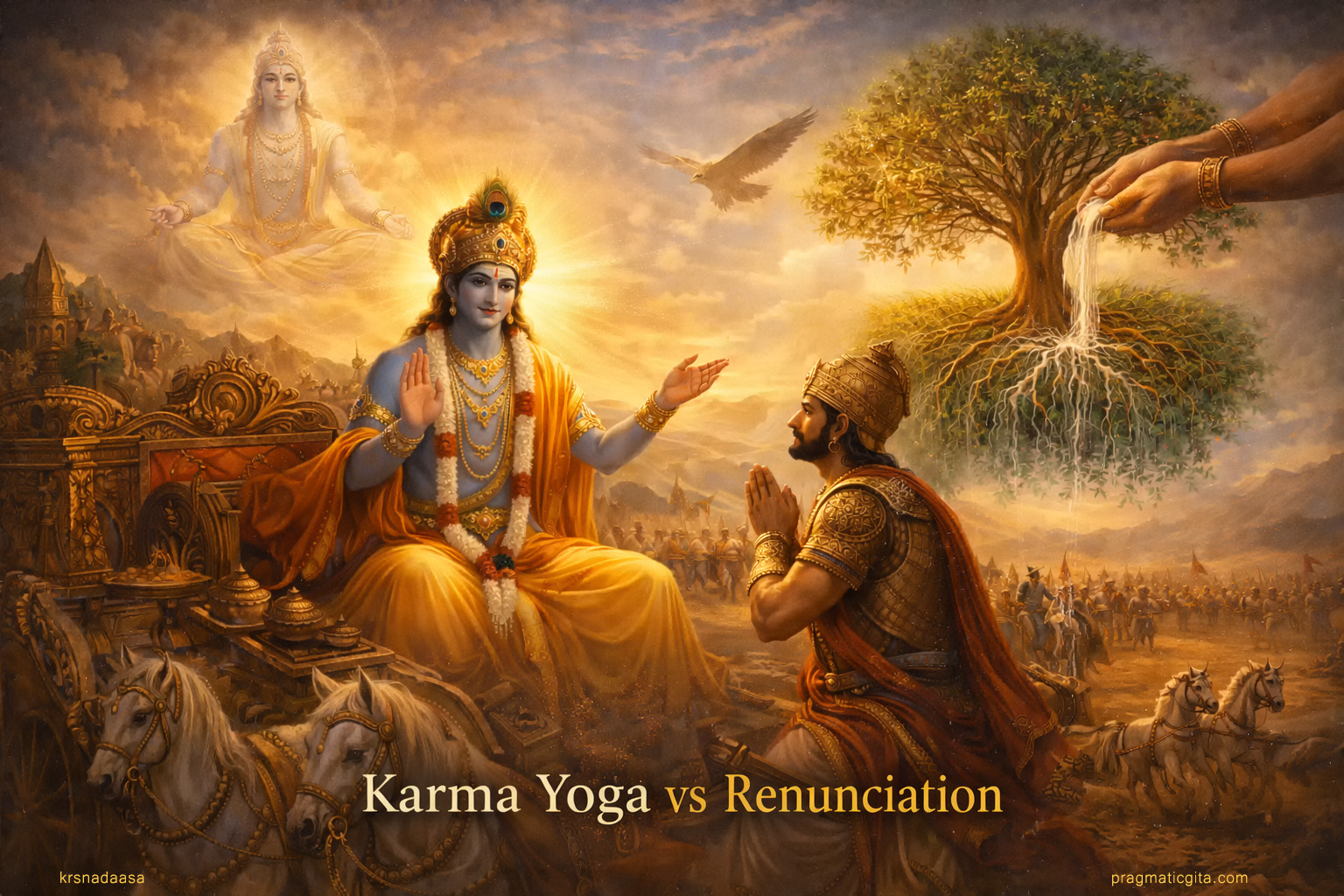
Knowledge is like finding the roots of the tree, while action is the watering of those roots. To grow, we must integrate both aspects of Karma Yoga vs Renunciation: acting responsibly in the world while anchoring our intelligence in the Divine. By realizing that “Einstein you cannot solve a problem from the same level of consciousness that created it,” we stop fighting the duality and start living the synthesis.
Keywords: Karma Yoga vs Renunciation, Path of Knowledge (Jnana Yoga), Spiritual Hypocrisy (Mithyachara), Actionlessness (Naishkarmya), Bhagavad Gita Chapter 3 summary, how to practice detachment in daily life, meaning of mithyachara in Bhagavad Gita, overcoming spiritual bypassing, Why is action better than inaction in Gita?, Can I find peace by running away from duties?, What are the two paths explained by Krishna?, Einstein you cannot solve a problem from the same level of consciousness that created it, copernicus galileo heliocentric view
Verses 3.3 to 3.6
श्रीभगवानुवाच |
लोकेऽस्मिन्द्विविधा निष्ठा पुरा प्रोक्ता मयानघ |
ज्ञानयोगेन साङ्ख्यानां कर्मयोगेन योगिनाम् || 3.3||
śhrī bhagavān uvācha
loke ’smin dvi-vidhā niṣhṭhā purā proktā mayānagha
jñāna-yogena sāṅkhyānāṁ karma-yogena yoginām
śrībhagavānuvāca (श्रीभगवानुवाच) – The Supreme Lord said; loke (लोके) – in the world; asmin (अस्मिन्) – this; dvividhā (द्विविधा) – two kinds of; niṣṭhā (निष्ठा) – faith or steadfastness; purā (पुरा) – formerly; proktā (प्रोक्ता) – were explained; mayā (मया) – by Me; anagha (अनघ) – O sinless one; jñānayogena (ज्ञानयोगेन) – through the path of knowledge; sāṅkhyānāṁ (साङ्ख्यानां) – for the Sankhyas; karmayogena (कर्मयोगेन) – through the path of action; yoginām (योगिनाम्) – for the yogis.
The Lord said: O sinless one, the two paths leading to enlightenment were previously explained by Me: the path of knowledge, for those inclined toward contemplation, and the path of work for those inclined toward action.
न कर्मणामनारम्भान्नैष्कर्म्यं पुरुषोऽश्नुते |
न च संन्यसनादेव सिद्धिं समधिगच्छति ||3.4||
na karmaṇām anārambhān naiṣhkarmyaṁ puruṣho ’śhnute
na cha sannyasanād eva siddhiṁ samadhigachchhati
na (न) – not; karmaṇām (कर्मणाम्) – by abstaining from actions; anārambhāt (अनारम्भात्) – by non-performance; naiṣkarmyam (नैष्कर्म्यं) – the state of actionlessness; puruṣaḥ (पुरुषः) – a person; aśnute (अश्नुते) – achieves; na (न) – not; ca (च) – and; saṁnyasanāt (संन्यसनात्) – by renunciation alone; eva (एव) – only; siddhim (सिद्धिं) – perfection; samadhigacchati (समधिगच्छति) – attains.
One cannot achieve freedom from karmic reactions by merely abstaining from work, nor can one attain perfection of knowledge by mere physical renunciation.
न हि कश्चित्क्षणमपि जातु तिष्ठत्यकर्मकृत् |
कार्यते ह्यवश: कर्म सर्व: प्रकृतिजैर्गुणै: ||3.5||
na hi kaśhchit kṣhaṇam api jātu tiṣhṭhatyakarma-kṛit
kāryate hyavaśhaḥ karma sarvaḥ prakṛiti-jair guṇaiḥ
na (न) – not; hi (हि) – indeed; kaścit (कश्चित्) – anyone; kṣaṇam (क्षणम्) – a moment; api (अपि) – even; jātu (जातु) – ever; tiṣṭhati (तिष्ठति) – remains; akarmakṛt (अकर्मकृत्) – without performing action; kāryate (कार्यते) – is compelled to act; hi (हि) – indeed; avaśaḥ (अवशः) – helplessly; karma (कर्म) – action; sarvaḥ (सर्वः) – all; prakṛtijaiḥ (प्रकृतिजैः) – born of material nature; guṇaiḥ (गुणैः) – by the modes.
There is no one who can remain without action even for a moment. Indeed, all beings are compelled to act by their qualities born of material nature (sattva, rajas and tamas).
कर्मेन्द्रियाणि संयम्य य आस्ते मनसा स्मरन् |
इन्द्रियार्थान्विमूढात्मा मिथ्याचार: स उच्यते ||3.6||
karmendriyāṇi sanyamya ya āste manasā smaran
indriyārthān vimūḍhātmā mithyāchāraḥ sa uchyate
karmendriyāṇi (कर्मेन्द्रियाणि) – the working senses; saṁyamya (संयम्य) – restraining; ya (य) – who; āste (आस्ते) – remains; manasā (मनसा) – with the mind; smaran (स्मरन्) – dwelling upon; indriyārthān (इन्द्रियार्थान्) – sense objects; vimūḍhātmā (विमूढात्मा) – deluded soul; mithyācāraḥ (मिथ्याचारः) – hypocrite; sa (स) – he; ucyate (उच्यते) – is called.
One who restrains the working senses, but mentally dwells upon the sense objects, is a deluded soul and should be called a hypocrite.
Arjuna Asks for One Clear Path
Let us first hear again what Arjuna said in 3.1 and 3.2, because his words show us how the mind behaves when it wants to avoid pain.
Arjuna said, O Janardana, if You consider understanding superior to action, then why do You ask me to wage this terrible war? With words that seem mixed, You are bewildering my intellect. So tell me decisively the one thing by which I may attain the highest good.
To understand why Arjuna speaks this way, we have to go back to 2.49. There Shri Krishna had said that mere action is far inferior to बुद्धियोग (buddhi-yoga), the discipline of awakened, steady understanding. What He meant was that action done with this understanding frees us, whereas action driven by selfish desire binds us. But Arjuna heard the word buddhi and took it to mean knowledge as the opposite of action. From there, his reasoning moved very quickly. If understanding is higher, then action must be lower. If detachment is important, then perhaps the best option is to leave everything and walk away.
One might wonder why Arjuna is still so bewildered after the entire teaching of sankhya yoga in chapter 2. Do you think it is a failure of Shri Krishna’s teaching? Of course not. Through Arjuna’s confusion, Shri Krishna answers a question that every sincere seeker eventually asks. How do knowledge and action fit together? And we see this same confusion everywhere.
A person hears “be detached” and assumes it means “stop caring.” A person hears “everything is Shri Krishna’s will” and assumes it means “we don’t have to do anything.” A person hears “knowledge is higher” and assumes it means “action is inferior.” A person hears “renounce” and assumes it means “leave your responsibilities.”
The teaching may be perfectly correct, and yet the way we interpret it causes confusion instead of transformation. Whenever we feel confused by a teaching, it may simply mean that the teaching is larger than our present capacity to understand it. The mind resists any new concept primarily because it is attached to what already feels comfortable and familiar.
We have a well known example of this from history. For thousands of years, people believed that the earth stood at the centre of the universe and everything else revolved around it. Then in 1543 Copernicus published his work explaining that the sun was at the centre of the solar system and that the earth was revolving around it. The idea met strong opposition, and in 1616 the book was placed on the Catholic Church’s list of forbidden books.
Galileo later supported the view through his own observations and was made to withdraw it publicly before the Inquisition in 1633. But after doing so, he quietly whispered, “Eppur si muove,” and yet it moves.
Truth does not need our permission. Reality does not rearrange itself to protect our ego. Copernicus was simply describing things as they were. The resistance came because people did not want to let go of their older beliefs.
Arjuna is in much the same position. In his old belief, he and his own role stood at the centre.
I am a Pandava. I am the doer. I will be responsible for what happens here. I will lose the people I love.
Shri Krishna is asking him to see from a different centre. The ātman is eternal. Our actions should be aligned with dharma. Action can become liberating when it is done without attachment. But Arjuna does what all of us tend to do. He tries to fit Shri Krishna’s teaching into his own belief system instead of allowing the teaching to transform his belief system.
In the Katha Upanishad, Yama teaches Nachiketa that the lastingly good, shreyas, and the merely pleasant, preyas, stand before us as two different choices. This is Arjuna’s inner struggle. His intellect wants shreyas, but his mind is attached to preyas. He wants liberation, but he also wants relief. He wants truth, but he also wants comfort.
Shri Krishna is teaching him that relief and liberation are not the same. A path may feel pleasant and still keep us bound. Another path may feel difficult but take us towards liberation.
Sometimes shreyas asks us to have the conversation we have been avoiding. Sometimes it asks us to apologise. Sometimes it asks us to keep serving when nobody notices. Sometimes it asks us to walk away from something attractive because we know it is taking us in the wrong direction.
And there is a grace hidden in Arjuna’s confusion. His confusion is honest. It says, I do not yet understand. Had Arjuna simply nodded in false understanding, the Gita might have ended with the second chapter. Because he admits that he is confused, the teaching continues. In our own lives, we should not hide our confusion either. We should bring it to Bhagavān, bring it to the guru, and bring it to our satsanga. Sincere seeking, when it is joined with humility and faith, is already the beginning of Shri Krishna’s grace.
Two Paths for Two Kinds of Seekers
Now let us hear how Shri Krishna responds in 3.3. Arjuna is asking for one single path, almost as if spiritual life were a fork in the road where we must choose left or right and reject the other. Shri Krishna refuses that kind of rejection.
He begins by addressing Arjuna as अनघ (anagha), O sinless one. This is not flattery. It is reassurance. Arjuna is confused and resisting, and yet Shri Krishna does not condemn him. There is a quiet lesson here for us. When we honestly admit our confusion to Bhagavān, He guides us with gentle kindness. However, if we lie to ourselves and try to defend our actions, He will point out our behavior very directly. We will see this clearly in verse 3.6.
Then Shri Krishna says, लोकेऽस्मिन्द्विविधा निष्ठा (loke ‘smin dvi-vidhā nishta), in this world there is a twofold nishta. Here, the word nishta means established in something. Shri Krishna is speaking of two ways in which a seeker’s whole life may become steadily established in the pursuit of the highest goal.
He says these two are पुरा प्रोक्ता मया (purā proktā mayā), declared by Me formerly.
So, what are these two nishtas? Shri Krishna says ज्ञानयोगेन साङ्ख्यानाम् (jñāna-yogena sankhyanām), the yoga of knowledge for the sankhyas. Here sankhya refers to those whose spiritual orientation is towards discernment and knowledge of the self. Then He says कर्मयोगेन योगिनाम् (karma-yogena yoginām), the yoga of action for those who proceed through action, taking the very work and responsibilities of life and gradually converting them into spiritual discipline.
Shri Krishna is certainly not dividing people into a higher group and a lower group. There is स्वभाव (svabhāva), our inner nature, and we can see these differences even in ordinary life. Some of us naturally find ourselves asking, “What is ultimately real? Who am I? What is this self that remains while everything else keeps changing?” Others instinctively ask, “What needs to be done? What is my responsibility here? How can I help?” One temperament naturally turns towards contemplation, the other towards engagement and action.
If you want to see this very simply, imagine that you had one completely free Sunday. There are no obligations, no deadlines, nobody expecting anything from you. Where does the mind naturally want to go? Does it want quietness, reflection, reading and inquiry, or does it begin looking for something to do, somewhere to go, to build, fix, or accomplish? There is no moral judgement in this. It simply tells us something about our own temperament.
This matters in spiritual life because one method cannot be imposed mechanically upon everyone. If a deeply contemplative person is kept in continuous outward activity, eventually that person may feel exhausted. If a strongly active person is pushed into long silent contemplation, it may lead to restlessness and frustration. Shri Krishna’s teaching is sensitive to the human being who is actually standing before Him.
At the same time, jñāna-nishta is not merely a liking for philosophy or spiritual books. It asks for deep discernment, dispassion, self-mastery and considerable inner steadiness. In the same way, karma yoga is not just doing many things and keeping ourselves busy. It is action in which attachment gradually loosens, so that the work itself becomes sādhana, and Bhagavān increasingly becomes the reason for which it is performed.
Why the Two Paths Cannot Be Pulled Apart
And this is where Arjuna’s difficulty begins. He hears Shri Krishna say that there are two paths, and somewhere in his mind a possibility appears. If there is a path of knowledge, perhaps he can choose that one and step away from Kurukshetra and from the action it demands of him. But Shri Krishna will not allow Arjuna to take a genuine spiritual teaching and turn it into an escape from the dutiful action that is actually before him.
Later, in 5.4, Shri Krishna will say साङ्ख्ययोगौ पृथग्बालाः प्रवदन्ति न पण्डिताः (sankhya-yogau pṛthag bālāḥ pravadanti na paṇḍitāḥ), it is the childish, not the wise, who speak of knowledge and yoga as separate. And He adds that one who is truly established in even one of them gains the fruit of both. So the two paths are not rivals. What Shri Krishna will not allow is for knowledge to become a way out of action for someone whose mind is not yet ready for it.
We can see this in a very ordinary example. Imagine someone who loves reading about fitness. They watch videos, collect fitness books, know the name of every muscle group, and can correct everyone else’s posture. But they never actually exercise. That is jñāna without karma. Lots of theory, but no action and no transformation.
Now imagine the opposite. Someone is working out all day, but with no knowledge on what the right way to work out is. They keep injuring themselves, exhaust their body, and wonder why they are not getting stronger. That is karma without jñāna. Lots of effort, but again no transformation.
In our daily lives, this means knowledge and action have to mature together. This is exactly what Shri Krishna meant by buddhi-yoga back in 2.49. Buddhi yoga is awakened understanding that is meant to transform our life, not to help us run away from it. That is why our spirituality is not really tested in the prayer room. It is tested in traffic, in deadlines, in conflict, in temptation, and in the moment our plan fails and the ego wants to blame someone.
There is another simple truth that Shri Krishna wants Arjuna to see. No action is not the same as no reaction. Have you ever avoided a difficult conversation and then watched the relationship decay anyway? You did nothing, and yet the consequences came. That is karma.
Our scriptures speak of action through मनस् (manas), the mind, वाक् (vāk), speech, and काय (kāya), the body. The body may be sitting completely still while the mind is conducting an entire argument. Outwardly there may be silence, while inwardly we have already accused the other person, defended ourselves, rehearsed our resentment and repeated the same conversation many times over. So physical stillness is not necessarily the same thing as inaction.
This is why Bhagavad Gita 2.47 is such a complete teaching. Everybody remembers the famous part, that we have a right to action but not to the fruits, but Shri Krishna does not stop there. He also says मा ते सङ्गोऽस्त्वकर्मणि (mā te saṅgo ‘stv akarmaṇi), do not become attached to inaction. That last instruction is very easy to forget, because sometimes inaction feels much safer than action. In 2.33 Shri Krishna had already warned Arjuna that abandoning his rightful duty would itself bring sin.
So we must know clearly, and that is jñāna. We must act rightly, and that is karma. We must learn to relinquish our possessive claim over the fruits, and that is tyāga. And through all of this we learn to remain steady within, which is the direction of the sthita-prajña.
Not Doing Is Not the Same as Being Free
Coming back to Arjuna, we see that his mind is trying to bargain with Shri Krishna. If action has brought him to this unbearable situation, perhaps the answer is simply to stop acting. Shri Krishna answers that directly in 3.4 when He says न कर्मणामनारम्भान्नैष्कर्म्यं पुरुषोऽश्नुते (na karmaṇām anārambhān naiṣkarmyaṁ puruṣo ‘śnute). A person does not attain naiṣkarmya merely by refusing to act.
The word नैष्कर्म्य (naiṣkarmya) needs careful attention, because it does not mean an idle condition in which nothing is happening. Naiṣkarmya is the state in which karma no longer binds. Shri Krishna is telling Arjuna that this high state is not reached by stopping work. It is reached by purifying the one who works.
Then He says न च संन्यसनादेव सिद्धिं समधिगच्छति (na ca sannyasanād eva siddhiṁ samadhigacchati), nor does one attain perfection by renunciation alone. That small word एव (eva) is important. By renunciation alone.
Shri Krishna is not rejecting संन्यास (sannyāsa). He honours true renunciation, and He will speak of it with great respect in later chapters. What He is rejecting is the assumption that renouncing the outside world automatically transforms our inside world.
Of course, simplifying our life can help. A little more solitude, fewer possessions, or simply stepping away from unnecessary activity can give the mind some breathing room and make our sādhana easier. But none of that, by itself, solves the real problem. If we leave everything behind and carry the same ego with us, the same desires, the same need to control, the same need to be recognised, then what have we really renounced? The surroundings may have changed, but the attachment has stayed the same within us.
And that is really the point Shri Krishna is making here. Bondage does not come from action alone. It comes from the inner claim we attach to the action. “I am the doer. I am in control. This must go the way I want. I deserve this result.” As long as that claim remains strong, even something outwardly noble can keep strengthening the ego and causing bondage. And once that claim is surrendered, even the hardest duty can become a path to freedom.
Take the example of somebody who has been deeply hurt in a relationship and says, “I am practising detachment now.” They stop speaking, stop showing concern, and outwardly everything looks controlled. But inside, the anger is still alive, the pride is still wounded, and perhaps there is even a quiet wish that the other person should suffer enough to realise what they have done.
So has attachment really ended? No. It has simply gone into hiding. Genuine detachment is not the rejection of responsibility or feeling. It is the gradual purification of our ego and pride.
No One Can Stay Still Even for a Moment
Then Shri Krishna takes the teaching one step further in 3.5. He says न हि कश्चित्क्षणमपि जातु तिष्ठत्यकर्मकृत् (na hi kaścit kṣaṇam api jātu tiṣṭhaty akarma-kṛt). No one can remain without action even for a moment.
And then He explains why. कार्यते ह्यवशः कर्म (kāryate hy avaśaḥ karma). The Sanskrit is quite powerful here. कार्यते (kāryate) carries the sense of being impelled into action, while अवशः (avaśaḥ) tells us that we are helpless and not yet masters of what is moving through us.
What is pushing us to act? Shri Krishna says प्रकृतिजैर्गुणैः (prakṛti-jair guṇaiḥ), the guṇas born of prakṛti (sattva, rajas and tamas).
Now this does not mean that we should become fatalistic and say, “The guṇas are doing everything, so what can I do?” If that were the teaching, there would be no reason for Shri Krishna to speak about discipline, discrimination, self-control or yoga at all. His point is much more practical. Until we get liberated, refusing action does not make us free from reaction (which is governed by prakriti).
Even Arjuna’s wish to leave the battlefield is itself something happening within prakṛti. The desire to do nothing is still a movement of the guṇas. So the useful question is not, “How can I stop acting altogether?” The useful question is, “What is actually making me act, what kind of action am I meant to take, and what should my state of mind be while I am doing it?”
That is where understanding the guṇas becomes very practical.
And that is why we need to practice buddhi yoga. We have to ask ourselves, honestly, what dharma requires, what motive is actually driving us, what we are afraid of, and what attachment we may be holding on to.
Am I waiting because wisdom says wait, or because I am overcome by laziness and lethargy? Am I acting because dharma asks me to act, or simply because my restless mind cannot tolerate stillness?
And then there is one more question that takes us deeper. For whom am I doing this? When the answer gradually begins to become “for Bhagavān,” karma begins to become yoga.
When the Hands Are Still but the Mind Is Not
Then in 3.6 Shri Krishna brings the teaching even closer to home. He says कर्मेन्द्रियाणि संयम्य (karmendriyāṇi saṁyamya), restraining the organs of action.
There is nothing wrong with restraint. In fact, restraint is necessary. The difficulty begins when the outer restraint and the inner mindset are moving in opposite directions.
Shri Krishna continues with य आस्ते मनसा स्मरन् इन्द्रियार्थान् (ya āste manasā smaran indriyārthān), the person sits there while the mind continues dwelling upon the objects of the senses. Then He says विमूढात्मा मिथ्याचारः स उच्यते (vimūḍhātmā mithyācāraḥ sa ucyate). Such a person is deluded and is called a hypocrite.
The word मिथ्याचार (mithyācāra) is strong. मिथ्या (mithyā) means false and आचार (ācāra) means conduct, the way one lives. So mithyācāra describes a condition in which the outer life and the inner life are not aligned. And विमूढात्मा (vimūḍhātmā) tells us something equally important. Before such a person deceives anybody else, they have already begun deceiving themselves.
But we have to be very careful here, because Shri Krishna is not condemning the sincere seeker who still has desires. Old desires return. Old anger returns. Old habits return. Sometimes something we thought we had left behind appears again even after years of spiritual practice. That does not make us hypocrites.
A sincere devotee may say, “Shri Krishna, this desire is still strong in me. I do not want it to control me. Please help me.” There is no falsehood in that. In fact, there is honesty.
Mithyācāra begins when protecting our external image becomes more important than facing what is actually happening within us.
I may want everybody to think that I have forgiven while privately holding a grudge inside. I may want people to think that I am detached while quietly checking whether they noticed me. I may say that I have renounced something while mentally returning to it again and again.
Shri Krishna has already prepared us for this in 2.59, where the objects may be removed but रसवर्जम् (rasa-varjam), the taste for them, can remain. The object may have gone away, while the rasa is still very much alive.
Swami Mukundananda tells a traditional story, which he attributes to the Purāṇas, that makes this point very memorable.
There were two brothers, Tavrit and Suvrit, who were on their way to the temple to hear a discourse on the Śrīmad Bhāgavatam when heavy rain began. They ran into the nearest building for shelter and discovered, to their dismay, that it was a house of ill repute where dancers were entertaining the guests.
Tavrit, the elder brother, was horrified and went straight back into the rain so that he could continue to the temple. Suvrit stayed behind, thinking that he was only taking shelter and would leave once the rain stopped.
If we look at the two brothers from outside, the judgement seems obvious. One is sitting in the temple while the other is sitting in that house. Surely there can be no doubt about which one is the more spiritual person.
But while Tavrit is sitting in the temple listening to the Bhāgavatam, his mind keeps returning to his brother. He begins thinking, “Why did I come here? This discourse is so boring. My brother must be enjoying himself.”
Suvrit, meanwhile, is thinking exactly the opposite. “Why did I stay here? My brother is listening to the Bhāgavatam. I should have gone with him. A little rain would not have melted me.”
Eventually the rain stops, and both brothers leave, each moving towards the other. They meet on the way, lightning strikes, and both die. The messengers of Yama come for Tavrit, and naturally he is shocked. He protests that there must be some mistake, because he was the one sitting in the temple while his brother had remained in that other place.
The messengers tell him that there is no mistake. Suvrit’s body had been there because he was taking shelter from the rain, but his heart was longing for the Bhāgavatam. Tavrit’s body was in the temple, but his mind was somewhere else.
That is precisely what Shri Krishna is describing. Tavrit’s body was restrained, but his mind was not.
We should not misuse the story and conclude that outward conduct does not matter. Of course it matters. Shri Krishna repeatedly teaches discipline of body, speech and senses. Suvrit is not being praised because sitting in that place was somehow spiritually equal to sitting in the temple. He is praised because his heart was longing for the discourse. The point is that although outer discipline is necessary, if the mind continues moving in the opposite direction, spiritual evolution cannot happen.
And how do we train the mind? Suppose resentment arises. First, we recognise it honestly instead of pretending that it is absent. Then we stop feeding it. We do not replay the incident twenty more times or keep improving the speech we wish we had given. Instead, we bring buddhi into the situation and ask what exactly hurt us, what expectation was violated, what the ego is demanding, and what dharma asks us to do now.
Then we turn the mind towards chanting, prayer, some seva, or remembrance of Shri Krishna. The thought may return, and very likely it will. When it does, we bring the mind back. If it returns again, we bring it back again.
That is sādhana. It is not fighting the mind with force. It is giving the mind a better home. Then restraint is no longer only a battle of willpower. It becomes an offering, and little by little, the mind that was remembering sense objects begins to remember its Beloved.
Pause and reflect
Where in my life have I given my fear or desire for comfort a spiritual name such as detachment, surrender or acceptance?
Where does my outer life look better than my inner life, and what attachment or fear is keeping that gap alive?
How to apply this today
Choose one responsibility you have been avoiding behind a comfortable explanation, and take one concrete step towards it this week.
When you notice that outwardly you are restrained but inwardly the mind is still dwelling upon something you genuinely wish to leave behind, do not condemn yourself. Admit what is happening, and gently bring the name or form of Shri Krishna into the mind in its place.
Before an important task, ask what the most dharmic action available to you is and offer it silently to Bhagavān. After the action is done, notice whether the ego quietly returns and says, “I did this, therefore I deserve that,” and offer that claim as well.
When you discover mixed motives within yourself, do not become discouraged. Bring those mixed motives themselves to Bhagavān. Sincerity is already a step in the right direction.
Returning to Shri Krishna
Just think of the patience of Shri Krishna in these verses. Arjuna is confused, frightened and looking for a way out, and Shri Krishna does not push him away. He calls him anagha, sinless one, takes each escape route seriously, and gently shows him why it will not lead where he hopes. He does this because He wants Arjuna free, not merely comfortable.
He does the same for us. Whenever we try to escape our life in the name of spirituality, He quietly turns us back towards it, because it is right here, in our duties, our relationships and our struggles, that He wants to meet us. The battlefield we wanted to run from is the very place where He sits beside us, holding the reins. We need not be perfect before we begin. We need only be honest, keep acting rightly, and keep remembering Him.
A One-Minute Inner Audit
Before we move on, pause for just one minute and do this silently:
Name one area where your outer life looks better than your inner life.
Name the attachment or fear that keeps that gap alive.
Choose one substitution, one higher practice, that you will use the next time the pattern appears.
This is how the gap closes. Not by shame, but by training.
kṛṣṇadaasa
Servant of Krishna