 Pragmatic Gita

Karma Yoga : Introduction to Mindful Action
If you have not already done so, I would request you to review the Chapter 2, Sankhya Yoga before studying chapter 3 as that would help set the right context.
You can find the explanation of the previous set of shlokas from chapter (3.20 to 3.24) here. Please go through that to get a better understand and maintain continuity in your learning.
You can also listen to all the episodes through my Spotify Portal, Apple Podcast, and on YouTube as well.
You can find below the condensed gist of the narrative. For the complete expanded narrative, look below the verses.
7 Life-Changing Insights on tattva-vit vs ahankara vimudatma
Key Terms Glossary
Tattva-vit Definition The knower of truth who understands reality. Deeper Meaning A person who sees the soul as distinct from the modes of nature and resulting actions. Modern Equivalent The mindful and detached observer.
Ahankara-vimudhatma Definition The individual completely deluded by ego. Deeper Meaning Someone who falsely believes they are the sole doer of actions that are actually driven by nature. Modern Equivalent The ego-driven achiever.
Loka-sangraha Definition Acting for the welfare of the entire world. Deeper Meaning Performing one’s duties to set a positive example and uplift society without personal attachment. Modern Equivalent Heart-centered community leadership.
Prakrti Definition The material nature or external and internal environment. Deeper Meaning The fundamental forces that shape the cosmos as well as human conditioning and impulses. Modern Equivalent The laws of nature and human psychology.
Guna Definition The fundamental modes or qualities of nature. Deeper Meaning The three binding forces that drive all cosmic and human activity. Modern Equivalent Universal energetic forces.
Sattva Definition The mode of goodness and purity. Deeper Meaning The energy of clarity, calmness, and spaciousness within the mind. Modern Equivalent Mindful clarity and balance.
Rajas Definition The mode of passion and action. Deeper Meaning The energy that creates urgency, restlessness, and a constant drive for results. Modern Equivalent Anxious ambition and hustle.
Tamas Definition The mode of ignorance and inertia. Deeper Meaning The energy of heaviness, confusion, and avoidance of responsibility. Modern Equivalent Procrastination and lethargy.
Buddhi-bheda Definition The disruption or fracturing of understanding. Deeper Meaning Causing confusion in an unprepared mind by introducing advanced concepts too early. Modern Equivalent Information overload causing analysis paralysis.
Yajña Definition Work performed as a sacred offering. Deeper Meaning Transforming ordinary daily duties into a profound spiritual practice of liberation. Modern Equivalent Purpose-driven selfless service.
Discussion Catalysts
Personal Reflection Question How often do you notice your ego taking complete credit for your successes while blaming external forces for your failures.
Philosophical Inquiry Question If our thoughts and impulses are largely driven by the gunas of nature, where exactly does our true free will reside.
Practical Application Question What is one specific way you can perform your daily duties tomorrow as an offering rather than working purely for a personal reward.
Introduction to Mindful Action
Understanding tattva-vit vs ahankara vimudatma is essential for anyone seeking lasting inner peace. This profound concept from the Bhagavad Gita radically transforms how we view our daily actions. The sharp contrast of tattva-vit vs ahankara vimudatma reveals the distinct difference between true wisdom and profound delusion. We will explore how to apply this ancient wisdom to our modern lives right now.
The Nature of the Deluded Mind
The ego-driven mind constantly claims ownership of every success and failure. This mindset traps us in a cycle of endless anxiety and exhaustion. When we examine tattva-vit vs ahankara vimudatma closely, we see that the deluded soul operates from a place of insecurity. Understanding the gunas of nature helps us realize that many of our impulses are simply universal forces at play. Moving away from this ego-centric view is the vital first step on the path to inner freedom.
The Freedom of the Wise Observer
The wise person acts with immense clarity and emotional freedom. They understand the profound mechanics of the universe and perform duties without attachment. This makes the study of tattva-vit vs ahankara vimudatma a highly practical discipline for modern leadership. The spiritual observer works for the welfare of the world rather than for personal glory. Applying tattva-vit vs ahankara vimudatma directly helps us detach from stressful outcomes while maintaining absolute excellence in our work.
Practical Steps for Daily Life
We can practice karma yoga daily by shifting our internal perspective. We learn to observe our mind gently rather than trying to force it into submission. The beautiful journey from deep delusion to absolute clarity is captured perfectly in the dynamic of tattva-vit vs ahankara vimudatma. We can practice this daily by witnessing our thoughts and releasing our tight grip on the results.
In conclusion, the timeless wisdom of tattva-vit vs ahankara vimudatma offers a clear and actionable path to absolute liberation. Embrace these teachings today and experience true spiritual freedom in everything you do.
Keywords: tattva-vit vs ahankara vimudatma, spiritual observer, ego dissolution, path to inner freedom, how to practice karma yoga daily, understanding the gunas of nature, performing duties without attachment, bhagavad gita lessons on ego, What is the meaning of loka-sangraha, How can I find true inner peace, Why do we feel bound by our actions.
Verses 3.25 – 3.28
सक्ता: कर्मण्यविद्वांसो यथा कुर्वन्ति भारत |
कुर्याद्विद्वांस्तथासक्तश्चिकीर्षुर्लोकसंग्रहम् || 25||
saktāḥ karmaṇyavidvānso yathā kurvanti bhārata
kuryād vidvāns tathāsaktaśh chikīrṣhur loka-saṅgraham
सक्ताः (saktāḥ) – attached; कर्मणि (karmaṇi) – to actions; अविद्वांसः (avidvāṁsaḥ) – the ignorant; यथा (yathā) – as; कुर्वन्ति (kurvanti) – they perform; भारत (bhārata) – O Bharata (Arjuna).
कुर्यात् (kuryāt) – should do; विद्वान् (vidvān) – the wise; तथा (tathā) – in the same manner; असक्तः (asaktaḥ) – unattached; चिकीर्षुः (cikīrṣuḥ) – wishing; लोकसंग्रहम् (lokasaṁgraham) – welfare of the world.
O Bharata (Arjuna), as the ignorant perform their duties with attachment to the results, the wise should perform their duties without attachment, wishing for the welfare of the world.
न बुद्धिभेदं जनयेदज्ञानां कर्मसङ्गिनाम् |
जोषयेत्सर्वकर्माणि विद्वान्युक्त: समाचरन् || 26||
na buddhi-bhedaṁ janayed ajñānāṁ karma-saṅginām
joṣhayet sarva-karmāṇi vidvān yuktaḥ samācharan
न (na) – not; बुद्धिभेदं (buddhibhedaṁ) – disruption of understanding; जनयेत (janayet) – should cause; अज्ञानां (ajñānāṁ) – of the ignorant; कर्मसङ्गिनाम् (karmasaṅginām) – who are attached to their actions;
जोषयेत् (joṣayet) – should inspire; सर्वकर्माणि (sarvakarmāṇi) – in all duties; विद्वान् (vidvān) – the wise; युक्तः (yuktaḥ) – engaged; समाचरन् (samācaran) – performing correctly.
The wise should not incite confusion within the minds of those less knowledgeable, who are attached to the outcomes of their actions, by suggesting that they cease to do their duties. Instead, by executing their responsibilities in a discerning way, the wise should encourage those less knowledgeable to fulfill their designated duties as well.
प्रकृते: क्रियमाणानि गुणै: कर्माणि सर्वश: |
अहङ्कारविमूढात्मा कर्ताहमिति मन्यते || 27||
prakṛiteḥ kriyamāṇāni guṇaiḥ karmāṇi sarvaśhaḥ
ahankāra-vimūḍhātmā kartāham iti manyate
प्रकृतेः (prakṛteḥ) – of nature; क्रियमाणानि (kriyamāṇāni) – being performed; गुणैः (guṇaiḥ) – by the modes; कर्माणि (karmāṇi) – actions; सर्वशः (sarvaśaḥ) – in all respects;
अहङ्कार (ahaṅkāra) – ego; विमूढ (vimūḍha) – deluded; आत्मा (ātmā) – the soul; कर्ता (kartā) – doer; अहम् (aham) – I; इति (iti) – thus; मन्यते (manyate) – thinks.
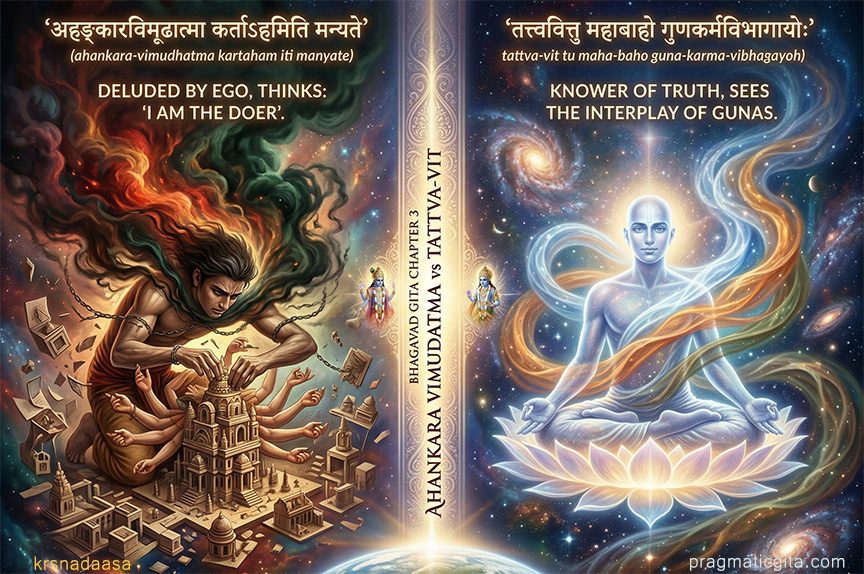
Actions in all respects are driven by the three modes of nature. But the person who is utterly deluded by ego, thinks ‘I am the doer’.
तत्त्ववित्तु महाबाहो गुणकर्मविभागयो: |
गुणा गुणेषु वर्तन्त इति मत्वा न सज्जते || 28||
tattva-vit tu mahā-bāho guṇa-karma-vibhāgayoḥ
guṇā guṇeṣhu vartanta iti matvā na sajjate
तत्त्ववित् (tattvavit) – the knower of truth; तु (tu) – but; महाबाहो (mahābāho) – O mighty-armed (Arjuna); गुणकर्मविभागयोः (guṇakarmavibhāgayoḥ) – of the differences of the modes of nature and their actions;
गुणाः (guṇāḥ) – the modes of material nature; गुणेषु (guṇeṣu) – in the modes; वर्तन्ते (vartante) – act; इति (iti) – thus; मत्वा (matvā) – thinking; न (na) – not; सज्जते (sajjate) – gets attached.
O mighty-armed (Arjuna), the knower of truth understands that the soul is distinct from guṇas and karmas. And those who know that the guṇas in the shape of the senses move among the guṇas in the shape of the objects of perception, do not get attached.
What the wise person does differently
Having established that the wise person acts without attachment, offering work as yajña directed toward loka-saṅgraha, Shri Krishna now turns the lens toward the person who has not yet awakened to this understanding. Such a person works, strives, plans, worries, reacts, and remains inwardly tied to outcomes at every step. Their mind keeps asking what will come to me from this, how will I be seen, whether I will gain or lose, whether I will be respected, appreciated, or left behind.
We tend to imagine that if someone has really understood life, that person will naturally lose interest in work, duty, family, and contribution. We imagine that outer disengagement is the proof of inner maturity. But Shri Krishna keeps correcting this. He does not approve of withdrawal from life. He points to something more refined. The wise person is not one who has escaped action. The wise person is one whose relationship with action has been purified.
Outwardly, the wise and the unwise may look similar. Both may be teaching, leading, serving, managing, earning, raising children, solving problems, or making difficult decisions. From the outside, they may both appear disciplined and engaged. But inwardly, one is acting from fear, attachment, comparison, and the scarcity mindset. While the other is acting from clarity, steadiness, and freedom from dependence on the fruit.
The unwise become bound by action. The wise become free through that very same action.
How extraordinary this teaching is. The action may look almost the same from the outside. Two people may both be working, serving, caring for family, fulfilling responsibilities, making difficult decisions, speaking, leading, helping, and carrying what life has placed before them. Outwardly, there may not be much difference at all.
But inwardly, they are not living the same life. One is becoming more entangled through action. The other is becoming lighter and free through the same action.
And that one difference changes the whole feel of life.
It changes whether work becomes a burden or an offering. It changes whether responsibility feels like pressure or privilege. It changes whether relationships become possession or service. It changes whether action leaves us inwardly tired and agitated, or inwardly purified and calm.
And this is where Shri Krishna’s teaching becomes so compassionate and so relevant. He does not place this truth in some distant spiritual world meant only for monks, recluses, or those who have walked away from normal life. He brings it right into the middle of life as we know it. Right into duty. Right into responsibility. Right into human relationships. And then He connects it to loka-saṅgraha.
Because when a person becomes inwardly more free, that freedom does not remain private. It begins to bless the world around them. When selfish clinging reduces, action becomes purer. When ego is no longer constantly trying to protect itself, prove itself, or complete itself, there is more room for sincerity. More room for steadiness. More room for patience. More room for compassion.
Such a person may still act firmly. They may still guide, protect, correct, and serve. But their presence does not create disturbance. The people around them feel less burdened by agitation, less burdened by emotional noise. Because they have stopped unconsciously spreading the tension of an ego that is always in conflict due to its insecurity.
That is why this teaching matters so much for us. It makes us introspect.
Is it saṅga, clinging, insecurity, possessiveness, fear, the need to be seen, the need to feel important, the need to stay in control, the need to protect an image? Or is our action becoming part of yajña, part of a sacred order in which what we do is an offering in such a way that karma does not bind you.
That is the key.
Bondage is not created just because action happens. Bondage is created when action gets mixed with egoic ownership, craving, fear, and self-definition. Action itself is not the problem. The problem begins when the ego enters and says this is my doing, my success, my failure, my image, my wound, my proof, my importance.
And once we truly understand this, even our questions begin to change.
Usually the question is what should I do. That question matters. But here another question becomes just as important. From what state of mind am I doing it?
What is moving this action right now?
Is it fear?
Is it vanity?
Is it guilt?
Is it resentment?
Is it insecurity?
Is it love?
Is it offering?
Is it duty?
Because karma-yoga begins there. Not only with the action, but with the inner place from which the action arises.
That is why karma-yoga is a profound path of purification. It allows the same work, the same responsibilities, the same family role, the same ordinary life to become a place of inner freedom rather than deeper bondage.
Then Shri Krishna says the wise should not create confusion in the minds of those who are still attached to action. The Sanskrit expression is buddhi-bheda, a splitting or fracturing of understanding.
This is such a compassionate instruction.
Because when we begin to understand even a little, there is often a temptation to speak too quickly. We feel we have seen something higher, and immediately we want to correct everyone. We want to point out lower motives. We want to speak the highest truth right away. We want to sound clear. We want to sound deep. But from inside, what feels like spiritual clarity may sometimes be nothing more than ahaṃkāra pretending to be spiritual and righteous.
Shri Krishna does not encourage that.
Because a truth given before it can be digested may cause more confusion than clarity. If someone is still learning discipline, steadiness, responsibility, and ethical living, and we suddenly give them the highest language of non-doership, the result may not be freedom at all. The immature mind can easily misuse a great teaching.
This happens very easily. For example:
A person hears that the Self does nothing and concludes then why should I make any effort?.
A person hears that all action belongs to the guṇas and says then nothing is really my responsibility.
A person hears about detachment and decides to become emotionally disengaged.
That is not wisdom. That is confusion trying to look like wisdom.
That is why Shri Krishna is advising that we should not try dictating a new way of life to these people who are not yet ready. We should instead continue doing our duties without attachment and leading by example. Gradually, these people will start following our example. Actions speak louder than words. And this is what Krishna is saying.
A great example is that of the Beatles musician George Harrison. The Beatles were the most popular band of all time and they had millions of fans all over the world. When George Harrison came to India and met Srila Prabhupada, he said he is interested in spirituality and if he should also shave his head and start living in the ashram.
Then Shrila Prabhupada used these verses we just discussed and instead advised George Harrison to use his musical talent to attract his followers towards Krishna consciousness. Because, whatever he does, his fans will follow. George Harrison went on to play a key role in bringing countless westerners on the path to Krishna consciousness. Just by getting into Krishna Consciousness himself and leading by example.
All actions are caused by the gunas
Then Shri Krishna takes us deeper. He says that all actions are performed by the guṇas of prakṛti, while the one whose mind is deluded by ahaṃkāra thinks, I am the doer. He uses rather strong language here:
प्रकृते: क्रियमाणानि गुणै: कर्माणि सर्वश: |
अहङ्कारविमूढात्मा कर्ताहमिति मन्यते || 27||
prakṛiteḥ kriyamāṇāni guṇaiḥ karmāṇi sarvaśhaḥ
ahankāra-vimūḍhātmā kartāham iti manyate
Actions in all respects are driven by the three modes of nature. But the person who is utterly deluded by ego, thinks ‘I am the doer’.
This goes right to the root of bondage.
Prakrteh kriyamanani gunaih. Shri Krishna is telling us something very deep here. All these karmas, all these actions, are being carried out by the gunas of prakrti, sattva, rajas, and tamas. These three gunas, through their endless combinations, shape the whole cosmos. And that same prakrti has shaped us also. Nature is active everywhere.
But what does a human being do?
The human being takes all these movements and claims them as their own. That is why Shri Krishna says ahankara-vimudhatma. The one whose mind is totally deluded by ahankara, by ego, says karta aham iti manyate. Such a person thinks, I am the doer.
This is the confusion.
Prakrti is functioning everywhere, within us and outside us. But the ego quickly comes in and takes ownership. It says I am choosing, I am doing, I am achieving, I am controlling, I am making everything happen. Shri Krishna is asking us to pause and look more deeply. Is that really so?
Vedanta asks us to understand prakrti better. In ordinary modern thinking, when people speak of nature, they usually mean only external nature, the outer world, matter, energy, physical processes. But Vedanta includes human nature also. So prakrti does not mean only the world outside. It also includes the body, the senses, the mind, the impulses, the emotional system, the patterns of conditioning, and even the faculty of intelligence as it expresses through the human being.
That is why later Shri Krishna will speak of two dimensions of prakrti. One is apara prakrti, the lower nature. The other is para prakrti, the higher nature. Apara prakrti includes the more external and material side of nature. Para prakrti is the higher principle that shines through as intelligence, awareness, and the possibility of freedom. Both are different dimensions of the same prakrti.
Even this body is part of that great play of prakrti. The chemistry and physics of the outer world appear inside us as biochemistry and biophysics. The body has its own order. The senses have their own movement. Hunger comes. Sleep comes. Fatigue comes. Attraction comes. Aversion comes. Hormones come. Emotions rise. All of them happen without our permission or active involvement.
Yet in the middle of all this, the ego stands up and says I am the doer of everything.
It is important to recognize how powerful prakrti is, both in the cosmos and in the human system.
So it is good to recognize this honestly.
Not to become fatalistic. Not to make excuses. Not to weaken effort.
But to understand where we actually stand.
Because Vedanta does not stop with saying all this is prakrti. It also tells us that within the human being there is also the possibility of rising beyond slavery to prakrti. That possibility begins through para prakrti, the higher nature, which expresses as intelligence, discernment, awakening, and the urge for spiritual freedom.
Animals are almost completely governed by nature. In them, prakrti predominates almost fully. But in the human being there is the possibility for complete freedom.
And that possibility is precious.
The whole purpose of spirituality, the whole purpose of Vedanta, is to strengthen and utilize that possibility.
If you observe, ego is not free. The waking ego disappears in sleep. Then a dream ego appears in the dream. Then even that disappears in deep sleep.
So how can such an ego be the source of freedom?
Behind the ego is something much deeper. Behind the ego is Atman, our own infinite divine nature. That alone is the true source of freedom. That alone is the true source of values. All real morality, all real ethics, all real dignity, all real spiritual strength draw their life from that deeper truth.
Until that awakening begins, much of life remains the play of prakrti.
First see clearly that prakrteh kriyamanani gunaih. Actions are being carried out by the gunas of prakrti.
Then see clearly that ahankara-vimudhatma karta aham iti manyate. The ego-deluded person says I am the doer.
And see clearly that ego is not as free as it imagines itself to be.
Then begins the real journey.
And that journey is not about fighting prakriti with arrogance. Shri Krishna will make this very clear again and again. The one who tries to defeat prakrti through ahankara only gets more deeply caught.
So the way forward is more intelligent, more patient, and more subtle.
We begin by understanding.
We begin by observing.
We begin by noticing the movements of prakrti within us.
We begin by seeing where sattva is present, where rajas is driving, where tamas is clouding.
We begin by recognizing how much of what we call I is really the movement of gunas.
And then slowly, steadily, with humility and sincerity, we begin to rise toward our higher truth.
Not through pride.
Not through self-assertion.
Not through spiritual vanity.
But through deeper understanding, deeper discipline, deeper sincerity, and awakening to our own real nature.
That real nature is Atman.
That is the source of freedom.
That is the source of values.
That is the source of dignity.
That is the source of spiritual strength.
So ordinarily, yes, we are subject to lower nature, apara prakrti. But we are not condemned to remain there. Through clarity, sadhana, and awakening, we can begin to live more and more from para prakrti. We can begin to rise above compulsion. We can begin to live with greater freedom, greater truth, greater value, and greater light.
This is the promise of the Gita.
This is the dignity of human birth.
And this is why Shri Krishna calls the egoistic attitude foolish. Because the ego says I am doing everything, while not even understanding the forces moving within it. The wise person sees more deeply. The wise person does not deny prakrti, but understands it. Does not worship ego, but sees through it. Does not stop at nature, but seeks the truth beyond nature.
And that is exactly where Shri Krishna now wants to take Arjuna in the next shloka.
In 3.28 Shri Krishna says: O mighty-armed (Arjuna), the knower of truth understands that the soul is distinct from guṇas and karmas. And those who know that the guṇas in the shape of the senses move among the guṇas in the shape of the objects of perception, do not get attached.
In the previous verse, Shri Krishna described the ahankara-vimudhatma, the one who is deluded by ego and therefore thinks, karta aham iti manyate, I am the doer. Now in this verse, He gives us the contrast. He shows us how the tattva-vit sees.
Tattva means the truth of a thing, its real nature. Shankaracharya explains it beautifully as tasya bhavah tattvam. The truth about a thing is called tattvam. And tattva-vit is one who knows that truth.
So what does such a person see?
Shri Krishna says that the tattva-vit knows the truth of guna-karma-vibhagayoho, the relationship between guna and karma, between the forces of nature and the actions that arise through them. Such a person sees clearly that gunah guneshu vartante. The gunas are moving among the gunas. Nature is interacting with nature. The field is moving within the field.
This is such a profound shift in vision.
What does it mean?
The gunas outside, in the world of objects, circumstances, conditions, and events, are interacting with the gunas inside, in the form of the body, senses, mind, tendencies, moods, and reactions.
Sattva, rajas, and tamas are at play outside us, and sattva, rajas, and tamas are at play inside us. The senses move toward their objects. Reactions arise. Thoughts arise. Likes and dislikes arise. The mind interprets. The body responds. The whole movement is gunah guneshu vartante, gunas interacting with gunas.
And the wise person sees this.
Shri Krishna says iti matva na sajjate. Knowing this, such a person does not get stuck or attached.
The ignorant person gets caught in the movement of the gunas and becomes a slave to them. The wise person sees the gunas as gunas and therefore is not bound by them in the same way. Detachment begins to arise. And with that detachment, a higher level of freedom begins.
The more we get entangled in ego-assessment, the more we become bound. I did this. I failed. I succeeded. I was insulted. I was appreciated. I was ignored. I was recognized. I must win. I must not lose. I must be seen in a certain way. All of this tightens bondage.
But the tattva-vit begins to see differently. They see how prakriti and the gunas play such a huge role in everything and how they are more of a participant than owners and doers.
This is why such a person can act with tremendous strength and yet remain inwardly free.
To conquer an enemy outside may look impressive. But to stand in the battlefield of life and not become inwardly conquered by attachment, that is a far greater victory. To act in the world and yet not be enslaved by praise and blame, gain and loss, success and failure, that is real strength. To remain steady while the arrows of attachment keep coming from all directions, that is the mark of a deeper warrior.
That is why Arjuna is being addressed as mahabaho (mighty-armed) here. It carries a deeper meaning. True might is not only outer power. True might is the strength to master one’s inner world. True heroism is not merely defeating others. True heroism likes in regulating one’s own mind, overcoming one’s own compulsions, and one’s own attachments.
The tattva-vit is such a hero.
Such a person knows that actions belong to the play of prakrti. The mind projects, the senses engage, the body acts, tendencies respond, and the gunas keep moving. Seeing this clearly, the wise person no longer carries the same anxiety over results. There is still care. There is still sincerity. There is still excellence in action. But there is less ego attachment.
This is why saints often speak in such a humble way. They say in essence, God is doing, but people think I am doing. The ego claims authorship, but the wise see divine order, prakrti, guna, karma, and the deeper presence of the Self behind all passing movements.
The wise person still acts. In fact, the wise person may act more beautifully, more cleanly, and more powerfully than the ego-bound person. Why? Because there is less inner distortion. Less insecurity. Less private agenda. Less craving. Less fear.
And the idea of the gunas itself is very profound. The whole universe is a play of energies. In one language we speak of sattva, rajas, and tamas. In another language, modern science speaks of fundamental forces of nature. Different systems use different terminology, but all serious inquiry is trying to understand the energies and laws through which the world functions.
The Gita speaks of these energies not only cosmically, but also in relation to the human being. That is why its vision is so practical. It does not stop with describing the universe outside. It shows us how these forces play through our own body, mind, and daily experience.
So 3.28 is not merely giving us another concept. It shows us the inner attitude of the wise person.
In practice, this means we begin observing the play of guṇas in everyday life.
When rajas is strong, the mind becomes urgent, restless, controlling, reactive, and impatient.
When tamas is strong, postponement, confusion, heaviness, dullness, and avoidance begin to take over.
When sattva is present, there is more space, proportion, calmness, and clarity.
This observation itself begins to transform us, because it introduces witnessing where earlier there was only blind personal identification. Instead of saying I am hopeless, I am broken, I am a failure, etc. we begin seeing more carefully that we have been influenced if not controlled by the gunas driven by prakriti.
That does not remove personal responsibility. It just makes responsibility more skillful and more mindful. We can learn to consciously navigate through these fields of nature without getting stuck within the maze they create.
And slowly, freedom begins to show itself in very simple ways.
A little less compulsion.
A little less self-importance.
A little less comparison.
A little more pause before reaction.
A little more humility when praised.
A little more steadiness when disappointed.
A little more honesty about what is really moving us.
These are not small things. These are signs that karma is loosening its grip on us.
And that will empower us to:
Act fully.
Care sincerely.
Fulfill dharma fearlessly.
That enables loka-saṅgraha in a very practical way. That is the path from bondage toward freedom.
And that is the vision Shri Krishna is patiently unfolding for Arjuna, step by step.
kṛṣṇadaasa
Servant of Krishna