 Pragmatic Gita

Chapter 4 – Jnana Karma Sanyasa Yoga – Find Purpose In Your Actions
If you have not already done so, I would request you to review the Chapter 3, Karma Yoga before studying chapter 4 as that would help set the right context.
You can find the explanation of the previous set of shlokas from chapter (3.39 to 3.43) here. Please go through that to get a better understanding and maintain continuity in your learning.
You can also listen to all the episodes through my Spotify Portal, Apple Podcast, and on YouTube as well.
Discussion Catalysts
Personal Reflection
Think about one responsibility in your life that has slowly become mechanical, something you used to do with meaning that now feels like autopilot. What understanding has gone missing? If you traced the original purpose behind that action, what would you rediscover, and what might change in how you approach it this week?
Philosophical Inquiry
Shri Krishna could have simply said, “Here is how to act wisely.” Instead, He traces this yoga back to Vivasvān, Manu, and Ikṣvāku, establishing a cosmic lineage. Why does He do this? What does it tell us about the nature of spiritual knowledge that it needs a lineage at all? And if such knowledge can be lost even when the words survive, what exactly is it that gets lost, and why?
Practical Application
Choose one daily responsibility, something as ordinary as preparing a meal, sitting down to work, or having a conversation with a family member. Design a small inner experiment for the coming week. Before beginning, consciously connect the action to a purpose beyond personal gain. After completing it, notice whether the inner quality of the experience changed. What did you observe about the relationship between understanding and the weight of duty?
Introduction to the 4th chapter:
In Sanātana Dharma, we don’t receive wisdom simply because it sounds new or clever or attractive. We receive it when we can trace it back to something eternal. When we can feel that it is connected to the same truth that our rishis realized, that our shastras have preserved, and that our paramparā has carried forward across thousands of years.
A teaching may be powerful. It may be practical. It may even be life-changing. But the sincere seeker will always ask, “Is this just someone’s personal opinion, or does it come from the same stream as the Vedas?”
This is Shraddha. A deep, earned trust in a tradition that has guided seekers for millennia. And it is this very shraddha that is now alive in Arjuna as we arrive at the fourth chapter.
To understand why, we need to look at what has already happened.
What Chapter 3 gave us
In Chapter 3, Shri Krishna gave a profound and transformative teaching on Karma Yoga. He did not present karma merely as outward action, duty, profession, or social responsibility. He lifted the entire idea of action to a sacred level. He taught Arjuna that action can become yajña, an offering. He showed that we do not live as isolated individuals, but as participants in a vast cosmic order. He explained that one must act without selfish attachment, not for personal gain alone, but for inner purification and for loka-saṅgraha, the welfare and stability of the world.
He showed Arjuna that we are not isolated individuals chasing our own little goals in our own little worlds. We are all woven into a vast, interconnected cosmic ecosystem. And when we act with awareness of this interconnection, when we stop making everything about personal gain, our actions contribute to loka-saṅgraha, the harmony and welfare of the entire world.
Then Shri Krishna went even deeper.
He addressed something that strikes at the very root of human suffering. He said that bondage does not come from action itself. Bondage comes from the false sense of doership. The guṇas of prakṛti, these three fundamental forces of nature, are constantly at work in our body, our mind, our senses. They are doing their thing. But the ego, the ahaṅkāra, steps in and claims ownership. “I did this. I achieved that. This success is mine. This failure is mine.” And this misidentification is the real trap.
He also gave Arjuna a very direct warning about kāma and krodha. Desire and anger, born from rajo-guṇa, are the great enemies of spiritual life. They cover wisdom the way smoke covers fire. They disturb the mind and pull even a sincere seeker off course.
So by the end of Chapter 3, Arjuna has received something extraordinary. He has been told to act, but not from ego. To fight, but not from hatred. To do his duty, but not for personal reward. To live fully in the world, but not get entangled by it.
The question that naturally arises
And so, naturally, something begins to stir in Arjuna. He is a devoted student of Vedānta. He has grown up revering the Vedic tradition. The wisdom of the rishis is not just something he has studied, it is something he has had great faith in.
Now Shri Krishna has given him this powerful, almost radical vision of Karma Yoga. And the question comes, as it would for any sincere seeker.
Is this something new? Is Shri Krishna creating a fresh philosophy to suit this particular crisis on this particular battlefield? Or is this the same ancient truth that Arjuna already trusts?
He is not doubting Shri Krishna. He is looking for that connection. He wants to know if and how Shri Krishna’s teaching connects with that eternal wisdom of the Vedas.
What Shri Krishna reveals
And Shri Krishna answers beautifully.
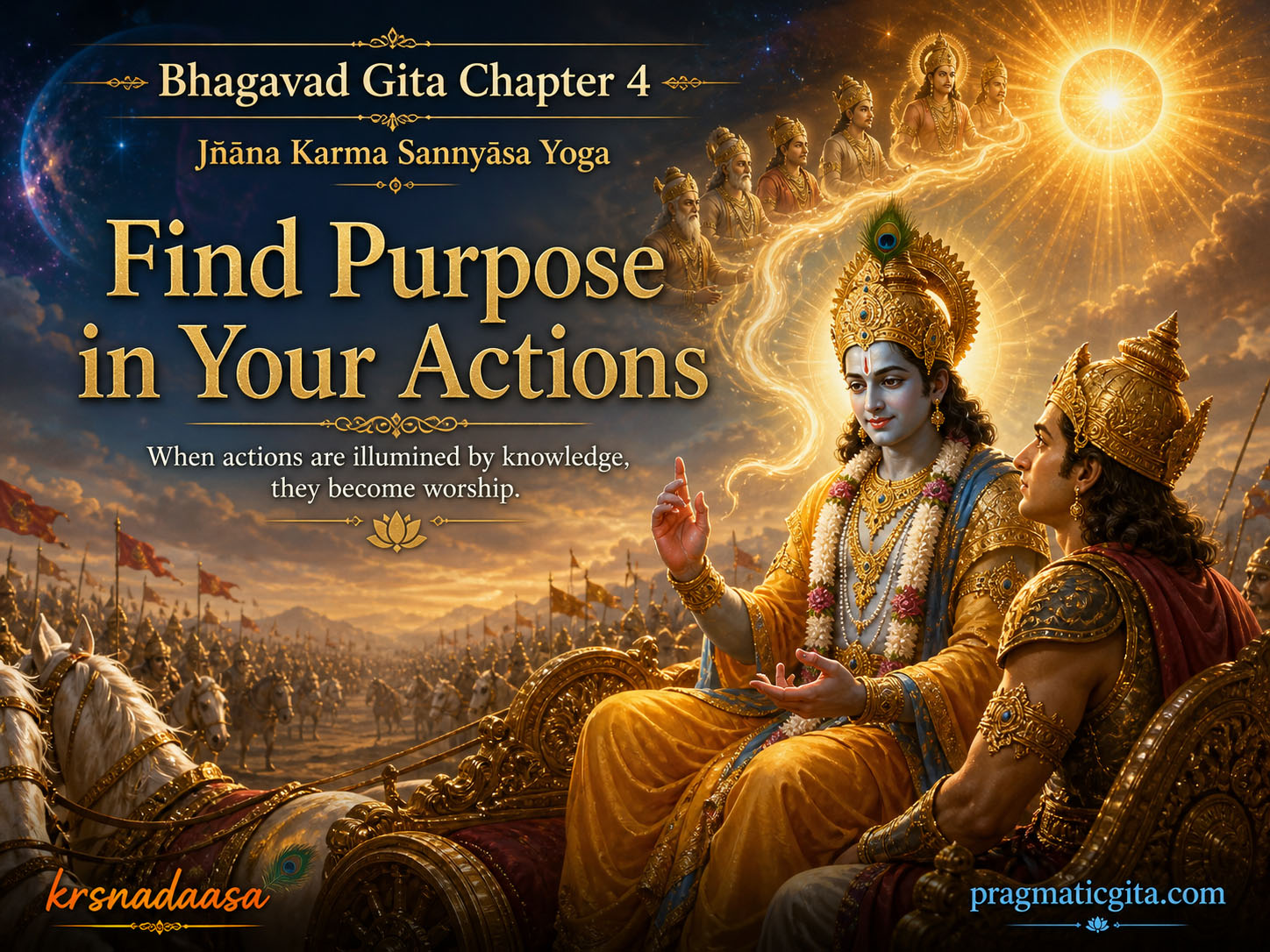
He says, this Yoga is not new. It is ancient. I taught it first to Vivasvān, the Sun God. Vivasvān passed it to Manu. Manu gave it to Ikṣvāku. It flowed through a sacred lineage, a paramparā, from teacher to student across ages. But over time, as the world changed and priorities shifted, this knowledge became weakened. It became obscured. It became forgotten.
And now, Shri Krishna says, I am giving it to you again. Not because I have just invented something, but because you are my friend, my devotee, and you are ready to receive what was always there.
This is very important.
Shri Krishna is not improvising. He is restoring. Think of it like a river that has been flowing underground for centuries. The surface has dried up, people have forgotten it was ever there, but the water has never stopped flowing. Shri Krishna is simply breaking open the ground so Arjuna can drink from it again.
And within this, He makes one thing absolutely clear. True Karma Yoga cannot stand on its own without Jñāna. Without understanding, even well-intentioned action becomes ego, ambition, restlessness, or bondage. We have all experienced this. We do the right thing but for the wrong reasons, and instead of freedom we feel exhaustion, resentment, or pride. But when knowledge illuminates action, everything changes. The same action becomes purification. It becomes worship. It becomes a path to liberation.
This is why the chapter is called Jñāna Karma Sannyāsa Yoga. It is about how knowledge transforms action from the inside out.
The sacred bond between guru and shishya
There is something else that begins to happen in this chapter, and it is very beautiful.
Arjuna loves Shri Krishna. He has always known Shri Krishna as his dear friend, his companion, his charioteer, someone he can speak to freely, laugh with, confide in. And that closeness is genuine. But because of it, there are moments when Arjuna forgets who is really sitting next to him. He forgets that this friend of his is also the Jagadguru. The teacher of the entire world.
In this chapter, Shri Krishna begins to gently open Arjuna’s eyes. He reveals that He is not just a wise friend offering advice on a difficult day. He is the one who comes into the world again and again, yuge yuge, whenever dharma weakens and adharma rises. He is the eternal source of all knowledge.
And something shifts between them. The friendship does not disappear. But now it is held by something deeper. Love is strengthened by shraddha. Closeness is strengthened by reverence. And that makes all the difference.
We can see this in our own lives. Ordinary knowledge can be transferred through information. A teacher explains, a student takes notes, and some content is understood. That works fine for school, for university, for professional training. But spiritual wisdom does not travel like that. It cannot simply be spoken and heard. It has to be offered by someone who has lived it, and received by someone whose heart is genuinely open and ready to receive.
Have we ever had a moment where someone told us something we had heard a hundred times before, but this time it made an impact? Not because the words changed, but because we were finally ready to hear them? That is what happens when the relationship between guru and shishya comes alive. The knowledge stops being information and starts becoming transformation. It moves from the ear to the heart. And once it reaches the heart, it changes how we see ourselves, how we act, and how we understand the presence of Bhagavān in our everyday life.
Where we stand now
So let us take a moment to see where we have come thus far.
Chapter 3 taught us how to act. Chapter 4 teaches us how to understand action.
Chapter 3 gave us the discipline of Karma Yoga. Chapter 4 gives us the knowledge that makes Karma Yoga spiritually alive and liberating.
Chapter 3 asked us to offer our actions as yajña. Chapter 4 shows us how jñāna itself becomes the fire that burns all bondage.
And this brings us to a question we can each ask ourselves, honestly, without judgement.
Am I acting out of habit? Out of pressure? Out of fear, desire, or social expectation? Or is there real understanding behind my actions?
Because this is what Shri Krishna is really teaching us.
When action is driven by ignorance, it binds.
When action is offered as yajña, it purifies.
When action is illuminated by knowledge, it liberates.
We may not be on Kurukṣetra. We may not have a bow in our hands. But every single day, we stand in the field of action. We make choices. We carry responsibilities. We face confusion. We wrestle with desire, comparison, fear, and emotional pressure. We want to do the right thing, but sometimes we are just not sure what the right thing is.
Chapter 4 tells us something very reassuring. Clarity does not come from doing more. It comes from understanding more deeply.
And when that understanding begins to guide our actions, something beautiful starts to happen. Work starts to feel less like a burden and more like an offering. Duty stops feeling heavy and starts feeling purposeful. Our relationships become a field where we learn and grow. Our struggles become opportunities for inner transformation. And slowly, gently, the very karma that once felt like chains around our ankles becomes the path we walk toward freedom.
Recap:
To find purpose in your actions is not about chasing motivation or rewriting your to-do list. It is about restoring the understanding that makes action meaningful from the inside. And that is exactly what Shri Krishna does for Arjuna in Bhagavad Gita 4.1 to 4.5.
Bhagavad Gita 4.1 to 4.5 Meaning – To come next
At the opening of Chapter 4, Shri Krishna reveals that this yoga was first given to Vivasvān, the Sun God, then passed to Manu, and through Manu to Ikṣvāku. This is the heart of the Bhagavad Gita 4.1 to 4.5 meaning. True wisdom is not invented for convenience. It is preserved, renewed, and received through paramparā, a living chain of teacher-to-student transmission. Arjuna needs to know that what he is receiving is not just good advice for a battlefield crisis. It belongs to the same sacred current that has guided seekers across ages. And this matters because wisdom disconnected from its source eventually becomes shallow, no matter how eloquently it is phrased.
Karma Yoga with Knowledge
Chapter 3 taught Arjuna to act without ego and to offer action as yajña. But Chapter 4 deepens this by adding the element that makes Karma Yoga spiritually alive. Karma Yoga with knowledge means we do not merely keep doing our duties mechanically. We begin to see why we act, who is truly acting, what binds us, and how action becomes purification rather than accumulation. Without this understanding, even sincere, disciplined work eventually becomes exhausting or ego-driven. With it, the same work becomes a field of inner freedom. This is how you find purpose in your actions without turning spiritual life into another self-improvement project.
How Knowledge Transforms Action
Why does action without understanding bind us? Because we may do the right thing outwardly while inwardly being driven by anxiety, pride, comparison, or craving for recognition. The outer form looks correct, but the inner experience is one of pressure rather than offering. The Gita helps us see how knowledge transforms action. It does not always change the task. It changes the consciousness behind the task. When jñāna illumines karma, the same responsibility that once felt heavy begins to feel purposeful. That is why you can find purpose in your actions not by changing what you do, but by understanding why you do it.
Guru Shishya Relationship in Gita
The guru shishya relationship in Gita becomes especially beautiful in these verses. Arjuna is not merely receiving information. He is beginning to recognize his dear friend as Jagadguru, the teacher of the entire world. The friendship does not disappear, but it is now held by something deeper, love strengthened by reverence, closeness strengthened by śraddhā. This is why paramparā is important in the Gita. Spiritual clarity in daily life does not come from clever ideas or downloaded content. It comes from living wisdom received with genuine openness from someone who has realized it.
Find Purpose in Your Actions Today
The ancient Yoga of action speaks directly to modern exhaustion and disconnection. Many people are busy, responsible, and outwardly productive, yet inwardly unanchored. To find purpose in your actions, try this. Pause before one daily responsibility and ask yourself honestly: Is this coming from fear, ego, habit, or offering? How can work become an offering today? When you find purpose in your actions through the teaching of Shri Krishna, duty stops being a burden you carry and becomes a path you walk toward freedom.
kṛṣṇadaasa
Servant of Krishna