 Pragmatic Gita
The Door That Opens Every Year
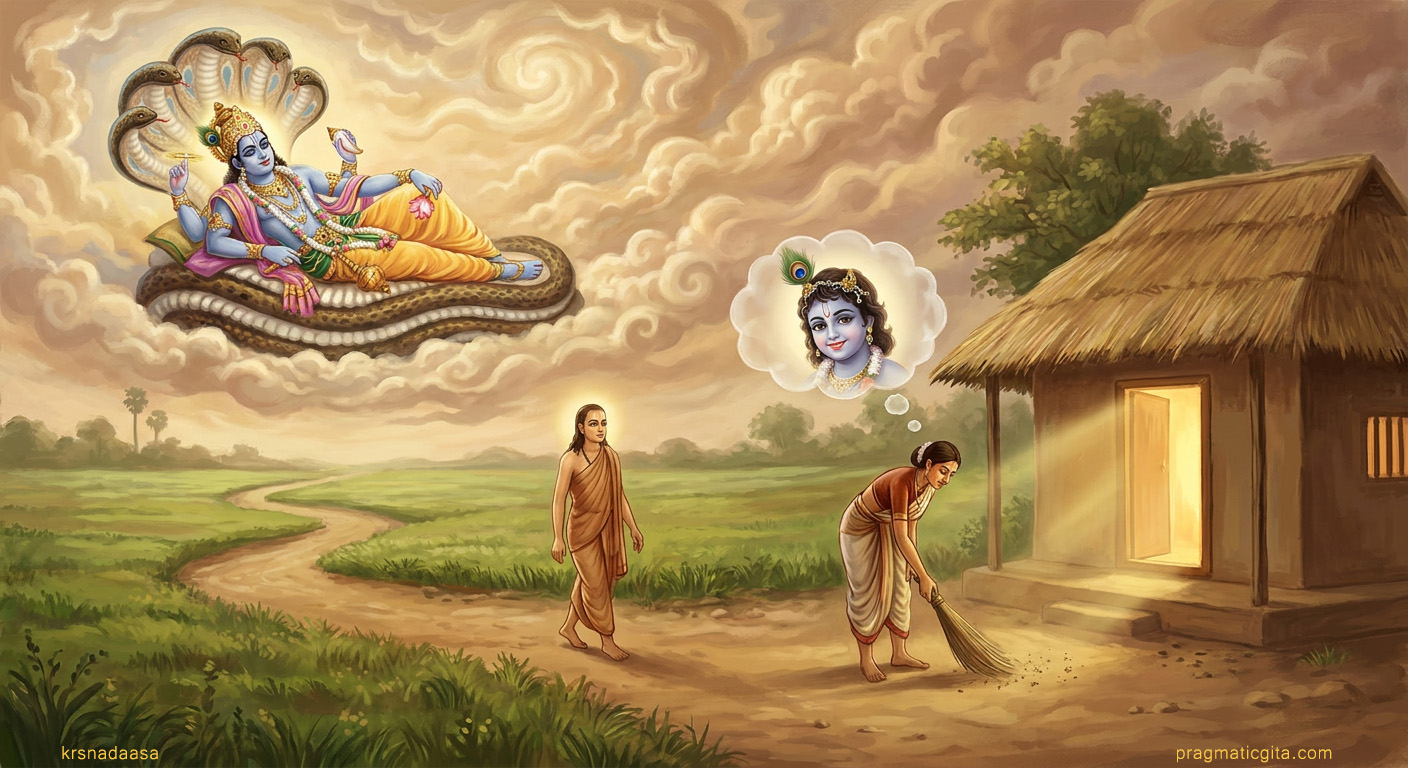
On the eleventh day of the bright fortnight of Ashadha, the Lord goes to sleep.
It is worth pausing to consider the deep meaning behind this profound event. The true Chaturmas spiritual significance begins on Devashayani Ekadashi. Tradition tells us that Bhagavan Vishnu lies down on the coils of Shesha and enters yoga nidra. For four months spanning Shravana, Bhadrapada, Ashwina, and Kartika, He remains in this peaceful state.
The world goes on around us while the Lord rests. We consciously pause our worldly activities during this time. We avoid marriages, delay griha pravesha ceremonies, and postpone great outward undertakings. The outward facing grace that carries these worldly events has turned inward, creating the perfect environment for deep Chaturmasya sadhana.
Many perceive this period as a time of immense generosity. It stands as a profound invitation. For four months of every single year, the entire cosmos turns its face inward, and you are warmly invited to turn inward along with it. Understanding this reveals the true Chaturmas spiritual significance.
A Space For Deep Transformation
Consider the profound focus that Chaturmasya sadhana creates in your life. The absence of auspicious muhurtas calling you outward allows for deep inner clarity. You have no large projects to build, nothing new to launch, and no worldly ceremonies pulling your attention away.
The tradition quietly discourages outward actions to give your inner journey undivided attention. This magnificent clearing allows you to explore the Chaturmas spiritual significance fully. The tradition has swept the room clean and left exactly one door open. This is the very same door we spend the other eight months of the year hurrying past.
The scriptures present this invitation with absolute clarity. The Hari Bhakti Vilasa gathers the Puranic injunctions regarding Chaturmas rules and practices. The text offers a very direct perspective.
यो विना नियमं मर्त्यो व्रतं वा जाप्यमेव वा ।
चातुर्मास्यं नयेन्मूर्खो जीवन्नपि मृतो हि सः ॥
That fool who passes Chaturmasya without niyama or vrata or japa is dead even while living. (Hari Bhakti Vilasa 15.116).
Jivann api mrito hi sah. Dead even while living. This fierce line stems from deep compassion and grief over lost opportunities. The door stands open every single year, and most people walk past it again and again for a whole lifetime. The verse mourns for our missed chances to experience the Chaturmas spiritual significance.
Bridging The Knowledge Gap
Let us explore the genuine purpose of Chaturmasya sadhana. Many dedicated seekers have studied a great deal. We have gone verse by verse through the Bhagavad Gita. We easily handle words like sthitaprajna, vairagya, and anasakti until they sit comfortably in our mouths. That work holds real and lasting value. Shri Krishna Himself calls svadhyaya a powerful form of tapas.
At the same time, we must acknowledge a common challenge. We often accumulate an enormous amount of knowledge while remaining exactly the same person. We might explain the three gunas beautifully, yet we still lose our temper at the same person over the same thing on the same evening. We might discourse on detachment while refreshing our inbox forty times waiting for a single reply.
We might know precisely what Krishna says about food, yet we continue to ignore proper Chaturmasya fasting and diet principles.
This gap between knowledge and action represents our core challenge. True understanding, known as Pratyakshavagamam, requires knowledge gained through direct personal experience. We must move beyond mere intellectual interpretation to achieve this deep realization. Additional information cannot close this gap.
We need a period of dedicated application, which is exactly why the Chaturmas spiritual significance is so profound. We must dedicate time to truly absorb the Chaturmas spiritual significance in our daily lives.
A verse in the Chandogya Upanishad from the Bhuma Vidya, the teaching Sanatkumara gives to Narada, quietly reorganizes our entire approach.
आहारशुद्धौ सत्त्वशुद्धिः सत्त्वशुद्धौ ध्रुवा स्मृतिः । स्मृतिलम्भे सर्वग्रन्थीनां विप्रमोक्षः ॥
When the food is pure, the being becomes pure. When the being is pure, memory becomes steady. On attaining that memory, there is release from all the knots. (Chandogya Upanishad 7.26.2).
Observe the profound simplicity of this verse. The path moves directly from food to freedom in three straightforward steps. We progress from ahara to sattva to smriti to the untying of every energetic knot. The chain requires no fourth step. The process completely bypasses the intellectual reading of books.
The Upanishad uses smriti, which means memory. The goal focuses entirely on remembering our true nature. We must awaken to what we already are. We simply suffer from forgetfulness, and purification serves as the ultimate cure. This makes proper Chaturmasya fasting and diet essential to the journey.
Chaturmasya sadhana offers an unparalleled gift. The tradition sets aside this specific season for us to stop adding external inputs and start subtracting them. We leave the books alone for a while and work instead on the physical and mental instrument that reads them. This focused internal work highlights the true Chaturmas spiritual significance.
Working From The Outside In
The practical genius of Chaturmas rules and practices becomes obvious when we look closely. These methods succeed beautifully where willpower alone falls short. We often treat ourselves as a single, uniform entity, yet we possess multiple complex layers. When the mind refuses to settle during a Chaturmas meditation practice, we often try to force the mind into submission.
We concentrate fiercely, hit a wall, and incorrectly conclude that we lack the proper temperament. In reality, the mind remains restless because the breath flows unevenly. The breath flows unevenly because the body suffers from inflammation. The body suffers from inflammation because of our dietary choices from the previous night. Trying to fix the mind directly resembles steadying a ladder by pushing on its very top.
The Taittiriya Upanishad provides a brilliant map. We exist as a series of nested sheaths. We have the annamaya kosha or the body of food, the pranamaya kosha or the body of breath and energy, the manomaya kosha or the mind, and even subtler layers. These sheaths interpenetrate seamlessly, much like heat permeating iron. A disturbance at any level immediately affects every other level.
Most importantly, a purification at any level actively assists all the other levels.
We achieve the best results by working from the outside in. We can easily decide what to put on our plate tonight. That mindful plate of food reaches and transforms the mind along the exact chain the Upanishad laid out. You simply take hold of the tangible elements you can control. You manage your food, your sleep, and the structure of your day, allowing these disciplines to carry you forward.
Many dedicated practitioners experience this exact phenomenon a few weeks into their Chaturmasya sadhana. They feel astonished when their Chaturmas meditation practice suddenly becomes effortless. They experience this ease because they transformed their dinner rather than forcing their meditation. This demonstrates the powerful, interconnected chain of Chaturmas spiritual significance at work.
Welcoming The Divine Guest
We must remember the ultimate goal behind the diet, the early rising, the breathing, and the strict Chaturmas rules and practices. These disciplines serve only as preparation.
Sage Narada beautifully defines our true objective in the second of his Bhakti Sutras with three powerful words. He uses parama prema rupa, meaning of the very nature of supreme love toward the Divine. This state consists entirely of love, exactly as a wave consists entirely of water.
These four sacred months aim to cultivate a living and loving relationship with the Divine. A human being is built specifically for this connection, yet we spend our whole lives arranging our schedules to avoid it. The Chaturmas spiritual significance points us back to our truest purpose. Embracing the Chaturmas spiritual significance transforms our daily routines into divine offerings.
Everything else functions simply as housekeeping. Keep this literal image in your heart, as it will carry you through October when the philosophical theory has worn thin.
Someone you deeply love is coming to your home.
This beautiful anticipation defines the entire Chaturmasya sadhana. You clean the house and wake up early because your beloved guest is arriving. You sweep the rooms and put away anything that might cause embarrassment. You become perfectly quiet so you will hear their footsteps at the door. You make the rooms ready, open the door, and offer everything you have. The material offerings matter very little, as the Divine comes solely for your love.
We clean a house in joyful anticipation of a guest. The sweetest word in the entire twelfth chapter of the Bhagavad Gita captures this beautifully. Shri Krishna says Nivasiṣyasi mayy eva, which means you will dwell in Me. The promise guarantees a permanent dwelling place.
We spend four months opening the door every single morning in the dark. We maintain our Chaturmas meditation practice regardless of our fleeting feelings, continuing this devotion until the experience transforms into a permanent state of dwelling.
Begin With Sincere Intent
The most important takeaway is that your Chaturmasya sadhana requires sincerity. Flawless execution was never the condition for success. Patanjali outlines the real conditions in a single sutra by emphasizing dirgha kala, nairantarya, and satkara. These translate to long, unbroken, and with reverence. The sutra focuses entirely on devotion and consistency.
I encourage you to simply begin. Simplify your meals following the Chaturmasya fasting and diet guidelines. Rise a little earlier each day. Take one honest vow and honor it without negotiation. Sit down each morning and turn inward. Maintain your Chaturmas meditation practice even for a few minutes, even with a wandering mind, and especially on the mornings when nothing at all seems to happen. Those challenging mornings hold the very core of your real practice.
The sacred door stands wide open from Devashayani Ekadashi all the way to Kartik Purnima. It will open again next year, and the year after, and every year after that. We must seize the opportunity while we have the vitality to see it open.
Make the powerful choice to walk through it this year and experience the Chaturmas spiritual significance for yourself.
If you would like the complete day by day practice, including the diet, the kriya sequence, the meditation and offering, and the full four month structure I follow with our community, I have written it all out in the Chaturmasya Sadhana Handbook, which is free to download.
Hare Krishna.
krsnadaasa, Servant of Krishna