 Pragmatic Gita
Five Creatures, One Lesson
Have you ever watched a moth circling a lamp late in the evening? It goes round and round, coming a little closer each time, and then it touches the flame. Nobody forced it there. It went willingly, because it loved what it saw.
Ādi Śaṅkarācārya uses this very moth, along with four other creatures, in one of the most memorable verses of the Vivekachudamani. Anyone who has ever tried to control the tongue, or any of the senses, will recognise themselves in it.
We have also discussed this in our Bhagavad Gita sessions here.
शब्दादिभिः पञ्चभिरेव पञ्च पञ्चत्वमापुः स्वगुणेन बद्धाः ।
कुरङ्गमातङ्गपतङ्गमीनभृङ्गा नरः पञ्चभिरञ्चितः किम् ॥śabdādibhiḥ pañcabhir eva pañca pañcatvam āpuḥ svaguṇena baddhāḥ
kuraṅga-mātaṅga-pataṅga-mīna-bhṛṅgā naraḥ pañcabhir añcitaḥ kimThe deer, the elephant, the moth, the fish and the bee each meet their death, bound by their own nature to just one of the five sense objects, beginning with sound. What then of the human being, who is held by all five? (Vivekachūḍāmaṇi 76)
Each of these creatures is a teacher, so let us look at them one by one. The kuraṅga, the deer, is so charmed by sweet sound that the hunter only has to play music, and the deer stands still to listen while the arrow comes. The mātaṅga, the wild elephant, is caught through touch, lured into a pit by its longing for the touch of a she-elephant. The pataṅga, the moth, is drawn by form and light straight into the flame. The mīna, the fish, bites the bait for its taste and swallows the hook along with it. And the bhṛṅga, the bee, loves the fragrance of the lotus so much that it lingers inside until evening, when the petals close and it is trapped.
One sense. That is all it took.
And what about us? We have all five, and all five are pulling at us at the same time. That is why Śaṅkara asks the question so pointedly. If one sense is enough to bring down a deer or an elephant, what chance do we have when all five are working together?
Śaṅkara does not leave it there. In the very next verse he tells us just how serious this really is.
दोषेण तीव्रो विषयः कृष्णसर्पविषादपि ।
विषं निहन्ति भोक्तारं द्रष्टारं चक्षुषाप्ययम् ॥doṣeṇa tīvro viṣayaḥ kṛṣṇa-sarpa-viṣād api
viṣaṃ nihanti bhoktāraṃ draṣṭāraṃ cakṣuṣāpy ayamIn its harmful effect, the sense object is more potent than even the venom of the black cobra. Poison kills only the one who swallows it, whereas the sense object destroys even the one who merely looks at it. (Vivekachūḍāmaṇi 77)
You see, a cobra’s venom has to enter the body before it can harm us. A sense object only has to enter the mind. One look, one fragrance, one taste remembered, and the whole chain of craving begins.
Of these five creatures, the fish deserves our closest attention. The fish stands for the tongue, and as so many of us have discovered in our own sādhana, the tongue is the hardest of all the senses to bring under control. Our great teachers knew this very well, and they had a great deal to say about it.
The Fish and the Hook
In the eleventh canto of the Śrīmad Bhāgavatam, Śrī Kṛṣṇa tells Uddhava the story of an Avadhūta, a wandering free soul who once met King Yadu. The king asked him how he had become so carefree and so full of joy. The Avadhūta replied that he had learned from twenty four gurus he found in nature, and one of those gurus was the fish.
जिह्वयातिप्रमाथिन्या जनो रसविमोहितः ।
मृत्युमृच्छत्यसद्बुद्धिर्मीनस्तु बडिशैर्यथा ॥jihvayāti-pramāthinyā jano rasa-vimohitaḥ
mṛtyum ṛcchaty asad-buddhir mīnas tu baḍiśair yathāBewildered by taste through the tongue, which agitates us so violently, a person of poor understanding goes to his death, just as the fish is caught by the hook. (Śrīmad Bhāgavatam 11.8.19)
Think about what the fisherman actually does. He never offers the fish a bare hook. No fish would touch it. He hides the hook inside something delicious, the fish sees only the bait, enjoys it for a moment, and by then it is too late.
Our cravings catch us in just the same way. Nobody sets out to choose suffering. We choose the sweet, the salty, the rich, the one more helping, and the hook is hidden inside. Heaviness of body, dullness of mind, ill health, and a craving that only grows stronger the more we feed it.
Look also at the word the Avadhūta uses for the tongue. Ati-pramāthinī, that which churns and agitates us violently. Kṛṣṇa uses the very same word, pramāthīni, in the Gītā when He describes how the senses can carry away the mind of even a wise person who is sincerely trying. So the tongue is not a small matter. It is the most turbulent of a turbulent family.
Why Fasting Alone Does Not Win
Next the Avadhūta tells King Yadu something that every honest sādhaka will recognise from experience.
इन्द्रियाणि जयन्त्याशु निराहारा मनीषिणः ।
वर्जयित्वा तु रसनं तन्निरन्नस्य वर्धते ॥indriyāṇi jayanty āśu nirāhārā manīṣiṇaḥ
varjayitvā tu rasanaṃ tan nirannasya vardhateThe wise quickly bring the senses under control by withholding their food, all except the tongue. For one who fasts, the craving of the tongue only grows. (Śrīmad Bhāgavatam 11.8.20)
Have we not all seen this? On a fasting day, the very day we have decided not to eat, the mind seems to think of nothing but food. We find ourselves planning tomorrow’s breakfast. A smell drifting over from the neighbour’s kitchen feels ten times stronger than usual. The body is fasting, whereas the tongue is feasting in the imagination.
Kṛṣṇa tells Arjuna exactly the same thing in the second chapter of the Gītā.
विषया विनिवर्तन्ते निराहारस्य देहिनः ।
रसवर्जं रसोऽप्यस्य परं दृष्ट्वा निवर्तते ॥viṣayā vinivartante nirāhārasya dehinaḥ
rasa-varjaṃ raso ‘py asya paraṃ dṛṣṭvā nivartateFor the embodied one who abstains, the sense objects fall away, but the taste for them remains. Even that taste falls away once he has seen the Supreme. (Bhagavad Gītā 2.59)
Rasa-varjam, except the taste. Such a small phrase, and yet so much depends on it. Kṛṣṇa is telling us that we can keep our hands away from something, we can keep it off our plate, and still the relish for it stays alive deep inside us. Śaṅkara, in his commentary on this verse, explains this rasa as the subtle rāga, the attachment that lingers even after the outer contact has stopped. That is why abstinence by itself is never the whole answer. Kṛṣṇa gives the real remedy in the very same breath, paraṃ dṛṣṭvā, on seeing the Supreme, and that remedy is the heart of this whole teaching.
Then Kṛṣṇa makes an admission that I find deeply comforting.
यततो ह्यपि कौन्तेय पुरुषस्य विपश्चितः ।
इन्द्रियाणि प्रमाथीनि हरन्ति प्रसभं मनः ॥yatato hy api kaunteya puruṣasya vipaścitaḥ
indriyāṇi pramāthīni haranti prasabhaṃ manaḥO son of Kuntī, the turbulent senses forcibly carry away the mind of even a wise person who is striving hard. (Bhagavad Gītā 2.60)
Even the wise. Even the one who is trying. If you have struggled with your senses and slipped again and again, you are in very good company. Kṛṣṇa is not shocked by our struggle. He expects it, and He speaks about it with great compassion.
At the same time, He warns us against a kind of false victory.
कर्मेन्द्रियाणि संयम्य य आस्ते मनसा स्मरन् ।
इन्द्रियार्थान्विमूढात्मा मिथ्याचारः स उच्यते ॥karmendriyāṇi saṃyamya ya āste manasā smaran
indriyārthān vimūḍhātmā mithyācāraḥ sa ucyateOne who holds back the organs of action but sits dwelling on the objects of the senses in his mind is deluded, and he is called a pretender. (Bhagavad Gītā 3.6)
Mithyācāra is a strong word, but Kṛṣṇa is not condemning the sincere seeker who struggles. He is speaking about the person who is satisfied with outer restraint while the inner indulgence carries on unchecked. Clenching the fist while the mind keeps on feasting is not the self control Kṛṣṇa is asking of us. You see, the senses cannot be won by force alone. Something deeper has to change.
When Taste Is Conquered, All Is Conquered
Then the Avadhūta speaks the words that give this whole teaching its title.
तावज्जितेन्द्रियो न स्याद्विजितान्येन्द्रियः पुमान् ।
न जयेद्रसनं यावज्जितं सर्वं जिते रसे ॥tāvaj jitendriyo na syād vijitānyendriyaḥ pumān
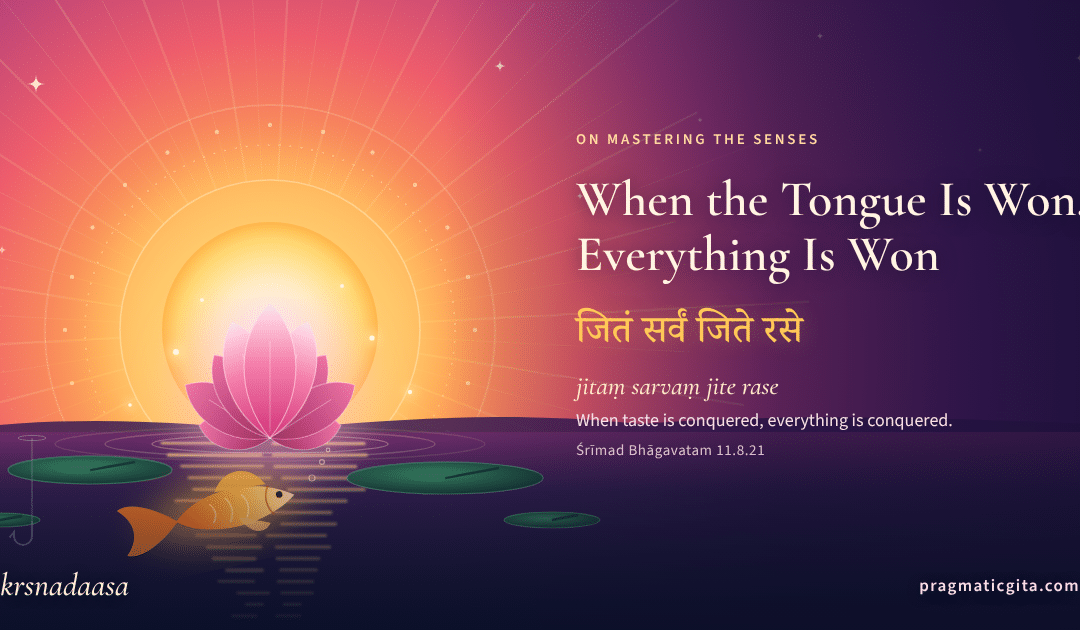
na jayed rasanaṃ yāvaj jitaṃ sarvaṃ jite raseA person may have conquered all the other senses, and still he cannot be called jitendriya, a master of the senses, until he has conquered the tongue. When taste is conquered, everything is conquered. (Śrīmad Bhāgavatam 11.8.21)
Jitaṃ sarvaṃ jite rase. What a promise! The Avadhūta is telling us that the tongue is not one sense among five. It is the key that opens the whole lock.
Why should the tongue be so special? Here is one beautiful reason our tradition gives. Every other sense has just one job. The eyes only see, the ears only hear, the nose only smells, the skin only feels. But the tongue has two jobs. It tastes, which makes it a jñānendriya, a sense of knowing, and it speaks, which makes it a karmendriya, an organ of action. It eats and it talks, and both can run wild.
That is why, in almost every tradition of sādhana, restraint of food and restraint of speech go together. The person who overeats very often overtalks as well, and the person who gossips freely rarely eats with discipline. When we train one side of the tongue, we usually find the other side growing steadier as well.
The Tongue and Our Deeper Hungers
Many of us have felt that the tongue is closely tied to sexual craving. When we eat heavily and indulgently, the mind grows restless, and the body starts hungering for other pleasures as well. Is this only a personal impression, or did our teachers see it too?
They saw it very clearly. Śrīla Rūpa Gosvāmī begins his Upadeśāmṛta with this verse.
वाचो वेगं मनसः क्रोधवेगं जिह्वावेगमुदरोपस्थवेगम् ।
एतान्वेगान्यो विषहेत धीरः सर्वामपीमां पृथिवीं स शिष्यात् ॥vāco vegaṃ manasaḥ krodha-vegaṃ jihvā-vegam
udaropastha-vegam etān vegān yo viṣaheta dhīraḥ sarvām apīmāṃ pṛthivīṃ sa śiṣyātThe steady person who can bear the urge to speak, the restlessness of the mind, the force of anger, and the urges of the tongue, the belly and the genitals, is fit to guide the whole world. (Upadeśāmṛta 1)
Look carefully at the order Rūpa Gosvāmī gives. Jihvā, udara, upastha. The tongue, the belly, the genitals. Teachers in the Gauḍīya line often explain that these three lie in a straight line in the body, and that an indulgence which begins at the top rarely stays at the top. When the tongue is pampered, the belly is overfilled, and an overfed body naturally starts looking for its next pleasure.
Kṛṣṇa gives us the deeper reason through the three guṇas. In the seventeenth chapter He describes the food that a rājasic person enjoys.
कट्वम्ललवणात्युष्णतीक्ष्णरूक्षविदाहिनः ।
आहारा राजसस्येष्टा दुःखशोकामयप्रदाः ॥kaṭv-amla-lavaṇāty-uṣṇa-tīkṣṇa-rūkṣa-vidāhinaḥ
āhārā rājasasyeṣṭā duḥkha-śokāmaya-pradāḥFoods that are too bitter, too sour, too salty, too hot, too pungent, too dry and burning are dear to the rājasic person, and they bring pain, sorrow and disease. (Bhagavad Gītā 17.9)
And in the third chapter He tells Arjuna where kāma, desire, is born.
काम एष क्रोध एष रजोगुणसमुद्भवः ।
महाशनो महापाप्मा विद्ध्येनमिह वैरिणम् ॥kāma eṣa krodha eṣa rajo-guṇa-samudbhavaḥ
mahāśano mahā-pāpmā viddhy enam iha vairiṇamIt is desire, it is anger, born of rajo-guṇa. It is the great devourer and the great sinner. Know this to be the enemy here. (Bhagavad Gītā 3.37)
Put these two verses side by side and the connection becomes plain to see. Rājasic food feeds rajas in us, and rajas is the very soil in which kāma grows. And look at the word Kṛṣṇa chooses for this desire. Mahāśana, the great eater, the one who is never full. Even His description of lust is the description of an appetite!
The physicians of Āyurveda give us a parallel understanding. Food, once digested, becomes rasa, the first of the seven dhātus or bodily tissues. That rasa is refined step by step into blood, flesh, fat, bone and marrow, until it finally becomes śukra, the reproductive essence. So in the traditional view, what we take in through the tongue becomes, at the very end, the energy that sexual desire draws upon. It is no accident that one word, rasa, means both taste and that first essence of the body.
So the link so many of us have felt is not imagined. The tongue and sexual craving are two ends of one stream. And the wisest place to tame any stream is near its source.
Waking Up the Charioteer
So how do we actually manage these senses? Our teachers never give us just one technique. They give us a whole way of living, layer upon layer, and the very first layer has nothing to do with the tongue at all. It has to do with the one who is holding the reins.
In the Kaṭha Upaniṣad, Yama teaches young Naciketā with one of the most famous images in all of Vedānta.
आत्मानं रथिनं विद्धि शरीरं रथमेव तु ।
बुद्धिं तु सारथिं विद्धि मनः प्रग्रहमेव च ॥ātmānaṃ rathinaṃ viddhi śarīraṃ ratham eva tu
buddhiṃ tu sārathiṃ viddhi manaḥ pragraham eva caKnow the Self as the master of the chariot, and the body as the chariot itself. Know the intellect as the charioteer, and the mind as the reins. (Kaṭha Upaniṣad 1.3.3)
इन्द्रियाणि हयानाहुर्विषयांस्तेषु गोचरान् ।
आत्मेन्द्रियमनोयुक्तं भोक्तेत्याहुर्मनीषिणः ॥indriyāṇi hayān āhur viṣayāṃs teṣu gocarān
ātmendriya-mano-yuktaṃ bhoktety āhur manīṣiṇaḥThe senses, the wise say, are the horses, and the sense objects are the roads they run upon. The Self joined with body, senses and mind is called the enjoyer. (Kaṭha Upaniṣad 1.3.4)
यस्तु विज्ञानवान्भवति युक्तेन मनसा सदा ।
तस्येन्द्रियाणि वश्यानि सदश्वा इव सारथेः ॥yas tu vijñānavān bhavati yuktena manasā sadā
tasyendriyāṇi vaśyāni sad-aśvā iva sāratheḥBut for one who has discernment and whose mind is always steady, the senses obey, like good horses obey a skilled charioteer. (Kaṭha Upaniṣad 1.3.6)
Picture a chariot with five powerful horses. If the charioteer is asleep, or distracted, or drunk, the horses will go wherever the greenest grass is. They are not evil. They are simply horses, doing what horses do. But when the charioteer is awake and the reins are firmly in hand, those very same horses carry the master safely home.
The tongue is one of those horses. Shouting at the horse does very little. What really changes things is waking up the charioteer, the buddhi, so that it remembers who the master is and where the journey is meant to end. That is why svādhyāya, regular study of scripture, and satsaṅga, the company of fellow seekers, are not luxuries in sense control. They are how the charioteer stays awake.
Catching the Craving at the First Thought
Kṛṣṇa gives Arjuna a very precise map of how a craving grows, step by step, from one small thought into complete ruin.
ध्यायतो विषयान्पुंसः सङ्गस्तेषूपजायते ।
सङ्गात्सञ्जायते कामः कामात्क्रोधोऽभिजायते ॥dhyāyato viṣayān puṃsaḥ saṅgas teṣūpajāyate
saṅgāt sañjāyate kāmaḥ kāmāt krodho ‘bhijāyateWhen a person dwells on the objects of the senses, attachment to them is born. From attachment comes desire, and from desire comes anger. (Bhagavad Gītā 2.62)
क्रोधाद्भवति सम्मोहः सम्मोहात्स्मृतिविभ्रमः ।
स्मृतिभ्रंशाद्बुद्धिनाशो बुद्धिनाशात्प्रणश्यति ॥krodhād bhavati sammohaḥ sammohāt smṛti-vibhramaḥ
smṛti-bhraṃśād buddhi-nāśo buddhi-nāśāt praṇaśyatiFrom anger comes delusion, and from delusion the loss of memory. When memory is lost, the intellect is destroyed, and when the intellect is destroyed, the person is lost. (Bhagavad Gītā 2.63)
Where does the whole chain begin? Not with eating. It begins with dhyāyataḥ, with dwelling. With thinking about the object again and again.
This is so true of the tongue. The real battle is rarely fought at the dinner table. It is fought an hour earlier, when we start imagining that particular dish, remembering how it tasted last time, planning where we might get it. By the time the plate is in front of us, the outcome has usually been decided already. So the wisest place to stand guard is at that very first thought. A craving that is caught as a thought is like a small spark, easily put out. A craving that has been fed for an hour is already a fire.
Kṛṣṇa adds one more honest truth in the third chapter.
इन्द्रियस्येन्द्रियस्यार्थे रागद्वेषौ व्यवस्थितौ ।
तयोर्न वशमागच्छेत्तौ ह्यस्य परिपन्थिनौ ॥indriyasyendriyasyārthe rāga-dveṣau vyavasthitau
tayor na vaśam āgacchet tau hy asya paripanthinauAttraction and aversion are firmly seated in every sense toward its objects. One should not come under their sway, for they are highwaymen on the path. (Bhagavad Gītā 3.34)
Kṛṣṇa does not say that liking and disliking will simply disappear. They are stationed, vyavasthitau, in every sense. Our tongue will go on liking some things and disliking others for a long time. What Kṛṣṇa asks is that we do not come under their sway. We can feel the pull and still decline to follow it. That freedom, small as it seems at first, is where real mastery begins.
The Middle Path at the Dinner Table
After hearing all this, some of us might be tempted to go to the other extreme. Let me starve the tongue completely, we think, and then it will have no power over me. But Kṛṣṇa gently stops us right there.
नात्यश्नतस्तु योगोऽस्ति न चैकान्तमनश्नतः ।
न चातिस्वप्नशीलस्य जाग्रतो नैव चार्जुन ॥nāty-aśnatas tu yogo ‘sti na caikāntam anaśnataḥ
na cāti-svapna-śīlasya jāgrato naiva cārjunaO Arjuna, yoga is not for the one who eats too much, nor for the one who does not eat at all. It is not for the one who sleeps too much, nor for the one who stays awake too long. (Bhagavad Gītā 6.16)
युक्ताहारविहारस्य युक्तचेष्टस्य कर्मसु ।
युक्तस्वप्नावबोधस्य योगो भवति दुःखहा ॥yuktāhāra-vihārasya yukta-ceṣṭasya karmasu
yukta-svapnāvabodhasya yogo bhavati duḥkha-hāFor one who is moderate in eating and recreation, balanced in action, and regulated in sleep and waking, yoga becomes the destroyer of sorrow. (Bhagavad Gītā 6.17)
Yukta-āhāra, balanced eating. Not feasting, not starving. Remember what the Avadhūta told us. Harsh fasting alone only makes the tongue hungrier. So Kṛṣṇa is not asking us to fight the body. He is asking us to befriend it, to give it what it truly needs, and to stop giving it what it merely wants.
And here is something lovely that we often miss. Look at how Kṛṣṇa describes sāttvic food.
आयुःसत्त्वबलारोग्यसुखप्रीतिविवर्धनाः ।
रस्याः स्निग्धाः स्थिरा हृद्या आहाराः सात्त्विकप्रियाः ॥āyuḥ-sattva-balārogya-sukha-prīti-vivardhanāḥ
rasyāḥ snigdhāḥ sthirā hṛdyā āhārāḥ sāttvika-priyāḥFoods that increase life, purity, strength, health, happiness and contentment, that are flavourful, nourishing, sustaining and pleasing to the heart, are dear to the sāttvic person. (Bhagavad Gītā 17.8)
Rasyāḥ, flavourful! Kṛṣṇa never asks us to eat tasteless food as a punishment. Sāttvic food is delicious food. It is simply food that leaves us lighter, clearer and more peaceful afterwards, instead of heavy, dull and craving more. That is a test any of us can apply at our next meal. How do I feel an hour after eating this?
Pure Intake, Pure Mind
In the Chāndogya Upaniṣad, Sanatkumāra is teaching Nārada, and near the very end of that long teaching he gives a beautiful sequence.
आहारशुद्धौ सत्त्वशुद्धिः सत्त्वशुद्धौ ध्रुवा
स्मृतिः स्मृतिलम्भे सर्वग्रन्थीनां विप्रमोक्षः ।āhāra-śuddhau sattva-śuddhiḥ sattva-śuddhau
dhruvā smṛtiḥ smṛti-lambhe sarva-granthīnāṃ vipramokṣaḥWhen the intake is pure, the inner being becomes pure. When the inner being is pure, memory becomes firm. When that memory is gained, all the knots of the heart are loosened. (Chāndogya Upaniṣad 7.26.2)
What is this āhāra, this intake? Here our two great ācāryas give us two readings, and both are precious. Rāmānujācārya takes it in its plain sense, as the purity of the food we eat. Śaṅkarācārya reads it more widely. For him āhāra is everything that is gathered in, āhriyate iti āhāraḥ, through all the senses. What we see, what we hear, what we touch and smell, as well as what we taste.
We do not have to choose between them. We can hold both. The food on our plate matters, and so do the films we watch, the conversations we join, and the things we scroll through late at night. All of it is āhāra. All of it becomes the substance of our mind.
And look at what Sanatkumāra promises at the end. Dhruvā smṛtiḥ, a steady remembrance. In the bhakti tradition this is the remembrance of the Lord, the constant awareness of the Beloved. So pure intake is not an end in itself. We purify what we take in so that we can remember Him, and in that remembrance the knots of the heart are loosened.
Every Meal an Offering
Up to now, almost everything we have discussed is about restraint. Here Kṛṣṇa turns restraint into something warm and positive. He asks us not merely to control our eating but to transform it.
यज्ञशिष्टाशिनः सन्तो मुच्यन्ते सर्वकिल्बिषैः ।
भुञ्जते ते त्वघं पापा ये पचन्त्यात्मकारणात् ॥yajña-śiṣṭāśinaḥ santo mucyante sarva-kilbiṣaiḥ
bhuñjate te tv aghaṃ pāpā ye pacanty ātma-kāraṇātThe good, who eat what remains after yajña, are freed from all faults. But those who cook only for their own sake truly eat sin. (Bhagavad Gītā 3.13)
पत्रं पुष्पं फलं तोयं यो मे भक्त्या प्रयच्छति ।
तदहं भक्त्युपहृतमश्नामि प्रयतात्मनः ॥patraṃ puṣpaṃ phalaṃ toyaṃ yo me bhaktyā prayacchati
tad ahaṃ bhakty-upahṛtam aśnāmi prayatātmanaḥWhoever offers Me with devotion a leaf, a flower, a fruit or a little water, that offering of love from a pure heart I accept. (Bhagavad Gītā 9.26)
Think of what happens when food becomes prasāda. Before, the meal was for me, for my pleasure, for my tongue. Now the meal is first for Him, and I receive what remains as His grace. The tongue is no longer the master of the meal. It becomes a servant at a sacred act.
And something very practical happens too. When we pause to offer, even for a few seconds, the gap between craving and grabbing grows wider. That small gap is exactly where the charioteer wakes up. Very often, we find we simply want less. Not because we are fighting the craving, but because the whole meal has taken on a different meaning.
A Higher Taste
Now we can return to those two words Kṛṣṇa spoke in the second chapter. Paraṃ dṛṣṭvā. The taste falls away on seeing the Supreme. This is the deepest answer our teachers give, and it is a very hopeful one.
Think of a child who loves a cheap plastic toy. You can take the toy away, and the child will cry and keep asking for it. But give that child something far more wonderful, and the old toy is forgotten without a single tear. Nobody had to fight the child’s attachment. The child simply forgot the smaller joy once a greater one was in hand.
That is exactly how Kṛṣṇa wants us to win over the senses. Not by killing taste, but by finding a higher taste. Right after the verse on rasa, He says this.
तानि सर्वाणि संयम्य युक्त आसीत मत्परः ।
वशे हि यस्येन्द्रियाणि तस्य प्रज्ञा प्रतिष्ठिता ॥tāni sarvāṇi saṃyamya yukta āsīta mat-paraḥ
vaśe hi yasyendriyāṇi tasya prajñā pratiṣṭhitāRestraining all of them, one should sit in yoga, devoted to Me as the Supreme. For one whose senses are under control, wisdom is firmly established. (Bhagavad Gītā 2.61)
Mat-paraḥ, devoted to Me. Rāmānujācārya, in his commentary, explains that without fixing the mind on the Lord, the senses simply cannot be subdued by our own effort. That is why Kṛṣṇa places these two words right in the middle of a verse about restraint. Self control and devotion are not two separate projects. Devotion is what makes self control possible.
And what is this higher taste? The ṛṣis of the Taittirīya Upaniṣad give it a name.
रसो वै सः । रसꣳ ह्येवायं लब्ध्वाऽऽनन्दी भवति ।
raso vai saḥ, rasaṃ hy evāyaṃ labdhvānandī bhavati
He indeed is rasa. Having attained that rasa, one becomes full of bliss. (Taittirīya Upaniṣad 2.7.1)
Raso vai saḥ. He Himself is rasa, the very essence of sweetness. All along, the tongue has been searching for rasa. It just has been searching in the wrong places! The whole spiritual life could be described as turning the search toward its true object.
Śrīla Rūpa Gosvāmī tells us something remarkable about where this turning begins.
अतः श्रीकृष्णनामादि न भवेद्ग्राह्यमिन्द्रियैः ।
सेवोन्मुखे हि जिह्वादौ स्वयमेव स्फुरत्यदः ॥ataḥ śrī-kṛṣṇa-nāmādi na bhaved grāhyam indriyaiḥ
sevonmukhe hi jihvādau svayam eva sphuraty adaḥThe holy name, form and qualities of Śrī Kṛṣṇa cannot be grasped by the material senses. But when one turns toward service, beginning with the tongue, He reveals Himself of His own accord. (Bhakti-rasāmṛta-sindhu 1.2.234)
Jihvādau, beginning with the tongue. Of all the senses, Rūpa Gosvāmī names the tongue first. The very sense that dragged the fish onto the hook becomes the first doorway to the Lord. When the tongue tastes prasāda and chants the holy name, it is still enjoying rasa. It has simply found the rasa that never leaves us hungry.
Isn’t that beautiful? In bhakti, nothing is wasted. The tongue is not our enemy to be destroyed. It is a servant waiting for the right Master.
Guarding the Speaking Tongue
We said earlier that the tongue has two jobs. So far we have spoken mostly about tasting. But Kṛṣṇa also gives us a beautiful discipline for the speaking tongue, which He calls the austerity of speech.
अनुद्वेगकरं वाक्यं सत्यं प्रियहितं च यत् ।
स्वाध्यायाभ्यसनं चैव वाङ्मयं तप उच्यते ॥anudvega-karaṃ vākyaṃ satyaṃ priya-hitaṃ ca yat
svādhyāyābhyasanaṃ caiva vāṅ-mayaṃ tapa ucyateSpeech that causes no agitation, that is truthful, pleasant and beneficial, along with the regular practice of studying scripture, is called the austerity of speech. (Bhagavad Gītā 17.15)
Four qualities, and all four together. Truthful, but also kind. Kind, but also genuinely helpful. And never disturbing to others. That is a high standard, isn’t it? Most of us would speak far less if we checked each sentence against these four!
And that is exactly the point. When we speak less, and speak more carefully, the whole tongue becomes calmer. This is why our sages have always valued mauna, the practice of silence. With even one hour of silence a day, or a quiet meal eaten without chatter, we give the tongue a rest from both of its jobs at once. Many seekers find that on the days they guard their speech, guarding their eating becomes noticeably easier too.
The Nectar Śaṅkara Prescribes
We began with Śaṅkara’s warning, and it is only fitting that we end with his medicine. A few verses after the five creatures, he gives the seeker this advice.
मोक्षस्य काङ्क्षा यदि वै तवास्ति त्यजातिदूराद्विषयान्विषं यथा ।
पीयूषवत्तोषदयाक्षमार्जवप्रशान्तिदान्तीर्भज नित्यमादरात् ॥mokṣasya kāṅkṣā yadi vai tavāsti tyajātidūrād viṣayān viṣaṃ yathā
pīyūṣavat toṣa-dayā-kṣamārjava-praśānti-dāntīr bhaja nityam ādarātIf you truly long for liberation, keep sense objects far away from you, as you would poison. And with loving care, drink every day, as if it were nectar, contentment, compassion, forgiveness, straightforwardness, calmness and self control. (Vivekachūḍāmaṇi 84)
Look at how wise this is. Śaṅkara does not leave us with an empty space where our cravings used to be. He fills that space with nectar. Toṣa, contentment. Dayā, compassion. Kṣamā, forgiveness. Ārjava, straightforwardness. Praśānti, deep calm. Dānti, self control.
Of all these, toṣa, contentment, is perhaps the most direct medicine for the tongue. After all, what is craving? It is simply the feeling that what I have right now is not enough. The moment we are content, the hook loses its bait. There is nothing left to bite.
Bringing It Into Our Daily Lives
So what does all this mean for us, on an ordinary Tuesday, standing in front of the fridge late at night?
If we gather everything our teachers have told us, we find three movements working together. First, we understand, so the charioteer is awake. Second, we restrain gently and with moderation, so the horses do not run wherever they please. And third, we redirect, so the senses have something higher to enjoy. Without that third movement, the first two rarely last. That is exactly what the Avadhūta warned us about when he spoke of the fasting tongue that only grows hungrier.
Here are a few simple ways to begin.
- Offer before you eat. When we offer the meal, even for a few seconds, it becomes prasāda, and the charioteer has time to wake up.
- Catch the first thought. When you find yourself imagining a particular food, that is the moment to choose, not later at the table.
- Ask the sāttvic question. How will I feel an hour after eating this? Lighter and clearer, or heavy and craving more?
- Keep one small vow you can sustain. Ekādaśī, a Cāturmāsya observance, or simply giving up one item you know has a hold on you. Small and joyful is better than grand and short lived.
- Rest the speaking tongue. With a little mauna each day, or one quiet meal, we steady both jobs of the tongue at once.
- Give the tongue its higher work. The holy name, kīrtana, reading scripture aloud, kind words to someone who needs them.
And please be patient with yourself. Remember that even the wise, Kṛṣṇa says, are carried away by the senses at times. Each time we slip, we simply pick up the reins again. That too is sādhana.
The fish does not lose its life because it eats. It loses its life because it cannot tell the food from the hook. Mastering the tongue, in the end, is simply learning to tell the difference, and then discovering a sweetness that has no hook in it at all.
Raso vai saḥ. He is that sweetness.
krsnadaasa
(Servant of Krishna)