 Pragmatic Gita
Journey From Jnana to Dharma to Karma: Karma Yoga
Here is the gist of what these verses explain. You can find the verses, translations and detailed explanations below this section:
The third chapter of the Bhagavad Gita opens with one of the most psychologically honest moments in spiritual literature. Arjuna, having received the soaring vision of Chapter 2, now stands with a question that burns. If Sankhya, the path of knowledge, reveals the eternal Atman beyond all change, and if Buddhi Yoga leads to steady wisdom, then why this insistence on terrible action? The Bhagavad Gita 3.1 3.2 meaning unfolds from this very tension, revealing the journey from jnana to dharma to karma that every sincere seeker must walk.
Arjuna’s Confusion in Chapter 3: The Honest Question
In verses 3.1 and 3.2, Arjuna speaks with striking candor. He uses the phrase vyamishreneva vakyena, telling Krishna that his words seem mixed or contradictory. The meaning of vyamishreneva vakyena points to genuine bewilderment rather than complaint. Arjuna has heard Krishna praise the stillness of the sthita prajna. He has absorbed the teaching that weapons cannot cut the Self and fire cannot burn it. And yet Krishna urges him toward war.
Why does Krishna urge Arjuna to fight after delivering such transcendent teaching? This question is not Arjuna being difficult. It is the natural result of deeply hearing a teaching and then facing the demands of embodied life. Arjuna asks for the path to Shreyas or Ultimate Good, wanting clarity about which direction leads to liberation.
From Deha Buddhi to Atma Buddhi: The Inner Shift
Chapter 2 established the fundamental error that underlies all confusion. Arjuna had been operating from Deha Buddhi, identification with the body, which made the battlefield appear as a site of irreversible destruction. Krishna’s teaching aimed to shift him toward Atma Buddhi, identification with the Self that cannot be destroyed.
But intellectual understanding is not the same as lived realization. Arjuna grasped the teaching of Sankhya. He understood that the Atman is nitya, eternal, and avinashi, indestructible. Yet understanding alone does not dissolve the pull of duty and the weight of circumstance. The movement from Deha Buddhi to Atma Buddhi requires more than hearing. It requires integration through action.
This is precisely why Krishna emphasizes action after knowledge. Buddhi Yoga, the yoga of intellect, is not meant to remain abstract. It must flow into Nishkama Karma, desireless action, where the insights of discrimination become the foundation for transformed engagement with the world.
Is Renunciation Better Than Action?
Arjuna’s question carries a subtle hope. Having heard Krishna describe the peace of the wise, part of him wonders whether he can simply renounce the battlefield and retreat into contemplation. Is renunciation better than action? This is the question that many seekers ask when spiritual teachings seem to point toward withdrawal.
Krishna will address this directly as Chapter 3 unfolds. The answer is nuanced but clear. True renunciation is not the abandonment of action but the abandonment of craving. The one who acts without attachment, who performs duty as offering rather than transaction, is the true renunciate even while fully engaged. Learning how to practice nishkama karma daily becomes the practical key that unlocks this teaching.
The confusion Arjuna experiences is described in Chapter 2 as dharma sammudha chetah, a mind bewildered about duty. How to overcome dharma sammudha chetah is the very purpose of Chapter 3. The answer lies not in choosing between knowledge and action but in understanding how they unite.
How Do Jnana, Dharma, and Karma Fit Together?
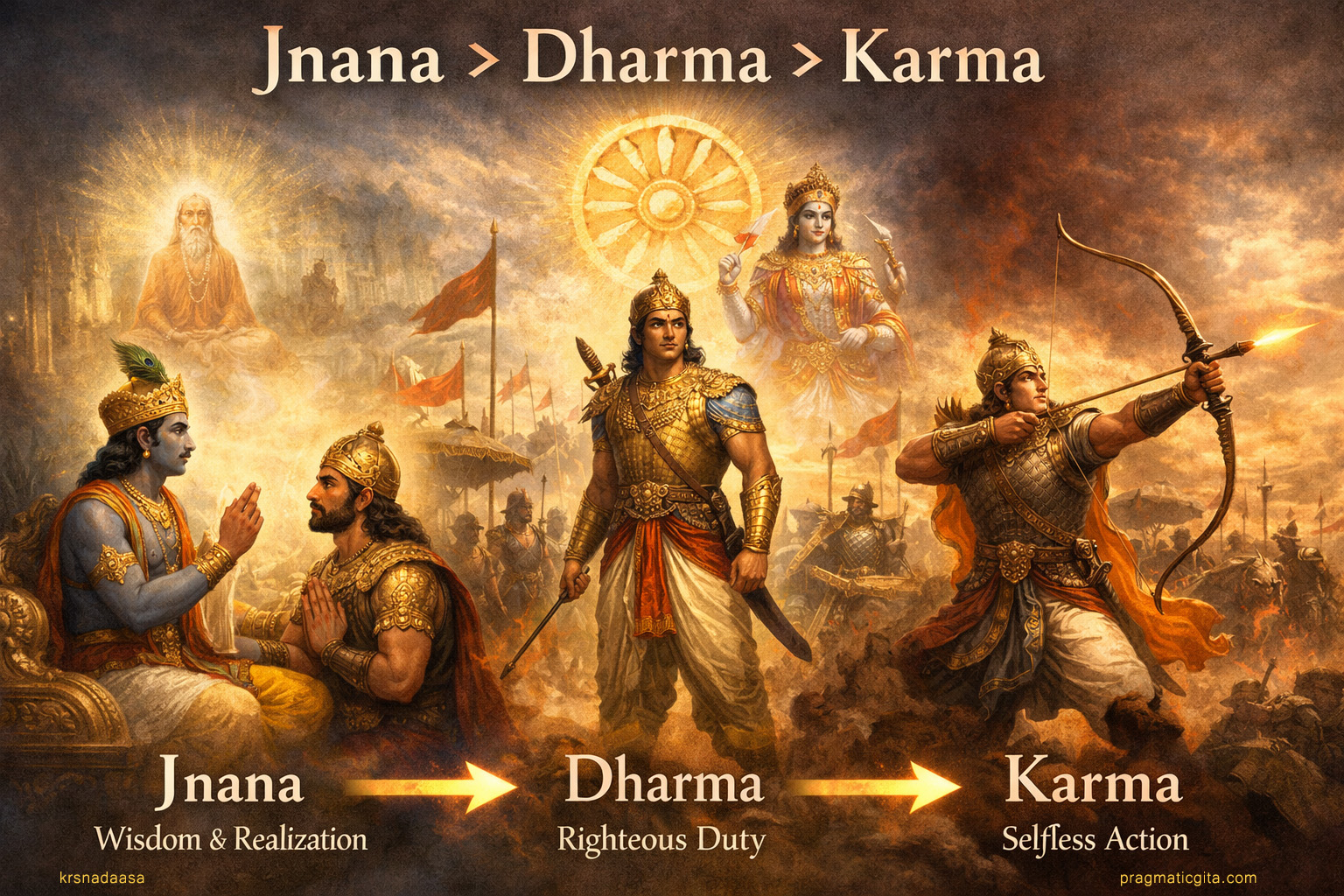
The from jnana to dharma to karma meaning points to an organic progression rather than separate compartments. Jnana is the clear seeing that distinguishes the eternal from the passing. Dharma is the recognition of what is ours to do given our nature and circumstances. Karma is the actual doing, the engagement with life that can bind or liberate depending on the inner orientation.
Why does Krishna tell Arjuna to act after teaching knowledge? Because knowledge that remains only in the head has not completed its journey. It must descend into the hands and feet. It must inform how we meet our obligations, relationships, and choices. The path to Shreyas or Ultimate Good runs through the integration of seeing and doing.
What is the meaning of Gita 3.1 and 3.2? These verses are the hinge between vision and practice. They honor the genuine confusion of a sincere student while setting the stage for the teaching that will resolve it. Chapter 3 exists because Arjuna had the honesty to ask what many seekers feel but hesitate to voice. And in that asking, the deeper teaching of Karma Yoga becomes possible.
If you have not already done so, I would request you to review the Chapter 2, Sankya Yoga before studying chapter 3 as that would help set the right context.
You can also listen to all the episodes through my Spotify Portal. And here on YouTube as well.
Keywords: from jnana to dharma to karma, Sankhya (Path of Knowledge), Buddhi Yoga (Yoga of Intellect), Nishkama Karma (Desireless Action), Arjuna’s confusion in Chapter 3, meaning of vyamishreneva vakyena, path to Shreyas or Ultimate Good, from Deha Buddhi to Atma Buddhi, from jnana to dharma to karma meaning, Bhagavad Gita 3.1 3.2 meaning, why Krishna emphasizes action after knowledge, how to practice nishkama karma daily, Why does Krishna urge Arjuna to fight?, Is renunciation better than action?, How to overcome dharma sammudha chetah, Why does Krishna tell Arjuna to act after teaching knowledge?, What is the meaning of Gita 3.1 and 3.2?, How do jnana, dharma, and karma fit together?
Chapter 3 – Karma Yoga
Recap of Chapter 2 From Deha Buddhi to Atma Buddhi
Have you ever received advice where every individual sentence sounded perfectly sensible, but when you tried to put everything together, you were left wondering, “So what exactly am I supposed to do?”
That is more or less where Arjuna finds himself at the beginning of the third chapter.
And this is one of the things I find so beautiful about the Bhagavad Gita. Arjuna’s questions are very often our questions. He becomes confused at precisely the places where we are likely to become confused. He does not simply accept everything passively because Krishna has spoken. When something does not make sense to him, he asks. When two teachings appear contradictory, he requests Shri Krishna to explain how they fit together.
So as we enter Chapter 3, let us stand beside Arjuna, because the question he is about to ask is one that almost every sincere spiritual seeker eventually encounters.
Before we can understand his question, however, we need to remember what he and all of us have heard thus far.
Chapter 2 began with Arjuna completely overwhelmed. The great warrior who had entered the battlefield prepared to fight suddenly put down his Gāṇḍīva. His mind was flooded with grief, attachment and confusion. He could no longer determine what was right. Finally, he reached the point where he admitted that his own reasoning was no longer helping him.
He turned to Krishna and said,
śiṣyas te ‘haṁ śādhi māṁ tvāṁ prapannam
“I am Your disciple. I surrender to you. Please instruct me.”
That was an important turning point.
Shri Krishna accepted his request immediately and started imparting divine wisdom.
He told Arjuna that his grief arose partly because he had confused the temporary body with the eternal Self. The body changes, ages and eventually dies, but the Ātman is not born and does not die.
na jāyate mriyate vā kadācit
The Self is never born and never dies.
Shri Krishna therefore began by shifting Arjuna’s identity. Before deciding how to act, Arjuna first had to understand who the real “I” is.
But Shri Krishna did not stop with metaphysics. He gradually brought the teaching back into the world of action.
He explained Arjuna’s dharma as a warrior. He introduced buddhi yoga, bringing right understanding into action. He taught equanimity in success and failure. And then came perhaps one of the most famous teachings of the entire Gita,
karmaṇy evādhikāras te mā phaleṣu kadācana
Your responsibility is toward the action, never toward controlling the fruit of that action.
But there is another part of that verse which we sometimes forget, and it becomes especially important as we enter Chapter 3.
mā te saṅgo ‘stv akarmaṇi
Do not become attached to inaction.
Shri Krishna had already planted the seed of what was to come.
He was not teaching Arjuna to become indifferent to life. He was not telling him to avoid responsibility. He was teaching him the right way to engage in action.
Krishna then told him,
samatvaṁ yoga ucyate
Equanimity is yoga.
And,
yogaḥ karmasu kauśalam
Yoga is skill in action.
So already in Chapter 2, action and spiritual wisdom were being brought together.
Then, toward the end of the chapter, Shri Krishna shifted the discussion again and gave us that magnificent description of the sthitaprajña, the person of steady wisdom.
This person is not constantly pushed and pulled by the world. Desires no longer dominate the mind. Pleasure does not carry such a person away, and pain does not completely disturb that inner balance. The senses are disciplined. The mind has developed steadiness.
Shri Krishna also showed Arjuna how easily that steadiness can be lost.
When the mind repeatedly dwells upon sense objects, attachment develops. From attachment comes desire. When desire is obstructed, anger arises. From anger comes delusion, then confusion of memory, loss of discrimination, and eventually one loses oneself.
This is one of the most psychologically powerful teachings in Chapter 2 because Shri Krishna is showing us that our downfall begins inside the mind.
And finally, Shri Krishna brought Chapter 2 to an extraordinary conclusion.
eṣā brāhmī sthitiḥ pārtha
“This, O Pārtha, is the state of being established in Brahman.”
A mind that is no longer tossed about by every desire and circumstance. A person established in wisdom. Someone who can move through life without continually losing inner balance.
But imagine being Arjuna at this point.
He has heard Krishna praise wisdom, detachment, control of the senses, freedom from desire and the person who is established in the Self. Shri Krishna has spoken about rising above pleasure and pain. He has spoken about the limitations of action performed merely for worldly rewards. He has described the sthitaprajña whose mind has withdrawn from dependence upon sense objects.
And at the same time, Shri Krishna continues telling Arjuna to stand up and fight.
So Arjuna is left thinking, “Krishna, what exactly are You asking me to do?”
If wisdom is so important, why action?
If detachment is the ideal, why involvement?
If the highest person has become inwardly free from worldly desires, why are You asking me to enter this terrible war?
This is the confusion with which Chapter 3 begins.
And then he says,
“Your words seem mixed to me. They seem to confuse my understanding. Please tell me decisively the one path by which I can attain the highest good.”
There is something very human in that request.
“Just tell me one thing.”
How often do we want the same thing from spiritual teachings?
Just give me one clear rule.
Should I act or should I renounce?
Should I remain involved or withdraw?
Should I pursue worldly responsibilities or renounce everything?
Should I engage with people or seek solitude?
We like specific answers because they save us the trouble of using our own viveka.
There is also something subtle in Arjuna’s language here which is worth noticing. He uses the word iva, “as if” or “it seems,” twice. Your words seem mixed. You seem to be confusing me.
Arjuna does not arrogantly say, “Krishna, You are contradicting Yourself.”
There is enough humility in him to recognize that perhaps the contradiction is not in Krishna’s teaching. Perhaps the contradiction exists in his own understanding of it.
That is the mark of a sincere student.
When we encounter something in the Gita that does not immediately fit our understanding, our first reaction should not be, “This does not make sense.” We can also ask, “What am I not yet seeing?”
And in Arjuna’s case, there is another layer to the confusion.
We should remember that Arjuna entered this conversation already wanting to avoid the battle.
Before surrendering to Shri Krishna as a disciple, he had given many reasons why fighting would be wrong. Some were emotional, some ethical, some social, and some even sounded spiritual.
So as Krishna was teaching him, part of Arjuna was probably still listening for something that would validate the conclusion he had already reached.
When Krishna spoke about detachment and the person who has withdrawn the senses, Arjuna could easily hear that as support for his own preference.
“Exactly. Why fight? Let me renounce all of this.”
But then Krishna would again bring him back to action.
This tendency is not unique to Arjuna.
We do it too.
Sometimes we go to a teacher, friend or counsellor saying that we want guidance, while somewhere inside we already know what we want to hear. We listen selectively. We notice the part of the advice that agrees with us and quietly ignore the part that challenges us.
Sometimes we think we are asking for guidance when what we really want is validation.
And scripture can also be used in exactly the same way.
If we already want to do something, we can often find a verse somewhere that appears to support it. If we want to avoid something difficult, we may call it detachment. If we do not want to confront somebody, we may call it tolerance. If we do not want to perform our duties, we may call it renunciation.
The mind is extremely clever at giving spiritual names to its preferences.
That is why Arjuna’s confusion is so useful for us.
Shri Krishna now has to clarify a fundamental distinction which Arjuna has not yet fully understood.
There is a difference between renouncing action and renouncing attachment within action.
Arjuna is still thinking largely in terms of an external choice. Either I fight or I renounce.
Shri Krishna is going to move the discussion inward.
The important question is not merely what we are doing externally. The more important question is what is happening within us while we do it.
Most of us naturally imagine that spirituality requires a trouble-free life. We think, “If only I had fewer responsibilities, fewer difficult people around me, fewer duties, fewer financial pressures, then I could be spiritual.”
Perhaps we imagine some future stage of life when everything will settle down and become perfect.
Then I will spend time on meditating, studying the Gita or even have time for Bhagavān.
But what if the life we already have is not necessarily standing in the way of spiritual growth?
What if it is the very field in which spiritual growth will happen?
Just like a seed thinking that it will sprout when there is no dirt or wetness around it. Without realizing that it is that dirt (soil) and water that is going to help is sprout.
This is the direction in which Chapter 3 begins to take us.
We may be sitting quietly in one room while replaying an argument from three days ago, worrying about money, imagining what somebody thinks of us, etc.
Outwardly, there is very little activity.
Inwardly, there is tremendous action.
So simply doing less does not automatically create freedom.
And the opposite is also true. Being active does not automatically make us non-spiritual.
A person can be deeply engaged with life and yet gradually develop inner detachment.
This is where Karma Yoga becomes extremely practical.
Karma Yoga does not simply mean performing lots of actions. We are already doing that.
Working hard and being busy is not automatically Karma Yoga.
Doing good deeds like charity is not automatically Karma Yoga.
Something has to change within us while performing the action.
Normally, our actions are strongly tied to expectation.
“I am doing this, therefore I should get that.”
And once we become psychologically attached to the result, our peace becomes dependent upon the result.
If people respond the way I want, I am happy. If they do not, I am disturbed.
If my plan works, I feel successful. If it fails, I may begin questioning myself, or even Bhagavān.
Very quickly, the action itself becomes secondary. The mind becomes occupied by the fruit.
Think about how much of our anxiety arises because we are trying to control outcomes which are never entirely under our control.
This is why Chapter 3 is so important for people like us.
Most of us are not going to leave our families, professions and responsibilities behind.
Nor is Krishna asking us to manufacture an artificial spiritual life separate from the life we already have.
We already have a field in which to practise.
- Our work reveals our attachments.
- Our relationships reveal our expectations.
- Difficult people reveal the condition of our mind.
- Success reveals our ego.
We should not ask, “How do I escape these situations so that I can become peaceful?”
The more useful question is, “What is this situation teaching me about my own mind?”
This is where Chapter 3 begins.
Chapter 2 showed us the ideal of the sthitaprajña, the person whose wisdom has become steady.
But we should not imagine that one day we simply wake up and become such a person.
That steadiness has to be cultivated. And it is cultivated while engaging with life.
That is why Arjuna’s question is so important.
He thinks Krishna is asking him to choose between wisdom and action.
Shri Krishna is going to show him how action itself can become the path to wisdom?
Arjuna wants Krishna to give him one simple answer.
Shri Krishna is going to give him something much more valuable.
He is going to teach him how to live.
Verses 3.1 and 3.2
अर्जुन उवाच |
ज्यायसी चेत्कर्मणस्ते मता बुद्धिर्जनार्दन |
तत्किं कर्मणि घोरे मां नियोजयसि केशव || 3.1||
arjuna uvācha
jyāyasī chet karmaṇas te matā buddhir janārdana
tat kiṁ karmaṇi ghore māṁ niyojayasi keśhava
jyāyasī (ज्यायसी) – better; cet (चेत्) – if; karmaṇas (कर्मणस्) – than fruitive action; te (ते) – your; matā (मता) – opinion; buddhiḥ (बुद्धिः) – intellect; janārdana (जनार्दन) – O maintainer of all living entities; tat (तत्) – then; kiṁ (किं) – why; karmaṇi (कर्मणि) – in action; ghore (घोरे) – terrible; mām (माम्) – me; niyojayasi (नियोजयसि) – do You engage; keśava (केशव) – O Keshava.
व्यामिश्रेणेव वाक्येन बुद्धिं मोहयसीव मे |
तदेकं वद निश्चित्य येन श्रेयोऽहमाप्नुयाम् || 3.2||
vyāmiśhreṇeva vākyena buddhiṁ mohayasīva me
tad ekaṁ vada niśhchitya yena śhreyo ’ham āpnuyām
vyāmiśreṇa (व्यामिश्रेण) – with equivocal; iva (इव) – as if; vākyena (वाक्येन) – with words; buddhiṁ (बुद्धिं) – intellect; mohayasī (मोहयसी) – You are bewildering; me (मे) – my; tad (तत्) – that; ekam (एकम्) – one; vada (वद) – please tell; niścitya (निश्चित्य) – conclusively; yena (येन) – by which; śreyaḥ (श्रेयः) – the ultimate good; aham (अहम्) – I; āpnuyām (आप्नुयाम्) – may achieve.
Arjuna said: O Janardana, if You consider knowledge superior to action, then why do You ask me to wage this terrible war? My intellect is bewildered by Your contradictory advice. Please tell me decisively the one path by which I may attain the highest good.
This confusion is not a failure on Arjuna’s part. It is exactly the question that must be asked if the teaching is to go deeper. In this chapter, Shri Krishna will resolve this apparent tension by revealing that wisdom and action are not opposites.
The truly wise do not act out of compulsion or craving, but for the welfare of the world. This is loka-saṅgraha. And the one who acts without ego, without attachment, without craving for results, even while engaged in the most intense activity, remains inwardly free.
Shri Krishna has explained jñāna, the path of knowledge, with such clarity, and he has praised the stillness of the sthita-prajña with such authority, that Arjuna now feels a tension between what appears to be two different paths.
On one side he thinks the teachings ask him to practice inner withdrawal, renunciation, and solitude. On the other side, Shri Krishna repeatedly urges Arjuna to perform rightful action, to align with his svadharma and fight, and insisting that choosing inaction is not right.
Arjuna’s confusion is the very confusion that arises when a sincere seeker tries to integrate transcendental wisdom into their own lives. Arjuna here asks for clarity, what is the right direction that leads to shreya, the highest good.
Arjuna had already leaned toward withdrawal before Shri Krishna spoke. He wished to renounce the battlefield, not out of spiritual realization, but out of emotional exhaustion, fear of consequence, and the unbearable weight of grief. When Shri Krishna spoke of inner peace, withdrawal from sense objects, and freedom from desire, Arjuna heard validation of his own reluctance. That is human tendency. We always hear what we like to hear, not necessarily what is actually being said.
Yet Shri Krishna skillfully clarifies Arjuna’s apparent confusion. He refuses to allow Arjuna to confuse weakness with detachment. This refusal and firmness forces the student to mature, to rise beyond self-justification, and to see the truth clearly.
Chapter 2 is primarily Shri Krishna’s teaching, delivered to a student who is still recovering from emotional collapse. By Chapter 3, Arjuna has regained enough steadiness to question, to examine, and to seek clarity on how he should put the teachings to practice.
The teacher-student relationship deepens into the classical Vedantic mode, where humble and sincere inquiry is the instrument by which clarity is born. Shri Krishna will go on to provide clarity on few key questions like:
- How do jñāna and karma relate?
- How does inner realization coexist with outer duty?
- How can one be established in the Self and still move through the material world that is full of obligations and duties?
Open-Floor Discussion Questions
These questions are designed to be “safe” yet provocative. They don’t require Sanskrit knowledge to answer, but the answers will reveal if the students understood the philosophy.
- The “Gandiva” Moment “In the text, Arjuna’s bow slips from his hand because his anxiety became physical. We all have a physical ‘tell’ when we are overwhelmed by shoka (grief) or stress. For some, it is a tight chest; for others, it is a migraine or shaky hands. What is your physical signal that you have fallen into deha-buddhi? How can you use that physical symptom as an alarm bell to wake yourself up?”
- The “If I Don’t Care, Will I Fail?” Debate “Krishna teaches nishkama karma, acting without desire for the fruit. A common fear is that if we stop craving the result (the ‘A’ grade, the promotion, the money), we will lose our motivation and become lazy. Do you agree or disagree? Can you be intensely ambitious about the process while being indifferent to the outcome? Has anyone here ever tried that?”
- The Modern Tortoise “We talked about the sthita-prajna withdrawing their senses like a tortoise. In 2024, our ‘sense objects’ are mostly digital. Be honest, what is the one app, website, or habit that drags your mind away against your will? If you had to apply the ‘tortoise technique’ to that specific thing for 24 hours, what exactly would you have to do? Would it be painful?”
- The Cost of Anger “Krishna warns that anger leads to smriti-bhramsha—loss of memory. This doesn’t mean amnesia. It means forgetting who you are and what you value in the heat of the moment. Can you share a time when anger made you say something you immediately regretted? In that moment, what ‘knowledge’ did you lose access to? How long did it take for your buddhi (intelligence) to come back online?”
kṛṣṇadaasa
Servant of Krishna