

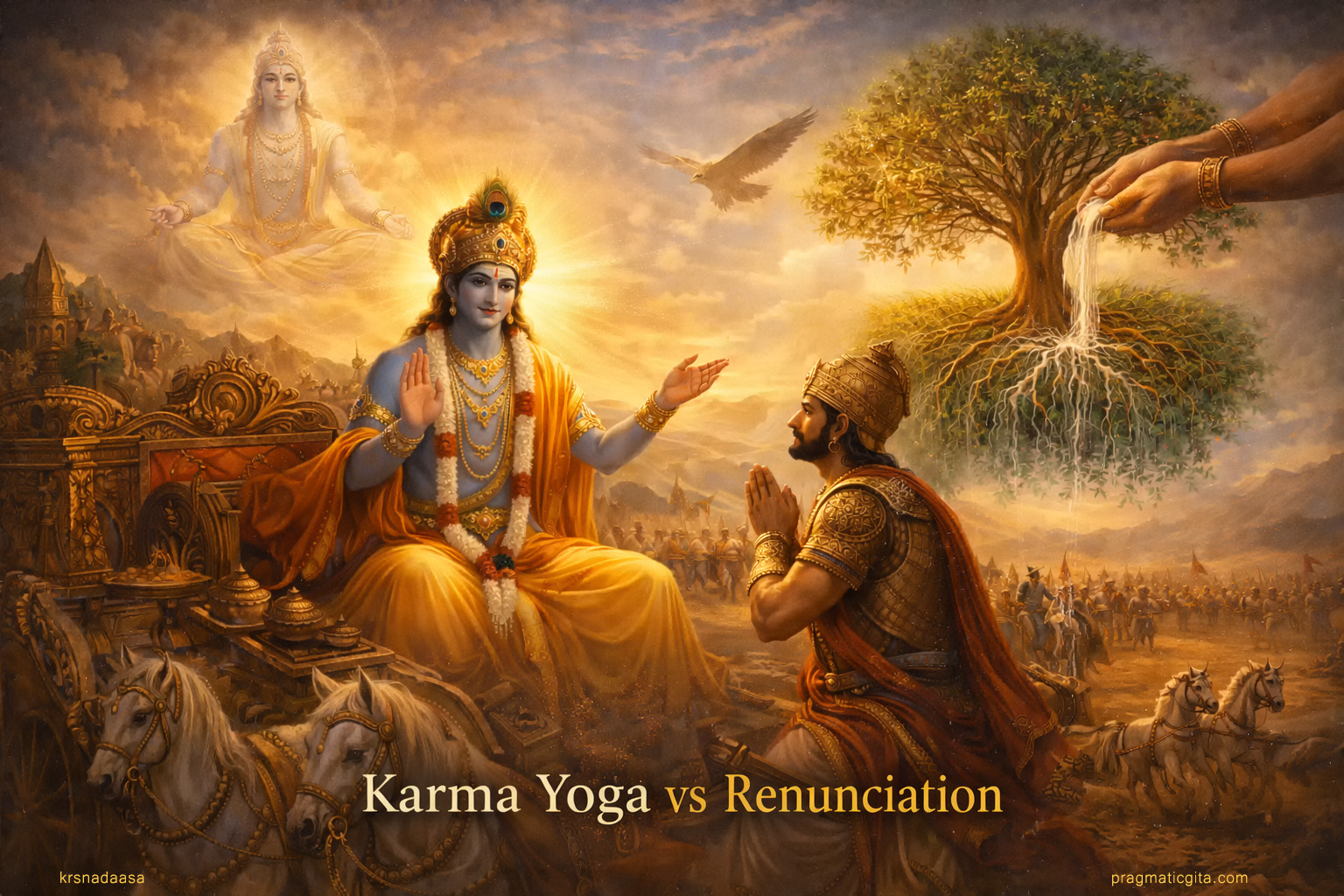

Karma Yoga vs Renunciation: The Gist of Shlokas 3.3 to 3.6
If you have not already done so, I would request you to review the Chapter 2, Sankhya Yoga before studying chapter 3 as that would help set the right context.
You can find the explanation of the final shlokas of chapter 2 (67 to 72) here. Please go through that to get a better understand and maintain continuity in your learning.
You can also listen to all the episodes through my Spotify Portal. And here on YouTube as well.
The Eternal Dilemma: Karma Yoga vs Renunciation Have you ever felt the urge to leave your job, your relationships, or your responsibilities, believing that “walking away” is the only way to find spiritual peace? You are not alone. In Chapter 3 of the Bhagavad Gita, Arjuna faces this exact dilemma. He is torn between the desire to withdraw from the world and the demand to fight, sparking the classic spiritual debate of Karma Yoga vs Renunciation.
He wants to escape the battlefield, thinking that silence equals spirituality. However, Krishna shatters this illusion, teaching us that the choice between Karma Yoga vs Renunciation is not about physical location, but about inner consciousness.
Shifting Perspectives: Beyond the Binary Arjuna’s confusion about Karma Yoga vs Renunciation stems from viewing them as mutually exclusive opposites. He thinks he must choose one and reject the other. This mental block is common. As the saying goes, “Einstein you cannot solve a problem from the same level of consciousness that created it.”
Arjuna is trying to solve his spiritual crisis with a material mindset. To understand the synthesis of Karma Yoga vs Renunciation, he must elevate his thinking. This is similar to how humanity struggled to accept the copernicus galileo heliocentric view. Just as people ridiculed the idea that the Earth was not the center, our ego ridicules the idea that we can be active without being the “doer.”
The copernicus galileo heliocentric view required a total paradigm shift, just as understanding Karma Yoga vs Renunciation requires shifting from an ego-centric to a divine-centric view.
The Danger of the Mithyachari When misunderstanding Karma Yoga vs Renunciation, many seekers fall into the trap of becoming a Mithyachari (spiritual hypocrite). Krishna warns that if you choose the external appearance of Renunciation while your mind is still full of worldly desires, you are merely pretending.
True Karma Yoga vs Renunciation teaches that it is better to struggle honestly in the world than to fake holiness in a cave. You cannot attain freedom simply by stopping your hands from working; you must stop your mind from claiming ownership. This integrity is the heart of the Karma Yoga vs Renunciation teaching.
Integrating the Two Paths Ultimately, the battle of Karma Yoga vs Renunciation is resolved when we realize they are complementary, not contradictory. Krishna explains that while there are two paths—the path of contemplation (Jnana Yoga) and the path of action (Karma Yoga)—they must eventually converge.
Knowledge is like finding the roots of the tree, while action is the watering of those roots. To grow, we must integrate both aspects of Karma Yoga vs Renunciation: acting responsibly in the world while anchoring our intelligence in the Divine. By realizing that “Einstein you cannot solve a problem from the same level of consciousness that created it,” we stop fighting the duality and start living the synthesis.
Keywords: Karma Yoga vs Renunciation, Path of Knowledge (Jnana Yoga), Spiritual Hypocrisy (Mithyachara), Actionlessness (Naishkarmya), Bhagavad Gita Chapter 3 summary, how to practice detachment in daily life, meaning of mithyachara in Bhagavad Gita, overcoming spiritual bypassing, Why is action better than inaction in Gita?, Can I find peace by running away from duties?, What are the two paths explained by Krishna?, Einstein you cannot solve a problem from the same level of consciousness that created it, copernicus galileo heliocentric view
Verses 3.3 to 3.6
श्रीभगवानुवाच |
लोकेऽस्मिन्द्विविधा निष्ठा पुरा प्रोक्ता मयानघ |
ज्ञानयोगेन साङ्ख्यानां कर्मयोगेन योगिनाम् || 3.3||
śhrī bhagavān uvācha
loke ’smin dvi-vidhā niṣhṭhā purā proktā mayānagha
jñāna-yogena sāṅkhyānāṁ karma-yogena yoginām
śrībhagavānuvāca (श्रीभगवानुवाच) – The Supreme Lord said; loke (लोके) – in the world; asmin (अस्मिन्) – this; dvividhā (द्विविधा) – two kinds of; niṣṭhā (निष्ठा) – faith or steadfastness; purā (पुरा) – formerly; proktā (प्रोक्ता) – were explained; mayā (मया) – by Me; anagha (अनघ) – O sinless one; jñānayogena (ज्ञानयोगेन) – through the path of knowledge; sāṅkhyānāṁ (साङ्ख्यानां) – for the Sankhyas; karmayogena (कर्मयोगेन) – through the path of action; yoginām (योगिनाम्) – for the yogis.
The Lord said: O sinless one, the two paths leading to enlightenment were previously explained by Me: the path of knowledge, for those inclined toward contemplation, and the path of work for those inclined toward action.
न कर्मणामनारम्भान्नैष्कर्म्यं पुरुषोऽश्नुते |
न च संन्यसनादेव सिद्धिं समधिगच्छति ||3.4||
na karmaṇām anārambhān naiṣhkarmyaṁ puruṣho ’śhnute
na cha sannyasanād eva siddhiṁ samadhigachchhati
na (न) – not; karmaṇām (कर्मणाम्) – by abstaining from actions; anārambhāt (अनारम्भात्) – by non-performance; naiṣkarmyam (नैष्कर्म्यं) – the state of actionlessness; puruṣaḥ (पुरुषः) – a person; aśnute (अश्नुते) – achieves; na (न) – not; ca (च) – and; saṁnyasanāt (संन्यसनात्) – by renunciation alone; eva (एव) – only; siddhim (सिद्धिं) – perfection; samadhigacchati (समधिगच्छति) – attains.
One cannot achieve freedom from karmic reactions by merely abstaining from work, nor can one attain perfection of knowledge by mere physical renunciation.
न हि कश्चित्क्षणमपि जातु तिष्ठत्यकर्मकृत् |
कार्यते ह्यवश: कर्म सर्व: प्रकृतिजैर्गुणै: ||3.5||
na hi kaśhchit kṣhaṇam api jātu tiṣhṭhatyakarma-kṛit
kāryate hyavaśhaḥ karma sarvaḥ prakṛiti-jair guṇaiḥ
na (न) – not; hi (हि) – indeed; kaścit (कश्चित्) – anyone; kṣaṇam (क्षणम्) – a moment; api (अपि) – even; jātu (जातु) – ever; tiṣṭhati (तिष्ठति) – remains; akarmakṛt (अकर्मकृत्) – without performing action; kāryate (कार्यते) – is compelled to act; hi (हि) – indeed; avaśaḥ (अवशः) – helplessly; karma (कर्म) – action; sarvaḥ (सर्वः) – all; prakṛtijaiḥ (प्रकृतिजैः) – born of material nature; guṇaiḥ (गुणैः) – by the modes.
There is no one who can remain without action even for a moment. Indeed, all beings are compelled to act by their qualities born of material nature (sattva, rajas and tamas).
कर्मेन्द्रियाणि संयम्य य आस्ते मनसा स्मरन् |
इन्द्रियार्थान्विमूढात्मा मिथ्याचार: स उच्यते ||3.6||
karmendriyāṇi sanyamya ya āste manasā smaran
indriyārthān vimūḍhātmā mithyāchāraḥ sa uchyate
karmendriyāṇi (कर्मेन्द्रियाणि) – the working senses; saṁyamya (संयम्य) – restraining; ya (य) – who; āste (आस्ते) – remains; manasā (मनसा) – with the mind; smaran (स्मरन्) – dwelling upon; indriyārthān (इन्द्रियार्थान्) – sense objects; vimūḍhātmā (विमूढात्मा) – deluded soul; mithyācāraḥ (मिथ्याचारः) – hypocrite; sa (स) – he; ucyate (उच्यते) – is called.
One who restrains the working senses, but mentally dwells upon the sense objects, is a deluded soul and should be called a hypocrite.
Arjuna’s Question: Karma Yoga vs Renunciation & The Search for a Spiritual Escape Route
Let us again hear exactly what Arjuna says in 3.1 and 3.2, because his words reveal something important about how the mind works when it wants to avoid pain.
Arjuna said: O Janardana, if You consider knowledge superior to action, then why do You ask me to wage this terrible war? My intellect is bewildered by Your contradictory advice. Please tell me decisively the one path by which I may attain the highest good.
Notice what Arjuna is doing here. He has taken a teaching meant to transform his relationship to action and turned it into an argument against action altogether. Shri Krishna praised buddhi, awakened intelligence. Shri Krishna spoke of acting without attachment. Arjuna heard this and concluded that “if wisdom is higher, then action must be lower. If detachment is praised, then the cleanest option is to leave everything and run away”.
See the use of words by Arjuna.
तदेकं वद निश्चित्य येन श्रेयोऽहमाप्नुयाम् || 3.2||
tad ekaṁ vada niśhchitya yena śhreyo ’ham āpnuyām
That word śreyas is not casual. It points to what is ultimately beneficial, what leads to lasting well being, not merely what feels pleasant in the moment. Arjuna is not asking for a spiritual buffet. He is asking for a single clear direction that can hold him steady when his emotions are pulling him in opposite directions.
And yes, one might wonder whether Shri Krishna had not already been crystal clear. In Chapter 2, across sixty two meticulously crafted verses, He has already laid out the immortality of the Self, the nature of duty, the discipline of equanimity, and the characteristics of a sthita-prajña, the one of steady wisdom. Yet here stands Arjuna, very confused and disturbed.
This confusion is not a failure of Shri Krishna’s teaching, nor a deficiency in Arjuna’s intellect. It is, as the tradition suggests, a līlā, a divine play with a practical purpose. Shri Krishna Himself tells us that His birth and actions are divya, operating on multiple levels simultaneously, and therefore even an apparent delay or repetition can be part of a deeper design.
Sanskrit (Bhagavad Gītā 4.9)
जन्म कर्म च मे दिव्यम्
janma karma ca me divyam
My birth and My actions are divine and transcendental.
Arjuna’s confusion creates space for Shri Krishna to address a universal human predicament. Which is about how we can reconcile the path of knowledge with the path of action. This question would haunt sincere seekers for millennia. Shri Krishna ensures it is explained in detail in such a way that all our confusions are cleared.
Why this confusion is universal
This exact confusion appears everywhere.
A person hears “be detached” and assumes it means “stop caring.”
A person hears “everything is Shri Krishna’s will” and assumes it means “do nothing.”
A person hears “knowledge is higher” and assumes it means “action is inferior.”
A person hears “renounce” and assumes it means “leave your responsibilities.”
In our daily lives, this means confusion is often not a sign that the teaching is wrong. It is a sign that the teaching is bigger than our current inner capacity to internalize it. The mind is being asked to stretch beyond its habitual framework, and it resists. Not because it is incapable, but because it is attached to what feels familiar and comfortable.
The human mind resists paradigm shifts
Arjuna’s response is deeply human. When confronted with ideas that challenge our existing mental frameworks, our first instinct is that of resistance, and of dismissal.
Think of Copernicus. For over a millennium, the geocentric model was treated as obvious truth. Earth at the center. The heavens revolve around us. It was supported by the religious as well as scientific authorities of those times. When Copernicus published a contradictory view in his De revolutionibus orbium coelestium in 1543, the reaction was plain outrage. The book was later placed on the Catholic Church’s list of Forbidden Books in 1616, and remained there for centuries.
Later on, Galileo, who supported it through his own observations, was forced to publicly withdraw his views before the Inquisition in 1633. Legend says that after publicly denying heliocentrism, he quietly whispered, “Eppur si muove,” and yet it moves.
That line is almost a spiritual teaching in itself.
Truth does not require our permission.
Reality does not adjust itself to protect our ego.
The irony is striking. Copernicus was simply describing reality as it was. The resistance came from humanity’s inability to shift its perspective.
Arjuna is in the same psychological situation. His old “geocentric model” puts his role identity at the center: I am a pandava, I am the doer, I will be responsible, I will be stained, I will lose what I love…
Shri Krishna is introducing the “heliocentric model” in which the center shifts: the ātman is eternal, dharma must be done, and action becomes liberating when it is performed without egoic attachments.
So Arjuna does what humans do. He asks for the teaching to fit inside the old framework rather than letting the teaching transform his views.
Einstein’s insight can be used to precisely describe what is happening in Arjuna’s mind.
Albert Einstein observed that a problem cannot be solved from the same level of consciousness that created it.
This is not about intelligence or information. It is about consciousness, the very lens through which we perceive reality. Arjuna’s confusion arises because he is attempting to comprehend Shri Krishna’s teaching through the same inner lens that produced his mental confusion and turmoil, a lens shaped by attachment to outcomes, identification with the body, and conventional notions of what spirituality looks like.
Shri Krishna’s teaching demands a major shift, a fundamental reorientation of how Arjuna sees himself, his actions, and his relationship with the Divine. This cannot happen through mere intellectual accumulation. It requires a transformation of his views through the elevation of his level of consciousness.
In our daily lives, this means you cannot solve anxiety using the same mental framework that caused your anxiety in the first place. You cannot heal a relationship through the same egoistic views that ruined the relationship in the first place. You need a higher level view, which is provided by the buddhi that is awakened and sharpened.
This is Arjuna’s inner war. He wants śreyas, but his tired mind wants preyas. He wants liberation, but he also wants relief. He wants truth, but he also wants comfort.
Shri Krishna is teaching him that relief is not the same as liberation. A path can feel pleasant and still keep you bound. A path can feel difficult and still set you free.
In our daily lives, examples of preyas often look like avoidance, delay, self justification, and escape. While examples of shreyas often look like responsibility, honesty, discipline, and surrender.
The grace of confusion
Arjuna’s confusion is, paradoxically, a form of grace. It is honest. It is unpretentious. It admits, I do not yet understand. And that honesty creates the opening through which wisdom enters.
Had Arjuna nodded along in false understanding, the Gītā would have ended at Chapter 2. Instead, his bewilderment and confusion gives rise to the unfolding of the full teaching.
In our daily lives, this means do not suppress confusion. Offer it. Bring it to Bhagavān. Bring it to the guru. Bring it into practice. Trust that sincere seeking, done with humility and faith, is already the beginning of grace.
Shri Krishna’s Response: Two Paths, Two Temperaments, One Destination
Now let us hear how Shri Krishna responds in 3.3. The gist of it is that it’s not karma yoga vs renunciation but rather it is karma yoga + renunciation.
Śrī Shri Krishna begins His reply in BG 3.3 with a move that is both compassionate and strategic. Arjuna is demanding one single path, as if enlightenment were a fork in the road where you must pick left or right and reject the other. Shri Krishna does not indulge that oversimplification. Instead, He explains that human beings are wired differently, and therefore the same truth is approached through different routes.
He addresses Arjuna as anagha, “O sinless one,” not as flattery, but as reassurance. Shri Krishna is counseling him without condemning him. That is the mark of a great leader.
Then Shri Krishna says, in essence: There are two established paths that lead toward the highest. One is jñāna-niṣṭhā, the orientation of knowledge and discernment. The other is karma-niṣṭhā, the orientation of action and duty.
This is not a division of human beings into superior and inferior. It is an acknowledgment of temperament, or svabhāva.
Some of us are naturally inclined to ask, “What is real? Who am I?” That is the svabhava of a jñāni.
Some of us are naturally inclined to ask, “What must be done? What is my responsibility?” That is karmi.
Now pause and check yourself. Which one are you?
If you had one free Saturday, no obligations, no deadlines, what would your mind naturally want to do?
Would it move toward silence, reflection, and inquiry.
Or would it move toward building, fixing, helping, doing.
This is not a moral ranking. It is temperament. It is svabhāva.
In our daily lives, this means spirituality cannot be one size fits all. If a deeply contemplative person is forced into nonstop external actions, they will tire out. If a deeply active person is forced into long withdrawal and inner contemplation too often, they will become restless or dull. That is why Shri Krishna’s teaching is very precise.
But then comes the twist that Arjuna did not expect.
Shri Krishna does not say, “Pick one and reject the other.”
He says, in effect, “If you separate them, you will suffer.”
Because jñāna without action becomes dry and pointless.
And action without jñāna becomes blind and dangerous.
Śrīla Prabhupāda gives a metaphor that even a child can understand.
Jñāna is like finding the roots of a tree.
Karma yoga is like watering those roots.
Now let me make this vivid.
Imagine someone who loves reading about fitness. They watch videos. They collect fitness books. They know the names of every muscle group. They can correct everyone else’s posture. But they themselves never exercise.
That is jñāna without karma. Lots of theory, but no transformation.
Now imagine the opposite.
Someone is working out all day, but with terrible form. They keep injuring themselves. They exhaust their body and wonder why they are not getting stronger.
That is karma without jñāna. Lots of effort, but again no transformation.
In our daily lives, this means knowledge and action have to mature together.
This is where Shri Krishna introduces buddhi yoga.
Buddhi yoga is awakened intelligence meant to transform our life. Not meant to help us run away from life.
In our daily lives, this means your spirituality is not tested in your prayer room. It is tested in traffic. In deadlines. In conflict. In temptation. In the moment your plan fails and your ego wants to blame someone.
Now we come to the line that should land like a bell in the room.
“No action is not equal to no reaction.”
Let me ask you directly.
Have you ever avoided a difficult conversation, and then watched the relationship decay anyway.
You did nothing. And yet things happened.
That is karma.
Shri Krishna’s point is brutally practical. You cannot escape karma by refusing to act. Besides, you just cannot ‘not act at all’. Even breathing is action. Even thinking is action. Even silence can be action.
Action happens on three levels.
manas, thought.
vāk, speech.
kāya, body.
So you may sit quietly, but inside the mind is rehearsing anger, craving, fear, comparison.
In our daily lives, this means you can be externally calm and internally burning. And the inner burning will shape your destiny more than your outer calmness.
This is why BG 2.47 is so complete. Most people quote the first half and forget the second.
Shri Krishna says: you have a right to action, not to the fruits. Yes.
But He also says: do not be attached to inaction.
Meaning: do not try to find an escape from karma.
Meaning: do not call your fear “renunciation.”
Meaning: do not call your laziness “detachment.”
Because if you abandon your rightful duty, that omission itself creates negative karma.
In our daily lives, this means if you are meant to protect, and you refuse, harm spreads. If you are meant to guide, and you avoid, chaos grows. If you are meant to speak the truth, and you stay silent, the lie gets stronger.
Then Shri reminds us what real wisdom looks like. In the 2nd chapter He describes the steady one as someone who is not shaken by sorrow, not addicted to pleasure, and free from rāga – attachment, dvesha – aversion, bhaya – fear, and krodha – anger.
That is the real test.
Not whether you can sit in a cave.
But whether anger sits in you.
Not whether you can leave society.
But whether craving follows you.
In our daily lives, this means the spiritual path is not about escaping discomfort. It is about transforming our discomfort into tools of learning and evolution.
So when Shri Krishna provides us with an integrated wisdom that says:
- Know clearly, that is jñāna.
- Act rightly, that is karma.
- Offer results, that is tyāga.
- Stay steady inside, that is sthita prajñā.
With this understanding, let us look at 3.4 to 3.6
Shri Krishna Closes the Escape Routes (BG 3.4 to 3.6)
At this point, Arjuna is not merely listening. He is bargaining.
Arjuna is standing in front of a war that will hurt him no matter what he chooses. If he fights, he fears sin, grief, and the loss of loved ones. If he does not fight, he fears dishonor, the collapse of dharma, and the ruin of those who depend on him.
So his mind reaches for a third option: a spiritual escape.
“If knowledge is higher, let me withdraw.”
“If detachment is praised, let me stop caring.”
“If renunciation is respected, let me leave the responsibility.”
Now Shri Krishna does not shout at him. He does not shame him. He does something far more powerful.
He removes the illusion that covers Arjuna’s buddhi.
These three verses are not random. They are a staircase. And Shri Krishna leads Arjuna up that staircase by first dismantling the escape routes that look spiritual but keep the ego untouched.
BG 3.4: Not doing is not the same as being free
In BG 3.4, Shri Krishna says you do not attain naiṣkarmya, freedom from the binding effects of karma, merely by abstaining from action.
Pause here, because many people misunderstand what Shri Krishna is saying here.
He is not denying the value of renunciation.
He is explaining the right way of performing renunciation.
The word naiṣkarmya is subtle. It points to a state where karma no longer binds. That is the goal. But Shri Krishna is telling us that the route is not to “stop acting.” The route is “stop acting under the control of the ego.”
Because bondage is not created by action alone. Bondage is created by the inner claim.
“I am the doer.”
“I am the controller.”
“This must go my way.”
“I deserve the outcome.”
As long as that inner claim remains, even a seemingly pious act can create bondage.
A common real life example: A parent feels overwhelmed and says, “I need detachment.” What they actually do is emotionally withdraw. They stop listening. They stop engaging. They stop getting involved. They call it spirituality. But the child experiences it as abandonment.
That is not detachment. That is disconnection.
Shri Krishna is saying: do not confuse detachment with abandonment. Detachment is the purification of attachment, not the rejection of responsibility.
BG 3.5: You cannot freeze life, so stop pretending you can
Now Shri Krishna takes away the next illusion in BG 3.5. He says no one can remain without action even for a moment. Everyone is driven by prakṛti, through the guṇas.
This is the verse that ends the fantasy of a neutral position.
There is no neutral gear in human life.
If you do not act consciously, you will act unconsciously.
If you do not choose dharma deliberately, you will follow habits automatically.
If you do not move upward, you will slide downward.
This is not pessimism. This is simply how prakṛti works.
The guṇas are always at play.
- Sometimes rajas pushes you into restlessness, ambition, irritation, constant activity.
- Sometimes tamas pulls you into heaviness, avoidance, dullness, procrastination.
- Sometimes sattva lifts you into clarity, balance, steadiness.
Now here is the key: even the desire to escape the war is still movement of the guṇas. Even the wish to “do nothing” is a kind of doing.
So Shri Krishna is telling Arjuna: “Stop fantasizing about escaping from action. Choose the right kind of action.”
In our daily lives, this means what you call inaction is often rajas or tamas operating with a clever story.
Let us make this painfully practical.
Example 1, procrastination dressed as surrender.
A student delays an application, an exam, a health checkup, or a tough conversation. They say, “If it is meant to happen, it will happen.” But deep down it is fear. Fear of rejection. Fear of discomfort. Fear of being exposed.
The delay feels like peace. It is not peace. It is fear avoiding reality.
Example 2, silence dressed as spirituality.
Someone in your family is being treated unfairly. You stay silent because you do not want conflict. You tell yourself, “I am practicing equanimity.” But the silence teaches the wrong lesson. It empowers injustice. It encourages further harm of the vulnerable.
This is why Swami Vivekananda used to quote the Upaniṣad while saying:
उत्तिष्ठत जाग्रत प्राप्य वरान्निबोधत ।
uttiṣṭhata jāgrata prāpya varān nibodhata
Arise, awake, and stop not until the goal is reached.
Awake is the opposite of drifting. Awake is the opposite of self deception. Awake is the opposite of spiritual sleep.
BG 3.6: The deepest impurity is not desire, it is falsehood
Now Shri Krishna brings the mirror closer in BG 3.6.
He says: if someone restrains the external organs of action, but their mind continues to dwell on sense objects, that person is deluded and is called mithyācāri.
This verse can sound harsh until you understand Shri Krishna’s compassion. He is trying to protect the seeker from a slow spiritual death.
Desire is human, it cannot be avoided but it can be transformed and purified.
The most dangerous trap is pretending you do not have any desire, while secretly feeding it internally.
That is why Krishna calls it mithyācāra.
mithyā means false.
ācāra means conduct, lived practice.
So mithyācāra is false living, inner and outer not aligned.
In our daily lives, this means the spiritual path is not about appearing to be pure. But rather about being genuine and honest.
Swami Mukundananda quotes this story from the Puranas to explain the point further.
Tavrit and Suvrit, to illustrate this point. The brothers were walking from their house to hear the Śhrīmad Bhāgavatam discourse at the temple. On the way, it began raining heavily, so they ran into the nearest building for shelter. To their dismay, they found themselves in a brothel, where women of disrepute were dancing to entertain their guests. Tavrit, the elder brother, was appalled and walked out into the rain, to continue to the temple. The younger brother, Suvrit, felt no harm in sitting there for a while to escape getting wet in the rain.
Tavrit reached the temple and sat for the discourse, but in his mind he became remorseful, “O how boring this is! I made a dreadful mistake; I should have remained at the brothel. My brother must be enjoying himself greatly in revelry there.” Suvrit, on the other hand, started thinking, “Why did I remain in this house of sin? My brother is so holy; he is bathing his intellect in the knowledge of the Bhāgavatam. I too should have braved the rain and reached there. After all, I am not made of salt that I would have melted in a little bit of rain.”
When the rain stopped, both started out in the direction of the other. The moment they met, lightning struck them and they both died on the spot. The Yamdoots (servants of the Bhagavan of Death) came to take Tavrit to hell. Tavrit complained, “I think you have made a mistake. I am Tavrit. It was my brother who was sitting at the brothel a little while ago. You should be taking him to hell.”
The Yamdoots replied, “We have made no mistake. He was sitting there to avoid the rain, but in his mind he was longing to be at the Bhāgavatam discourse. On the other hand, while you were sitting and hearing the discourse, your mind was yearning to be at the brothel.” Tavrit was doing exactly what Shree Krishna declares in this verse; he had externally renounced the objects of the senses, but was dwelling upon them in the mind. This was an improper kind of renunciation.
Physically restraining our senses is just the first step. It helps weaken our desires. However we should not forget that our ultimate goal is to restrain our minds and for that we use the substitution technique. Whenever we have a bad thought, substitute it with the thought of Bhagavan and service to God.
And to make it feel deeply rooted, we can bring Patanjali as a supporting witness. He says in yoga sutras 1.2:
योगश्चित्तवृत्तिनिरोधः ।
yogaś citta-vṛtti-nirodhaḥ
Yoga is the mastery of the fluctuations of the mind.
Shri Krishna and Patanjali are pointing to the same battleground. The real war is not outside. The real war is the mind’s craving, the mind’s self deception, the mind’s hunger for comfort and control.
The integrated takeaway
So here is what Shri Krishna accomplished in these verses.
He has not yet told Arjuna the full method. He has done something more foundational.
He has restored integrity.
- Do not mistake withdrawal for liberation.
- Do not imagine you can remain without action.
- Do not perform renunciation while feeding desire and attachments inside.
Only after this purification of understanding does the method of karma yoga become usable.
In our daily lives, this means before you ask “What practice should I do,” ask “What lie am I currently living.” Because the lie will corrupt the practice.
And now, with the escape routes closed and sincerity restored, Shri Krishna can begin the positive instruction from BG 3.7 onward, which is where duty becomes yoga, action becomes worship, and the same battlefield becomes the place of liberation.
A One-Minute Inner Audit
Before we move on, pause for just one minute and do this silently:
Name one area where your outer life looks better than your inner life.
Name the attachment or fear that keeps that gap alive.
Choose one substitution, one higher practice, that you will use the next time the pattern appears.
This is how the gap closes. Not by shame, but by training.
kṛṣṇadaasa
Servant of Krishna