 Pragmatic Gita
Introduction : Practical Bhagavad Gita Teachings
The Frozen Warrior
Hare Krishna, everyone. Thank you for being here.
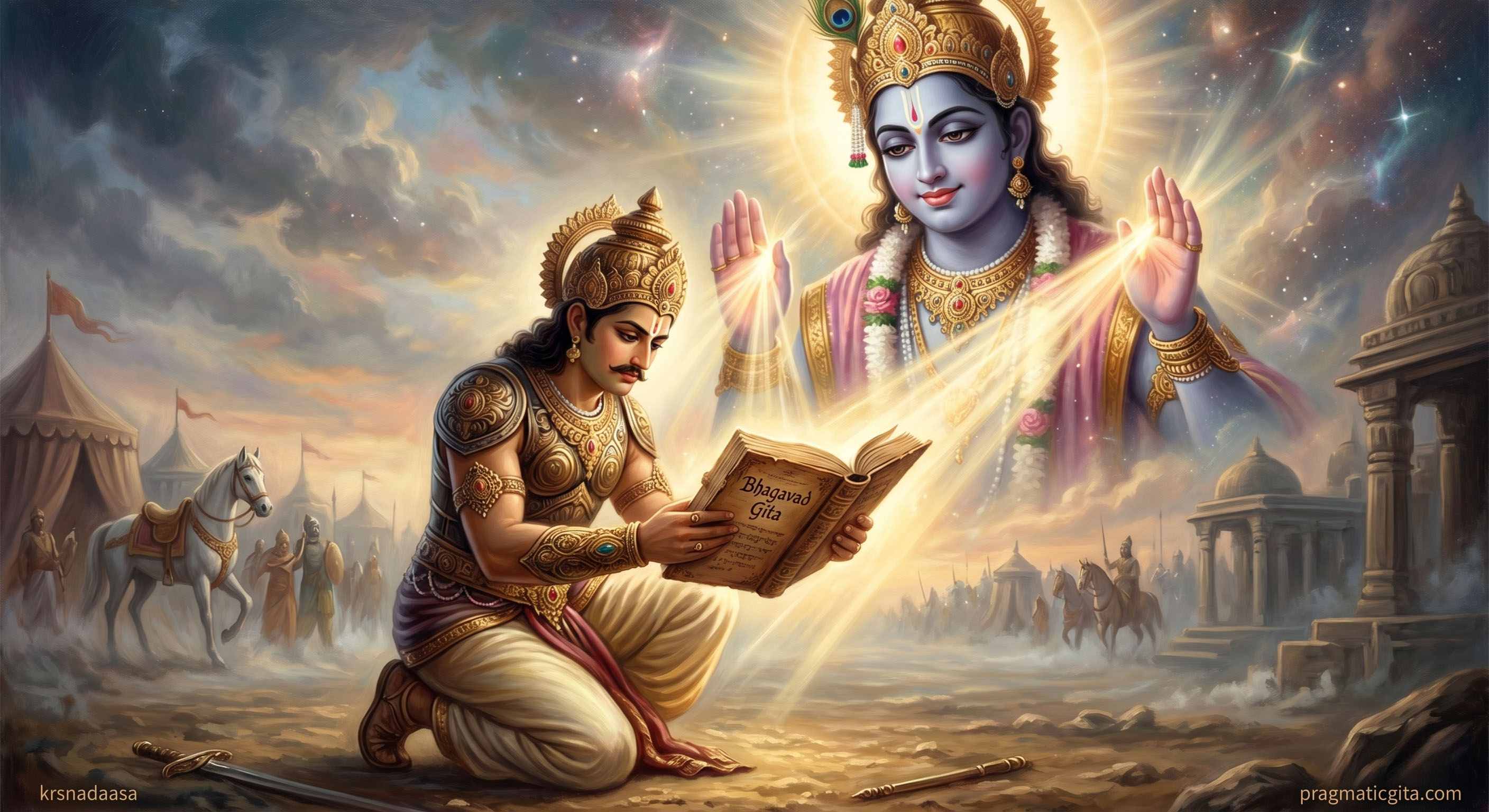
Five thousand years ago, the greatest warrior of his age stood on a battlefield and could not lift his bow.
His hands trembled. His mouth went dry. He looked across at the people he was about to fight, his cousins, his teachers, his childhood friends, and something inside him just broke. He sat down in his chariot and said, I cannot do this. I would rather die than go forward.
If you have ever felt that, frozen, unable to take the next step in your own life, then you and Arjuna are closer than you think. And what Shri Krishna spoke to him that day is exactly what your heart has been waiting to hear.
That warrior’s name was Arjuna. And the one who sat with him in that moment, who did not scold him, who did not tell him to be strong, who simply listened and then slowly, patiently, lovingly guided him back to clarity, was Lord Shri Krishna. What they spoke on that battlefield became the Bhagavad Gita. And though its words were first meant for Arjuna, they have reached across five thousand years and found their way to you.
A Word About Your Teacher
My spiritual name is krsnadaasa, which means servant of Shri Krishna. That is exactly what I am. I am not a Saint. I am not a Swami. I am a humble, practical-minded devotee who has spent over twenty years studying and applying the teachings of the Bhagavad Gita in everyday life.
My understanding has been shaped by many great teachers. The luminous works of Adi Shankaracharya, the eighth century philosopher who systematized Vedanta. The practical wisdom of Swami Chinmayananda. The devotional depth of the Gaudiya Vaishnava acharyas. The integrative vision of Swami Vivekananda. And the insights of Swami Mukundananda, Swami Ranganathananda, and many other luminaries.
I do not represent any single school or religious organization. I draw from various saints, sages, and Vedantic scriptures, and I share what has actually worked in my own life and in the lives of those I have had the privilege to guide and mentor.
Sri Ramakrishna, the nineteenth century mystic of Bengal, used to tell a beautiful story. He said, “A salt doll went to measure the depth of the ocean. The moment it entered the water, it dissolved and became the ocean. How then could it report the ocean’s depth?”
Something like that happens when we enter the ocean of the Gita’s wisdom. The small ego begins to dissolve into something infinitely greater. My role here is simply to share what I have learned, and to walk alongside you as sincerely as I can.
In 2017, I published a book on the practical insights I had extracted from the Bhagavad Gita. It was well received, and many readers asked me to go deeper, to explain the practical side of the Gita in simpler terms. That is how I started teaching the Gita, and that is how pragmaticgita.com was born.
Why You Are Really Here
Perhaps you are facing your own life challenges right now. And some of what Arjuna felt sounds familiar.
And we live in strange times. Technology connects us to billions of people, yet many of us have never felt lonelier. We have access to infinite information, yet we are drowning in anxiety. We have conquered outer space, yet our inner space remains a mystery we do not know how to enter.
Maybe you have lain awake at three in the morning, scrolling through other people’s highlight reels, feeling smaller with every swipe. Maybe Sunday evenings come with a quiet dread about the week ahead. Maybe you have had the same circular conversation with your parents about your career, or with your partner about your relationship, for years, and nothing moves. Maybe you reached the achievement that was supposed to finally make you feel fulfilled, and it did not. Maybe you are struggling to make some difficult choices and every option feels wrong.
If any of that sounds familiar, you are in the right place. Because these same eternal truths that transformed Arjuna’s despair into clarity are here for all of us now. They have been waiting, preserved perfectly for thousands of years, for this exact moment when you would be ready to receive them.
Mental health crises are reaching epidemic levels in every country, across every age group. Teenagers report record levels of stress and a quiet sense that nothing matters. Working professionals describe chronic burnout and a slow loss of purpose. We scroll endlessly, consume greedily, achieve relentlessly, and still feel a hollowness we cannot name.
We do not need more theories or philosophies. We need practical wisdom that transforms. Wisdom that actually works when life gets hard.
Three questions have haunted every human heart since the beginning.
Who am I?
Why do I suffer?
What is the purpose of my existence?
The Gita addresses all three. Not as abstract philosophy but as practical instruction. So today, we begin this journey together. Not as students sitting in a classroom studying ancient history, but as living souls seeking living answers. We are all like Arjuna seeking answers. Like him, we are all confused perhaps, struggling definitely, but ready to discover the truth that has always been waiting for us and present within us.
Creating Sacred Space: Gita Dhyana Shlokas
Before we embark on any kind of spiritual studies, we first recite the traditional Guru Invocation:
ॐ अज्ञानतिमिरान्धस्य ज्ञानाञ्जनशालाकया
चक्षुरुन्मीलितं येन तस्मै श्रीगुरवे नमः
om ajnana-timirandhasya jnananjana-shalakaya
chakshur unmilitam yena tasmai shri gurave namah
I offer my respectful obeisances unto my spiritual master, who has opened my eyes, which were blinded by the darkness of ignorance, with the torchlight of knowledge.
Then, for thousands of years, seekers have begun their study of the Bhagavad Gita with special prayers called the Gita Dhyana Shlokas. Think of them as nine verses that tune and prepare us, like tuning an instrument before playing sacred music. They help us move from the noise of everyday life into a space where wisdom can actually reach us. Traditionally, seekers and students have recited at least the first shloka before starting their study of the Bhagavad Gita.
I will share these 9 Gita Dhyana Shlokas in our group and I request you to read and reflect upon them.
When we recite these shlokas, we’re saying, “Yes, I’m ready. Yes, I’m open. Yes, I want to receive what transformed Arjuna and countless souls after him.”
And then, we can start our study of the Bhagavad Gita.
The Battlefield Within
We all know that the Bhagavad Gita was taught on the battlefield of Kurukshetra. But here is what I want you to notice. That battlefield is not just a location in history. It exists within each of us.
Every day we face our own Kurukshetra. The battle between dharma and adharma. Between our higher nature and our lower impulses. Between wisdom and ignorance. Between what is temporary and what is eternal. The external war at Kurukshetra reflects the eternal war within each of us.
This is what makes the Bhagavad Gita extraordinary. It reaches across generations and speaks to each person with a quiet intimacy, as if it knew them. Arjuna’s questions echo our own. His fears are our fears. His journey from confusion to clarity is the same journey waiting for each of us.
These teachings do not just inform. They transform. They do not just explain life. They reveal how to live it fully.
Krishna: The Universal Teacher, Source of Practical Bhagavad Gita Teachings
A very important aspect to reflect upon is that Shri Krishna did not teach the Bhagavad Gita to some scholars or saints sitting in some mountains or caves. Instead, He taught it in the middle of a battlefield to a householder and a warrior.
Shri Krishna is not asking us to come with degrees in philosophy or years of Sanskrit study.
And staying true to His intent, our emphasis in this satsanga is not to become scholars or intellectuals of the Gita. It is to become humbly transformed by it.
The Gita demonstrates the Rig Vedic truth: “Ekam sat vipra bahudha vadanti“ , meaning “The Truth is One; The wise sages describe it by various names.”
Whether we are naturally inclined toward action (Karma Yoga), devotion (Bhakti Yoga), knowledge (Jnana Yoga), or meditation and other disciplines (Raja Yoga), the Bhagavad Gita provides a path suited to our unique spiritual constitution. More importantly, it teaches us how to integrate these various approaches to reach the goal effectively.
Shri Krishna lovingly meets each one of us exactly where we stand and guides us forward from there.
Shri Krishna’s deepest wish, as revealed throughout the Gita, is simply that you come to Him with sincerity and humility. That is all. Come as you are, with your doubts, your struggles, your confusion, your longing for something real and lasting. He will take care of the rest.
Shri Krishna speaks as the most intimate friend, the one who knows you better than you know yourself and who loves you more than anyone can. He addresses our deepest fears and highest aspirations with infinite compassion. He is the friend who will never abandon you, the teacher who will never get tired of your questions, the guide who walks beside us even when we cannot feel His presence.
As He Himself declares in Chapter 10, Verse 20:
अहमात्मा गुडाकेश सर्वभूताशयस्थितः
ahamātmā guḍākeśa sarvabhūtāśayasthitaḥ
“I am the Atman, O Gudakesha, seated in the hearts of all creatures.”
He is already within us. This journey is not about finding something far away. It is about recognizing what has always been present.
Think of it this way. Shri Krishna could have simply won the war in a minute using His divine powers. Instead, He chose to teach, and to guide. He chose to sit with Arjuna in his pain, listen to his fears, and then lovingly, patiently, systematically guide him back to clarity. That is who Shri Krishna is. He is the teacher who would empower you with wisdom than simply demonstrate His own powers to achieve personal glory.
And I am passing on that same loving invitation to each of you right now.
The Systematic Teaching Method
As Swami Chinmayananda observed, “The Gita is a psychological treatise, taking the human mind from the lowest valleys of sorrow to the highest peaks of bliss.“
Shri Krishna addresses the root of human suffering, which is our misidentification with the temporary instead of the eternal. Through eighteen chapters, we undergo a systematic transformation that has awakened countless souls over thousands of years.
The Bhagavad Gita contains the essence of all the Upanishads and the truths taught by the Brahma Sutras. As Adi Shankaracharya states beautifully in the fourth Dhyana Shloka:
सर्वोपनिषदो गावो दोग्धा गोपालनन्दनः
पार्थो वत्सः सुधीर्भोक्ता दुग्धं गीतामृतं महत्
sarvopanishado gāvo dogdhā gopālanandanaḥ
pārtho vatsaḥ sudhīrbhoktā dugdhaṃ gītāmṛtaṃ mahat
All the Upanishads are like cows, Krishna is the milker, Arjuna is the calf, and the Gita is the milk drawn for the benefit of those with purified intellect.
The Bhagavad Gita provides the practical science for applying Vedantic philosophy to solve human problems. For this reason, it is called yoga shastra, and each chapter of Bhagavad Gita is titled as some yoga. And as you know, yoga is something that we have to practice. Thus, the Bhagavad Gita is a scripture of practice, not mere theory.
The Power of Satsanga: Learning Together
The importance of satsanga cannot be overstated. As Lord Shri Ram teaches in the Ramcharitmanas about Navadha Bhakti (the nine forms of devotion):
प्रथम भगति संतन कर संगा
दूसरि रति मम कथा प्रसंगा
prathama bhagati santana kara sanga
dusari rati mama katha prasanga
The first form of devotion is the association with saints; the second is love for My divine stories.
How Satsanga Enhances and Accelerates Spiritual Growth:
- Collective Consciousness: As stated in the Rig Veda 10.191.2: संगच्छध्वं संवदध्वं सं वो मनांसि जानताम् “Sangacchadhwam samvadadhwam” – “Move together, speak together, let your minds be in harmony.” When we study together, our collective consciousness creates a powerful field of transformation.
- Mirror of Understanding: The questions and doubts from each one of us helps illuminate the blind spots of everyone else, and the insights gained from the answers deepen our collective wisdom. As iron sharpens iron, seekers sharpen each other’s understanding.
- Divine Presence: The Mahabharata states: “Where there is dharma, there is Krishna.” When we gather with pure intention to study His words, His presence is guaranteed.
- Protection from Maya: Alone, we may fall prey to doubt or laziness. Together, we support each other through spiritual challenges.
Our Method of Learning Together
The Brihadaranyaka Upanishad prescribes a three-fold method for receiving and internalizing spiritual wisdom. This is the method we will follow together throughout our study. You will see these three words reflected in everything we do.
Shravan – Deep Listening
Shravan means listening. And not casual hearing, but deep, attentive, receptive listening. When we gather for each session, we practice Shravan by giving the teachings our full presence. That is the reason we request everyone to turn on their cameras while attending virtually.
The tradition places a lot of emphasis on hearing the Gita from a teacher in a living setting rather than merely reading it alone. The vibration of the spoken word, the shared attention of the group, the questions that arise in real time, all of this strengthens our Shravanam.
Manan – Reflection and Contemplation
Manan means reflection and contemplation. Between our sessions, we reflect on what we have heard. We match them against our own experience, think about how this helps us face our own challenges, and allow the deeper meanings to surface.
Nidhidhyasan – Sustained Practice
Nidhidhyasan means sustained meditation and practice, the continuous application of what we have understood until it becomes our lived reality. Not just a concept we can explain but a truth we live in our day to day lives. This is where the Gita’s wisdom moves from the head to the heart and finally into the hands and feet.
Nidhidhyasan is what makes the difference between someone who has studied the Gita and someone who has been transformed by it.
“The Gita is not philosophy to be understood but truth to be realized.” — Swami Ranganathananda
Our three-fold method ensures that we move from understanding toward transformation and realization.
The Transformative Fruits of Gita Study
Through our journey together, you will discover truths that do not merely add to your knowledge but fundamentally shift how you experience life.
You will find growing within you a calmness that the Gita calls the very definition of Yoga. “Samatvam yoga ucyate” (2.48). A freedom from being disturbed by the pairs of opposites, by pleasure and pain, praise and blame, success and failure.
Old conditioning will begin to fall away, like water from a lotus leaf, as contemplation on these teachings loosens the grip of past patterns and liberates you to respond to life freshly.
Guilt, that heavy burden so many of us carry, will be transformed into the clarity of right action. Shri Krishna offers an extraordinary promise in the 18th chapter where He says “I shall deliver you from all sins; do not fear.”
The Gita will become for you what tradition calls a Jnana Kavacham, an armor of knowledge. The Gita Mahatmya declares that help comes quickly where the Gita is recited, and that the Lord always dwells where it is read, heard, taught, and contemplated upon.
You will discover the movement from preya to shreya, from the merely pleasant to the truly good. Limited sensory pleasures will give way to an unlimited, ever-present joy that does not depend on circumstances.
The Practical Approach: From Knowledge to Transformation
As mentioned earlier, each chapter is titled as some ‘yoga’, a practical discipline. The Bhagavad Gita was revealed on a battlefield to signify that spiritual wisdom must be applied in the battlefield of daily life. The Bhagavad Gita shows how every small action becomes great when performed with the right understanding.
I am deeply grateful to everyone in this Satsanga for your association. Each soul here is both teacher and student. Your struggles will deepen our collective wisdom, and together we will discover that the highest teaching and learning happens in the association of sincere seekers.
Let us attend these sessions together with the understanding that:
- We are not just studying ancient wisdom but undergoing living transformation
- Every doubt shared and clarified strengthens the group’s understanding
- Each insight gained must be practiced and shared
- Together, we create a field of collective consciousness that accelerates everyone’s progress
The Promise of Divine Grace
While we approach with effort and intellect, remember that realization comes through grace. As Krishna promises (10.10):
तेषां सततयुक्तानां भजतां प्रीतिपूर्वकम्।
ददामि बुद्धियोगं तं येन मामुपयान्ति ते||10.10||
teṣāṁ satata-yuktānāṁ bhajatāṁ prīti-pūrvakam
dadāmi buddhi-yogaṁ taṁ yena mām upayānti te
To those who are constantly devoted to serving Me with love, I give the understanding by which they can come to Me.
Beginning Our Sacred Journey
With this foundation of reverence, understanding, and practical commitment, let us begin our journey through the first chapter of the Bhagavad Gita in our next session. We approach the teachings by assuming the role of Arjuna, ready to question with humility, to introspect, and ultimately to surrender to the highest truth within us.
Again, this is not a course about ancient philosophy but rather a call to inner revolution that transforms not just how we think, but how we live, love, and serve.
May this study awaken in each of us the same transformation that occurred in Arjuna – from confusion to clarity, from fear to fearlessness, from limitation to recognition of our infinite divine nature.
Let us now spend a moment reflecting on the opening shloka of the Krishnashtakam (Krishna Ashtakam), a devotional prayer to Shri Krishna composed by Adi Shankaracharya.
वसुदेवसुतं देवं कंसचाणूरमर्दनम्
देवकीपरमानन्दं कृष्णं वन्दे जगद्गुरुम्
vasudeva-sutaṃ devaṃ kaṃsa-cāṇūra-mardanam
devakī-paramānandaṃ kṛṣṇaṃ vande jagad-gurum
I worship Lord Krishna, the divine son of Vasudeva, who killed the demons Kamsa and Chanura, who is the source of ultimate joy for His mother Devaki, and who serves as the supreme spiritual teacher for the entire universe.
With these sacred intentions and the blessings of the countless gurus who have appeared for the benefit of humanity, let us embark on this transformative journey together.
Hare Krishna!
Krsnadaasa
(Servant of Krishna)
All the 9 verses of the Gita Dhyana Shloka for reference
ॐ श्री परमात्मने नमः
om shri paramatmane namah
Salutations to the Supreme Consciousness
ॐ पार्थाय प्रतिबोधितां भगवता नारायणेन स्वयं
व्यासेन ग्रथितां पुराणमुनिना मध्ये महाभारतम् ।
अद्वैतामृतवर्षिणीं भगवतीमष्टादशाध्यायिनीं
अम्ब त्वामनुसन्दधामि भगवद्गीते भवद्वेषिणीम् ॥१॥
om parthaya pratibodhitam bhagavata narayanena svayam
vyasena grathitam puranamuninaa madhye mahabharatam
advaitamritavarshinim bhagavatimashtadashadhyayinim
amba tvamanusandadhami bhagavadgite bhadveshinim ||1||
O Mother Bhagavad Gita, I meditate upon you, taught by Lord Narayana Himself to Arjuna, compiled by the ancient sage Vyasa in the middle of the Mahabharata, consisting of eighteen chapters, showering the nectar of non-dualism, destroyer of worldly bondage.
नमोऽस्तु ते व्यास विशालबुद्धे फुल्लारविन्दायतपत्रनेत्र ।
येन त्वया भारततैलपूर्णः प्रज्वालितो ज्ञानमयः प्रदीपः ॥२॥
namo’stu te vyasa vishalabuddhe phullaravindayatapatranetra
yena tvaya bharatatailapurnah prajvalito jnanamayah pradipah ||2||
Salutations to you, O Vyasa of vast intellect, with eyes like fully bloomed lotus petals. By you, the lamp of knowledge was lit, filled with the oil of the Mahabharata.
प्रपन्नपारिजाताय तोत्रवेत्रैकपाणये ।
ज्ञानमुद्राय कृष्णाय गीतामृतदुहे नमः ॥३॥
prapannaparijataya totravetraikapanaye
jnanamudraaya krishnaya gitamritaduhe namah ||3||
Salutations to Krishna, the wish-fulfilling tree for those who surrender, holding the whip in one hand, showing the jnana-mudra (gesture of knowledge), the milker of the nectar of the Gita.
सर्वोपनिषदो गावो दोग्धा गोपालनन्दनः ।
पार्थो वत्सः सुधीर्भोक्ता दुग्धं गीतामृतं महत् ॥४॥
sarvopanishado gaavo dogdha gopalanandanah
partho vatsah sudhirbhokta dugdham gitamritam mahat ||4||
All the Upanishads are cows, the milker is Krishna the cowherd boy, Arjuna is the calf, the wise are the drinkers, and the milk is the great nectar of the Gita.
वसुदेवसुतं देवं कंसचाणूरमर्दनम् ।
देवकीपरमानन्दं कृष्णं वन्दे जगद्गुरुम् ॥५॥
vasudevasutam devam kamsachanuramardanam
devakiparamanandam krishnam vande jagadgurum ||5||
I bow to Krishna, son of Vasudeva, destroyer of Kamsa and Chanura, supreme joy of Devaki, the world teacher.
भीष्मद्रोणतटा जयद्रथजला गान्धारनीलोत्पला
शल्यग्राहवती कृपेण वहनी कर्णेन वेलाकुला ।
अश्वत्थामविकर्णघोरमकरा दुर्योधनावर्तिनी
सोत्तीर्णा खलु पाण्डवै रणनदी कैवर्तकः केशवः ॥६॥
bhishmadronatata jayadrathajala gandharanilotpala
shalyagrahavati kripena vahani karnena velakula
ashvatthamavikarnaghormakara duryodhanavartini
sottirna khalu pandavai ranandi kaivartakah keshavah ||6||
The river of battle, with Bhishma and Drona as its banks, Jayadratha as its water, Gandhara as blue lotuses, Shalya as crocodiles, flowing by Kripa’s force, agitated by Karna’s waves, with Ashvatthama and Vikarna as terrible sharks, whirlpooling around Duryodhana, was crossed by the Pandavas with Krishna as their boatman.
पाराशर्यवचः सरोजममलं गीतार्थगन्धोत्कटं
नानाख्यानककेसरं हरिकथासम्बोधनाबोधितम् ।
लोके सज्जनषट्पदैरहरहः पेपीयमानं मुदा
भूयाद्भारतपङ्कजं कलिमलप्रध्वंसिनः श्रेयसे ॥७॥
parasharyavachah sarojamamalam gitarthagandhotkotam
nanakhyanakakesaram harikathsambodhanabodhitam
loke sajjanashatpadairaharahah pepiyamanam muda
bhuyadbharatapankajam kalimalpradhvamsinah shreyase ||7||
May the lotus of the Mahabharata, grown from the water of Vyasa’s words, pure, fragrant with the meaning of the Gita, with many stories as stamens, bloomed by the sun of Krishna’s tales, drunk joyfully by the bees of good people daily – bring welfare by destroying the impurities of Kali Yuga.
मूकं करोति वाचालं पङ्गुं लङ्घयते गिरिम् ।
यत्कृपा तमहं वन्दे परमानन्दमाधवम् ॥८॥
mukam karoti vachalam pangum langhayate girim
yatkripa tamaham vande paramanandam adhavam ||8||
I bow to that Madhava of supreme bliss, whose grace makes the dumb eloquent and the lame cross mountains.
यं ब्रह्मा वरुणेन्द्ररुद्रमरुतः स्तुन्वन्ति दिव्यैः स्तवैः
वेदैः साङ्गपदक्रमोपनिषदैर्गायन्ति यं सामगाः ।
ध्यानावस्थिततद्गतेन मनसा पश्यन्ति यं योगिनो
यस्यान्तं न विदुः सुरासुरगणा देवाय तस्मै नमः ॥९॥
yam brahma varunendrarudramarutah stunvanti divyaih stavaih
vedaih sangapadakramopanishadairgayanti yam samagah
dhyanavasthitatadgatena manasa pashyanti yam yogino
yasyantam na viduh surasuragana devaya tasmai namah ||9||
Salutations to that Divine One whom Brahma, Varuna, Indra, Rudra and the Maruts praise with divine hymns, whom the chanters of Sama Veda sing through the Vedas with all their branches and the Upanishads, whom the yogis see with minds absorbed in meditation, whose limit neither gods nor demons know.
With these sacred intentions and the blessings of the guru parampara, let us embark on this transformative journey together.
You can find the next session, Chapter 1, here:
Hare Krishna!
kṛṣṇadaasa
(Servant of Krishna)