 Pragmatic Gita

Karma Yoga : The Gist of Shlokas 3.7
If you have not already done so, I would request you to review the Chapter 2, Sankhya Yoga before studying chapter 3 as that would help set the right context.
You can find the explanation of the previous set of shlokas from chapter (3.3 to 3.6) here. Please go through that to get a better understand and maintain continuity in your learning.
You can also listen to all the episodes through my Spotify Portal. And here on YouTube as well.
You can find below the gist of the narrative. For the complete expanded narrative, look below the verses.
Mastering Action Without Attachment
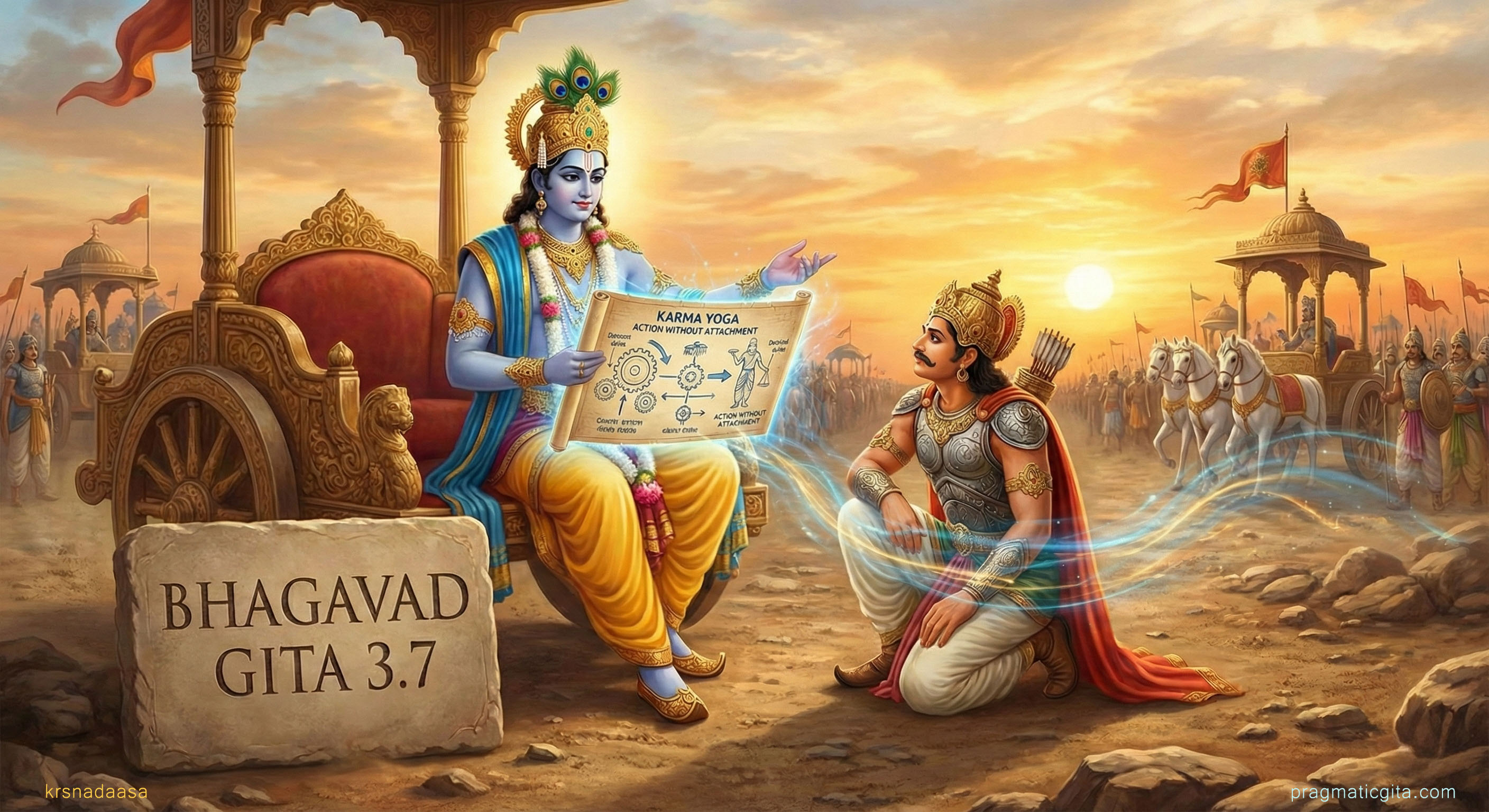
We often believe that a sincere spiritual life demands a choice between two impossible extremes. We think we must either indulge in the world until we are completely lost in its noise or we must run away to a cave and violently suppress our nature. But in Bhagavad Gita Verse 3.7 Shri Krishna destroys this false dilemma and offers a third superior option. He hands us a blueprint for Action Without Attachment.
This is not merely religious advice or a set of moral rules. It is described in the text as an entire science of inner freedom and a precise architecture for living that allows you to move through the world without being captured by it.
Architecture Not Advice
Shri Krishna teaches that true superiority or being viśiṣyate is not defined by your external appearance. It is not about the robes you wear or the temples you visit. It is defined by the architecture of your internal world. The concept of Action Without Attachment requires us to become architects of our own minds. If we try to stop our senses through brute force suppression we are like a person trying to stop heavy city traffic by standing in the middle of an intersection and screaming. This approach only leads to chaos accidents and eventual road rage.
Instead the blueprint for Action Without Attachment requires us to design the flow of traffic. We must use the mind (manasā) to harness and guide the senses (indriyāṇi) rather than fighting a war against them.
Restraint vs Suppression
A critical component of Action Without Attachment is understanding the difference between niyama (restraint) and suppression. Suppression is the language of the jailer who hates the prisoner. Restraint is the language of the charioteer who respects the horsepower of his horses. When we practice Action Without Attachment we do not declare war on our senses. We understand that the senses are necessary for the journey of the body (śharīra-yātra). The problem is never the horses. The problem is when the horses run without a charioteer.
Action Without Attachment is the skill of holding the reins firmly but not rigidly. It is the art of using the senses to navigate the world while the mind remains the master of the direction.
The Sponge and The City
To truly master Action Without Attachment we must look at the nature of our intake. Our mind is like a sponge that is constantly absorbing the world around it. If that sponge is already saturated with the “muddy water” of unregulated sensory input it cannot absorb anything pure. Action Without Attachment involves a “filtering” process. We choose what the sponge absorbs. We design the city of the mind so that our attention flows toward what is nourishing and away from what is toxic.
This intelligent regulation allows us to live in the “metro city” of the modern world without being overwhelmed by its noise. It creates a stable foundation where Action Without Attachment becomes a natural state rather than a forced struggle.
Engaging Without Entanglement
The final pillar of this blueprint is asakti or freedom from clinging. This is the secret to engaging in the world without being bound by it. We deploy our “organs of action” (karmendriyas) fully. We use our speech and hands and skills to serve with excellence. But we keep the mind free from the desperate need for specific results. Action Without Attachment does not mean indifference. It means working like a mother caring for a sick child. She acts with total dedication and love but she does not calculate what she will get in return.
When we align our inner restraint with this kind of outer engagement we build a life that is both active and free. We have constructed the building using the blueprint of Action Without Attachment and we find that we can live in the world without belonging to it.
Keywords: Action Without Attachment, science of inner freedom, spiritual blueprint for life, detached engagement, yoga of action, inner architecture, freedom from bondage, niyamya vs suppression, how to live without entanglement, mastering the senses through the mind, difference between suppression and restraint, engaging organs of action, bhagavad gita verse 3.7 meaning, stopping the war with the senses
Verse 3.7
यस्त्विन्द्रियाणि मनसा नियम्यारभतेऽर्जुन |
कर्मेन्द्रियै: कर्मयोगमसक्त: स विशिष्यते || 7||
yas tvindriyāṇi manasā niyamyārabhate ’rjuna
karmendriyaiḥ karma-yogam asaktaḥ sa viśhiṣhyate
यस्त्विन्द्रियाणि (Yastvindriyāṇi) – But whoever controls the senses; मनसा (manasā) – with the mind; नियम्य (niyamya) – having restrained; अरभते (arabhate) – begins; अर्जुन (arjuna) – O Arjuna; कर्मेन्द्रियै: (karmendriyaiḥ) – with the organs of action; कर्मयोगम (karmayogam) – the yoga of action; असक्त: (asaktaḥ) – without attachment; स (sa) – he; विशिष्यते (viśiṣyate) – excels.
But whoever controls the senses with the mind, O Arjuna, and without attachment, engages the organs of action in the path of work, he is superior.
Where We Stand
Arjuna has now heard something that can easily leave a sincere seeker confused. Simply stopping action is not freedom. We cannot remain without action because prakṛti continues to work through the body and mind. Yet mere control of the body is not the solution. Shri Krishna has just described the person who holds back the organs of action while the mind continues to feast upon sense objects as मिथ्याचारः (mithyācāraḥ), one whose outer conduct and inner life do not agree.
So what is the alternative? Verse 3.7 gives it with remarkable precision.
We have families, responsibilities, work, relationships, bodies that must be cared for, and duties that cannot simply be abandoned. Shri Krishna is showing us how spiritual discipline can be practised in the middle of all of that.
The question, then, is not merely whether we understand this intellectually. How do we actually live it? Let us take the verse one phrase at a time.
The reversal from 3.6 to 3.7
In 3.6 the hypocrite is कर्मेन्द्रियाणि संयम्य (karmendriyāṇi saṁyamya), restraining the organs of action, while मनसा स्मरन् (manasā smaran), in the mind he keeps remembering the objects of the senses. The body is still. But the mind is busy.
In 3.7 everything is turned around. The superior person, इन्द्रियाणि मनसा नियम्य (indriyāṇi manasā niyamya), controls the senses by the mind, and then with कर्मेन्द्रियैः (karmendriyaiḥ), the very same organs of action, takes up karma yoga. The mind is still. The body is busy.
Do you see the reversal? Both people have the same mind, the same senses and the same organs of action. What has changed is which one is held in check and which one is set to work.
Freedom does not come from refusing to act. It comes from acting rightly.
Governing the Senses Through the Mind
The first thing Shri Krishna asks of us is नियम्य (niyamya), having controlled, having held in check. And Shri Krishna names the instrument, मनसा (manasā), by the mind.
When Shri Krishna says the senses are to be controlled by the mind, He is describing exactly what a charioteer does, with the reins held by the बुद्धि (buddhi), our discriminating intelligence. And this is exactly Arjuna’s situation at this moment. He is sitting in a chariot, the horses are waiting, and Shri Krishna is holding the reins.
Think about what happens when you pull the reins too hard on a horse. The horse will choke. It will panic. It will fight to free itself. Many of us treat our senses this way. We declare war, grit our teeth and forcefully pull the reins too hard, and when the senses fight back and refuse to come under control, we conclude that spirituality is not for us.
A skilled charioteer does not fight his horses. He understands them. His hands are firm but not harsh. Our senses are not the enemy. They are our horsepower, and without them the chariot does not move at all. The trouble begins when the horses decide where the chariot will go.
There is a difference between restraint and repression. If a desire arises and I simply pretend it is not there, I have not mastered anything. I have only pushed it out of sight. Real restraint is more intelligent. It replaces the desires with something higher, like the name of the Lord, the form of the Lord, or thoughts of service to the Lord, etc.
What We Let In
Several acharyas interpret इन्द्रियाणि (indriyāṇi) in this verse particularly as the organs of perception, the jñānendriyas. These are hearing, touch, sight, taste, and smell. They are the channels through which impressions enter.
The distinction is useful because Shri Krishna immediately speaks separately of कर्मेन्द्रियैः (karmendriyaiḥ), the organs of action.
So there is an inward and an outward side to this verse.
There are two connected questions. What are we allowing to enter through the senses, and once something has entered, what are we doing through the organs of action?
We are usually much more careful about what enters the body than about what enters the mind. If food smells rotten, we avoid eating it because we know it may upset our stomach. Yet we may spend an hour absorbing anger, envy, gossip, fear, provocation, or endless comparison and then wonder why the mind feels disturbed.
The teaching is not that we should encounter only pleasant things. The teaching is that we should become more conscious of what we let our minds absorb and contemplate upon.
There is also a deeper point. Sense restraint cannot survive for long if the mind has no higher direction.
If we tell the mind only what it must not look at, must not enjoy, must not think about, and must not desire, then the whole spiritual life begins to feel dry and difficult.
The mind needs a higher purpose and a more meaningful attachment. Shri Krishna had already joined these two movements in 2.61. After asking the seeker to restrain the senses, He says युक्त आसीत मत्परः (yukta āsīta mat-paraḥ), remain steady with Me as the highest aim. Restraint therefore has a direction. We are not merely saying no to the senses. We are learning to give the mind to something higher.
For a devotee, this becomes very practical. We gradually give the mind better company. We listen to teachings that strengthen viveka. We chant the names of Shri Krishna. We remember His qualities. We spend time with people whose presence makes us want to become kinder, steadier, and more sincere. We read what lifts the mind instead of constantly feeding what agitates it.
What We Give Out
For the organs of action, Shri Krishna does not prescribe restraint. He says कर्मेन्द्रियैः कर्मयोगमारभते (karmendriyaiḥ karma-yogam ārabhate), with the organs of action he takes up karma yoga. The organs of action are not to be paralysed. They are to be put to work. We use our speech for dharma, our hands for service, our feet to go where duty calls. We filter what enters us. We offer what leaves us.
Spiritual maturity is not measured by how little we do. A person may do very little and remain intensely self-centred, while another, with a demanding life, grows steadily freer because the work is being used for purification. But we should be clear about something Shri Krishna is not saying. An adharmic act does not become karma yoga because we perform it calmly. Dishonest work does not become yoga because we claim to be detached, and cruel speech does not become yoga because we do not care about the result. The action itself must be aligned with dharma.
Then Shri Krishna adds the condition without which work cannot become yoga, असक्तः (asaktaḥ), without attachment. Without it, even regulated senses and busy hands create bondage. With it, every action becomes a step towards liberation. Shri Krishna had already said this in 2.48, योगस्थः कुरु कर्माणि सङ्गं त्यक्त्वा (yogasthaḥ kuru karmāṇi saṅgaṁ tyaktvā), established in yoga, perform your actions, giving up attachment.
Imagine preparing a presentation at work. The ordinary mind is busy with questions that have little to do with the work itself. Will they admire me? Will my manager notice? What if someone challenges me? Shri Krishna does not ask us to prepare carelessly. We prepare well, because careful work is part of our responsibility. But inwardly we change the reason for our preparation.
Let me do this honestly and skilfully, with the abilities Shri Krishna has given me, let me make it useful to those who depend on it, and let me stop making my worth depend on the applause. Outwardly nothing changes. The same slides, the same meeting, the same questions. Inwardly, our whole relationship with the work begins to transform.
Here a devotee may ask a very natural question. If I loosen my attachment to worldly results, where should the mind rest instead? In the bhakti tradition, non-attachment is not an empty state. We do not simply detach the mind and leave it empty. We give it to Shri Krishna. Jagadguru Shri Kripalu Ji Maharaj has explained this beautifully.
मन हरि में तन जगत में, कर्मयोग तेहि जान ।
तन हरि में मन जगत में, यह महान अज्ञान ॥
mana hari meṁ tana jagat meṁ, karmayoga tehi jāna
tana hari meṁ mana jagat meṁ, yaha mahāna ajñāna
When the mind is in Hari and the body is in the world, know that to be karma yoga. When the body is in Hari and the mind is in the world, that is great ignorance. (Bhakti Śatak 84)
And here we should be gentle with ourselves. Shri Krishna does not require perfect non-attachment before we begin on this path. Most of us act with mixed motives. Part of us wants to serve, and part of us still wants to be appreciated. We remember Shri Krishna for five minutes and then forget Him for an hour. That is not a reason to abandon the practice. It is the practice. We keep bringing the mind back, and each time we do, the higher motive grows a little stronger.
Pause and reflect
Where in my life am I controlling my outer behaviour while continuing to inwardly cling to attachments?
How to apply this today
Before one important task each day, ask whether the action itself is honest and worthy of being offered, offer it silently to Shri Krishna, and do it with full care. When the result comes, receive it, learn from it, and ask what dharma requires next, without letting praise or disappointment decide your inner state.
When you find the body in worship and the mind in the world, or the ego quietly preparing its invoice, do not condemn yourself. Bring the mind back gently, as a charioteer brings a straying horse back to the road, and begin again.
Returning to Shri Krishna
Now that we have spoken so much about the inner and outer life matching, we can ask the big question. Why are we investing in all this knowledge? In the bhakti tradition that we follow, the goal is a relationship of divine love with Bhagavān, and knowledge is meant to ripen into that love.
Shri Krishna Himself says in 18.54 that the one established in Brahman, serene and free from grief and craving, मद्भक्तिं लभते पराम् (mad-bhaktiṁ labhate parām), attains supreme devotion to Me. For the devotee, the more truly we know Shri Krishna, the stronger our love for Him becomes.
So let us close with a simple meditation in which knowing Shri Krishna helps strengthen our love for Him.
Meditation on Strengthening our Bhakti towards Krishna through Jnana
Let understanding melt into love
Sit comfortably.
Let your spine be erect, but relaxed.
Let your hands rest easily.
Close your eyes.
Take three slow breaths.
Breathe in.
Breathe out.
Again.
And one more time.
A simple intention
Say this inside, gently.
Today I will not force devotion.
Today I will learn, and let love rise naturally.
Today I will let jñāna, true knowing, strengthen my bhakti.
Pause for a few seconds.
Remember one truth.
The heart loves what it truly knows.
So we will learn more about Kṛṣṇa.
Not to collect facts.
But to connect with Him more deeply.
To trust Him more.
To love Him more.
The Practice
Step 1: Come to His name
Bring your attention to the name.
Kṛṣṇa.
Repeat it softly inside.
Kṛṣṇa.
Let the mind rest in that name.
If thoughts come, return to the name.
Step 2: The first knowing
Let us begin at the beginning.
Kṛṣṇa was born in a prison cell.
Devakī and Vasudeva were chained.
Kaṁsa had become so afraid of a prophecy that he had already killed 6 of Krishna’s siblings.
Imagine being born like that.
Your first breath is in a dungeon.
Your parents trembling in fear as they hold you.
And yet Kṛṣṇa did not wait for life to become perfect.
He arrived right in the middle of danger.
Now hold this next part gently in your heart.
The moment Kṛṣṇa arrived, the way opened.
The chains loosened.
The guards fell asleep.
The locked doors opened.
Kṛṣṇa did not run from darkness.
He entered it.
And He turned it into a path of light.
This is the first knowing.
Pause here.
Reflection Point:
Where do you feel imprisoned right now?
Where do you feel stuck, afraid, or trapped?
Do not fight the thought.
Just notice.
Now breathe.
Say inside:
The One who opens doors of the strongest prison in the middle of the night is the One I am learning to trust and love.
Return to His name.
Kṛṣṇa.
Step 3: The second knowing
The boy who protected the simple and weak
Now let us move forward.
Kṛṣṇa grew up in Vṛndāvana.
Among cowherds.
Among farmers.
Among simple village people.
And what did He do there?
He took the cows out each day.
He walked with them.
He watched over them.
He brought them home safely.
Not as a prince, but as a humble caretaker.
When Kāliya poisoned the Yamunā, Kṛṣṇa faced it.
When Indra sent heavy rains, Kṛṣṇa lifted Govardhana and gave shelter.
Why?
Not for show.
Not for fame.
Because the vulnerable needed His protection.
This is His promise:
अनन्याश्चिन्तयन्तो मां ये जनाः पर्युपासते ।
तेषां नित्याभियुक्तानां योगक्षेमं वहाम्यहम् ॥ २२॥
ananyāś cintayanto māṁ ye janāḥ paryupāsate
teṣāṁ nityābhiyuktānāṁ yoga-kṣemaṁ vahāmyaham
Those who worship Me with steady devotion, I carry what they lack and protect what they have.
This is the second knowing.
Kṛṣṇa protects.
Especially those who cannot protect themselves.
Pause and reflect.
Have you felt vulnerable and helpless in your life?
Now say inside:
The one who held a mountain to shelter simple people, the one who always protects the vulnerable is the One I am learning to trust and love.
Return to His name.
Kṛṣṇa.
Step 4: The third knowing
The friend who never forgot
Now remember Sudāmā.
A poor brāhmaṇa.
A childhood friend of Krishna.
A man who had nothing, except love and sincerity.
Sudāmā comes to Dvārakā with only a handful of flattened rice.
He feels ashamed.
He hesitates to come close to King Krishna.
But Kṛṣṇa runs to him.
Kṛṣṇa embraces him.
Kṛṣṇa washes his feet.
Kṛṣṇa makes him sit close.
And Kṛṣṇa eats that simple offering with joy.
Sudāmā does not ask for wealth.
He cannot even speak.
But Kṛṣṇa gives anyway.
Quietly.
Lovingly.
Without making his friend feel small.
This is the third knowing.
Kṛṣṇa is the best friend one can have.
Kṛṣṇa does not care about material wealth or social status.
Kṛṣṇa truly values love and friendship.
Pause here.
Have you ever felt small and unworthy?
Have you ever wondered if you matter?
Breathe.
Say inside:
The One who runs towards a poor old friend. The one whose friendship is selfless and eternal is the One I am learning to trust and love.
Kṛṣṇa.
Step 5: The fourth knowing
The Lord who chose the lower seat
Now come to Kurukṣetra.
Kṛṣṇa could have destroyed everyone with his divine weapons.
He could have earned fame and glory as the mightiest of warriors.
But He chose not to fight.
He chose to serve his devoted friend Arjuna.
He chose the humble role of being Arjuna’s charioteer.
Think of that.
The Lord of the universe serving someone as a humble charioteer.
Sitting below.
Facing the dust.
Helping his devoted friend receive the outer glory.
And when Arjuna broke down, Kṛṣṇa did not shame him.
He did not shout at him.
He guided him.
He taught him.
He stayed with him patiently.
This is the fourth knowing.
Kṛṣṇa cares.
Krishna guides.
Reflection Point:
Have you felt hesitant to seek help from Krishna?
Now breathe.
Say inside:
The One who became a servant to help his devoted friend become a King is the One I am learning to trust and love.
Kṛṣṇa.
Step 6: The fifth knowing
The One who stands for dharma and keeps His word
Bring to mind dharma, right order, duty, the principle that holds life together.
Kṛṣṇa stands for dharma.
Not only in speech.
But In action.
He tries for peace before war.
He takes responsibility.
He protects dignity.
And in the Gītā, He gives a promise that devotees remember across ages.
यदा यदा हि धर्मस्य ग्लानिर्भवति भारत |
अभ्युत्थानमधर्मस्य तदात्मानं सृजाम्यहम् || 7||
yadā yadā hi dharmasya glānir bhavati bhārata
abhyutthānam adharmasya tadātmānaṁ sṛijāmyaham
Whenever and wherever there is a decline in righteousness, O Arjuna, and a rise in unrighteousness, I manifest myself.
Pause here.
Have you ever felt discouraged by seeing injustice happening around you?
Have you wondered if Krishna cares? If He will come to make things right?
Now breathe.
Say inside:
The One who always keeps His promises, the one who always comes to protect dharma is the One I am learning to trust and love.
Kṛṣṇa.
Step 7: The sixth knowing
Rādhā and Kṛṣṇa, love without abandonment
Many people think Kṛṣṇa left Rādhā and never returned, so divine love ended in abandonment.
But Krishna Himself has said that Rādhā is not separate from Him.
She is Kṛṣṇa’s own inner power, the hlādinī śakti.
Krishna played a leela to make Rādhā and Him appear as two, so love can be tasted fully.
It is a mystery of love through the illusion of separation.
Kṛṣṇa brought forth Rādhā from His own being so He could taste the deepest love, even the deepest longing, what some call parama vyākulatā.
Surdas, the blind poet of Braj, captures the essence of this in his work Sursagar, where he mentions that when Krishna first meets Radha, he doesn’t approach her as a stranger but as a long-lost part of Himself.
Where Krishna speaks to his own heart (and by extension, to Radha) about their non-difference:
“सुनहु कान्ह एकै हम दोऊ, तुम तन हम मन अनत न कोऊ” > (Sunahu Kānha ekai hama doū, tuma tana hama mana anata na koū) > “Listen, O Kanhaiya, we two are one; you are the body and I am the soul, there is no one else.”
What to speak of Radha, Krishna has promised that anyone who loves Him dearly becomes a part of Him.
यो मां पश्यति सर्वत्र सर्वं च मयि पश्यति ।
तस्याहं न प्रणश्यामि स च मे न प्रणश्यति ॥ ३०॥
yo māṁ paśyati sarvatra sarvaṁ ca mayi paśyati
tasyāhaṁ na praṇaśyāmi sa ca me na praṇaśyati
One who sees Me everywhere and sees everything in Me, I am never lost to them, and they are never lost to Me.
Let this land softly.
If Kṛṣṇa knows longing from inside Himself, then your longing is not unknown to Him.
Pause.
Have you ever felt your love for the Divine is unanswered?
Breathe.
Say inside:
The One who willingly experiences the pain of separation certainly understands my pain and my longing. That is the One I am learning to trust and love.
Rādhe.
Kṛṣṇa.
Step 8: The seventh knowing
The One who protected dignity
Now bring your attention to dignity.
Kṛṣṇa protects those who are humiliated.
He stands with those who are cornered.
He does not enjoy cruelty.
He does not ignore suffering.
When Draupadī called, He was the only one who came to her protection, while no other human did.
And in the narratives of Narakāsura, Kṛṣṇa rescues many women who were held captive, and then takes responsibility for their protection and place in society.
Let the spirit of this touch you.
This is the seventh knowing.
Kṛṣṇa is compassionate.
Kṛṣṇa is reliable.
Kṛṣṇa is dependable.
Pause and reflect.
Have you felt ignored by people close to you?
Have you wondered if Krishna really cares about you?
Breathe.
Say inside:
The One who cares. The one who is dependable and reliable is the One I am learning to trust and love.
Kṛṣṇa.
Step 9: The eighth knowing
The One who feels our pain
Some people think God must be far from human sorrow.
But Kṛṣṇa is not distant.
He is present.
He enters life.
He knows what love costs.
He knows what loss feels like.
So bring one quiet pain from your life into His presence.
Not to dramatize.
Just to offer.
Breathe in.
Breathe out.
Say inside:
Kṛṣṇa, you are with me in this.
Kṛṣṇa.
Step 10: The ninth knowing
The teacher who never forces
Now remember something beautiful.
Kṛṣṇa teaches Arjuna completely.
Then He gives him freedom.
He does not force.
He invites Arjuna to use his own free will.
This is a precious quality.
Kṛṣṇa calls you with love, not with fear.
Breathe.
Say inside:
The One who respects my freedom and leads with love and compassion is the One I am learning to trust and love.
Kṛṣṇa.
Let the knowing become devotion
Now sit quietly for one minute.
Let all these truths gather inside you.
Kṛṣṇa enters darkness and makes a way.
Kṛṣṇa protects the vulnerable.
Kṛṣṇa remembers the sincere friend.
Kṛṣṇa serves without pride.
Kṛṣṇa stands for dharma.
Kṛṣṇa is not separate from love itself.
Kṛṣṇa is reliable and dependable.
Kṛṣṇa is not distant but always walking with us, feeling our pain.
Kṛṣṇa never forces. He leads with love and compassion.
Now simply feel.
If warmth comes, let it come.
If tears come, let them come.
If nothing comes, that is also welcome.
Return to His name.
Kṛṣṇa.
Kṛṣṇa.
The question
Now ask yourself.
Do I feel my devotion has become stronger?
Even slightly?
Do I feel closer than when we began?
Do I feel more trust?
If yes, offer gratitude.
If not yet, do not judge yourself.
This practice is still working.
It is planting seeds.
And now see the point clearly.
This is how jñāna strengthens bhakti.
And the more we truly know Kṛṣṇa, the more the devotion grows.
Closing
Take one final breath.
Place a hand on your heart if you like.
Make one gentle commitment.
This week, I will remember one true thing about Kṛṣṇa.
One quality.
One story.
One teaching.
Then sit with it for five minutes.
Let it warm your heart.
Know Him.
And in knowing, strengthen your trust and love.
Om Namo Narayanaya.
Om Tat Sat.
kṛṣṇadaasa
Servant of Krishna