 Pragmatic Gita

Karma Yoga : The Secret Alchemy of Actions that Liberate Us
If you have not already done so, I would request you to review the Chapter 2, Sankhya Yoga before studying chapter 3 as that would help set the right context.
You can find the explanation of the previous set of shlokas from chapter (3.3 to 3.6) here. Please go through that to get a better understand and maintain continuity in your learning.
You can also listen to all the episodes through my Spotify Portal. And here on YouTube as well.
You can find below the gist of the narrative. For the complete expanded narrative, look below the verses.
The Secret Alchemy of Actions That Liberate Us: Krishna’s Revolutionary Teaching
What if the very actions you believe are trapping you hold the key to your ultimate freedom? In Bhagavad Gita verses 3.8 and 3.9, Krishna reveals the secret alchemy of actions that liberate us, turning everything we thought we knew about karma upside down. This is not philosophy for the faint-hearted. This is spiritual dynamite.
Why Running Away Only Tightens Your Chains
Arjuna stands on the battlefield paralyzed. His solution seems obvious: drop the weapons, walk away, renounce it all. Surely peace waits in withdrawal? But Krishna shatters this illusion with a truth that echoes across millennia. Inaction is not freedom. It is a slower death.
In verse 3.8, Krishna commands: perform your sacred duty, for action is superior to inaction. Even the maintenance of your body would not be possible through inaction. This is not mere practical advice. Krishna is pointing to a cosmic truth. The universe itself is action. Rivers flow. Hearts beat. Stars burn. To pretend you can opt out of action is to wage war against existence itself. The one who avoids action does not escape karma. They accumulate the karma of avoidance, the karma of gifts ungiven, the karma of a life unlived.
This teaching strikes at the heart of spiritual bypassing. How many seekers use meditation as escape? How many use renunciation as sophisticated avoidance? Krishna sees through all of it. He tells Arjuna that running away from the battlefield will not bring peace. It will bring rot. The secret alchemy of actions that liberate us begins with this uncomfortable truth: you cannot escape action, so you must transform it.
The Sacred Offering That Dissolves All Bondage
Here Krishna reveals the alchemical secret in verse 3.9. Action performed as yajna, as sacred offering, creates no bondage. All other action binds. Read that again. Let it land.
The difference between bondage and liberation is not what you do but how you do it. The same action performed with grasping creates chains. The same action performed as offering creates wings. This is the alchemy. This is the transmutation that turns lead into gold.
Yajna means offering, sacrifice, gift. When you work not for what you can extract but for what you can contribute, the entire nature of karma shifts. You are no longer a beggar at the table of results. You become a priest at the altar of existence, offering your actions into the sacred fire of life itself.
Bringing the Alchemy Into Your Daily Life
The secret alchemy of actions that liberate us is not reserved for monks or warriors. It lives in your kitchen. It breathes in your office. It waits in your conversations and commutes and quiet moments.
When you cook a meal as offering, it becomes yajna. When you complete your work as service to something larger than your own gain, it becomes yajna. When you show up for the difficult conversation not to win but to offer your presence, it becomes yajna.
Krishna does not ask Arjuna to change what he does. He asks him to transform how he holds it. This is the invitation extended to you across thousands of years. Stop trying to escape your life. Start transmuting it.
The battlefield is not your enemy. It is your temple. The secret alchemy of actions that liberate us awaits your first offering.
Verses 3.8 – 3.9
नियतं कुरु कर्म त्वं कर्म ज्यायो ह्यकर्मण: |
शरीरयात्रापि च ते न प्रसिद्ध्येदकर्मण: || 8||
niyataṁ kuru karma tvaṁ karma jyāyo hyakarmaṇaḥ
śharīra-yātrāpi cha te na prasiddhyed akarmaṇaḥ
नियतं (niyatam) – prescribed; कुरु (kuru) – perform; कर्म (karma) – duty; त्वं (tvam) – you; कर्म (karma) – action; ज्यायो (jyāyo) – is better; ह्यकर्मण: (hyakarmaṇaḥ) – than inaction; शरीरयात्रापि (śarīrayātrāpi) – even the journey of the body; च (ca) – and; ते (te) – your; न (na) – not; प्रसिद्ध्येद (prasiddhyed) – would succeed; अकर्मण: (akarmaṇaḥ) – without action.
Perform your prescribed duty, for action is better than inaction. Even the maintenance of your body would not be possible without action.
यज्ञार्थात्कर्मणोऽन्यत्र लोकोऽयं कर्मबन्धन: |
तदर्थं कर्म कौन्तेय मुक्तसङ्ग: समाचर || 9||
yajñārthāt karmaṇo ’nyatra loko ’yaṁ karma-bandhanaḥ
tad-arthaṁ karma kaunteya mukta-saṅgaḥ samāchara
यज्ञार्थात् (yajñārthāt) – other than for sacrifice; कर्मणोऽन्यत्र (karmaṇo’nyatra) – action elsewhere; लोकोऽयं (loko’yaṁ) – this world; कर्मबन्धन: (karmabandhanaḥ) – is bound by actions; तदर्थं (tadarthaṁ) – for that purpose; कर्म (karma) – action; कौन्तेय (kaunteya) – O son of Kunti; मुक्तसङ्ग: (muktasaṅgaḥ) – free from attachment; समाचर (samācara) – perform properly.
Except for action performed for the sake of yajña (offering to the supreme), this world is bound by action. Therefore, O son of Kunti, perform action for that purpose, free from attachment.
Where We Stand
At this point in the Gita, Arjuna now knows what karma yoga looks like. And still he hesitates. His mind has started to agree with Shri Krishna, but his heart is pulling him back. We all know this feeling. We understand perfectly well what needs to be done, we even agree with it, and yet we do not actually do it.
So Shri Krishna stops explaining and starts instructing. Because Arjuna needs clarity now. The armies are ready, and the moment for action has come.
And that is where most of us are too. We have heard enough to know that we should do our work sincerely and not be tied to the results. Knowing is not the hard part. Doing is. So how do we live what we understand intellectually? Let us take the verses one at a time.
Shri Krishna opens 3.8 with नियतं कुरु कर्म त्वम् (niyataṁ kuru karma tvam), you, do your duty. Just think about the tone of these words. कुरु (kuru) means do it. It is a command. And त्वम् (tvam) means you.
He has spent several verses preparing for this moment, and now He gives a clear instruction. That is what a good teacher does. A swimming teacher may explain the strokes very patiently at the side of the pool, but sooner or later he has to say, now get into the water.
Adi Shankaracharya explains niyatam as the duty that scripture lays on a person, the work he does because it is his to do, and not because he is hoping for some particular reward. In our own lives, it is the work that truly belongs to us. A mother has her duties, and so does a teacher, a doctor and a leader.
Swami Ranganathananda explains this very practically. If we have responsibilities at work, let us carry them out so well that nobody has to come and check on us or tell us what to do. That is the attitude of a free person, someone with self-respect. The opposite is the attitude of someone who only works when there is a supervisor standing over them with a stick. So, niyatam kuru karma tvam, whatever is your duty, do it carefully, and do it well.
This is where we need to understand our own nature and our own duty, our स्वधर्म (svadharma). Think of a mango tree. It is in its nature to produce mangoes. You could say that its mangoness is its svadharma. It cannot decide to become a rose bush just because roses look prettier. Its niyatam karma is to absorb nutrition and produce mangoes.
Arjuna is a क्षत्रिय (kṣatriya), a warrior whose duty is to protect. His niyatam karma is to protect and fight for dharma, here and now, in this war at Kurukshetra, a war that came only after every effort for peace had failed. Arjuna cannot escape by taking up the life of a ब्राह्मण (brāhmaṇa), a priest and scholar, or by declaring himself a संन्यासी (sannyāsī), a monk, any more than a mango tree can start growing roses.
Life keeps moving and situations keep changing. But at any given moment there is a niyatam karma, a duty that fits this exact situation, given everything we are and everything that has brought us here. So the question is no longer, what would be comfortable for me? It becomes, what is the right thing for me to do in this instance, right now?
Why Action Is Better Than Inaction
Then Shri Krishna says कर्म ज्यायो ह्यकर्मणः (karma jyāyo hy akarmaṇaḥ), action is better than inaction. ज्यायः (jyāyaḥ) means better, and अकर्मणः (akarmaṇaḥ) means than not acting.
But what kind of not action does He mean?
We should be clear about what Shri Krishna is and is not saying. He is not criticising rest, or meditation, or those who have genuinely renounced the world, and He is not asking us to fill every spare moment with some work. Being busy all the time out of fear, out of ambition, or because we cannot bear to be alone with ourselves, creates bondage as much as laziness does. Shri Krishna never says that keeping busy is holy. He says that doing the work we ought to do is better than neglecting it.
Suppose we find a particular task at work very challenging, and because we are embarrassed we keep putting off the conversation seeking help with the task. On the surface we are not doing anything wrong, and yet things are getting worse every day. That is an example of avoidance.
There is another quiet way of avoiding work, and that is waiting for a miracle. We do very little and hope that destiny will somehow sort everything out for us. There is a well-known Sanskrit saying about this.
उद्योगिनं पुरुषसिंहमुपैति लक्ष्मीः (udyoginaṁ puruṣa-siṁham upaiti lakṣmīḥ), good fortune comes to the one who works hard, the lion among people.
दैवेन देयमिति कापुरुषा वदन्ति (daivena deyam iti kāpuruṣā vadanti), it is only the faint-hearted who say, fate will provide. And then it ends very gently.
यत्ने कृते यदि न सिध्यति कोऽत्र दोषः (yatne kṛte yadi न sidhyati ko ‘tra doṣaḥ), if we have made the effort and still not succeeded, where is the fault in that?
The saying is not denying grace or the unseen hand in our lives. Shri Krishna Himself asks us to not be in the mindset of the doer. What the saying warns against is using fate as an excuse for not doing our niyatam karma. Make the effort, and if it still does not succeed, there is no shame in that.
We generate negative not just by performing wrong or adharmic actions. It is also generated when we fail to perform rightful actions aligned with dharma.
We already know from 3.5 that complete inaction is impossible anyway, because our nature keeps us acting. So the real question is never whether we will act. The real question is whether we will act consciously, in line with dharma, or let habit, fear and inertia push us along like a piece of wood drifting in the ocean aimlessly.
Even the Body Needs Action
Now Shri Krishna provides another practical reason. शरीरयात्रापि च ते न प्रसिद्ध्येदकर्मणः (śarīra-yātrāpi ca te na prasiddhyed akarmaṇaḥ), without action you could not even keep your body alive.
The word यात्रा (yātrā) is interesting. Put together as शरीरयात्रा (śarīra-yātrā), it normally means looking after the body, the everyday business of keeping ourselves alive.
Yātrā also means journey, this body is not a waiting room where the soul sits idle until it is set free. It is part of a sacred journey with a divine purpose.
- Through the body, action becomes possible.
- Through action, dharma can be fulfilled.
- Through dharma, the heart is purified.
- Through purification, the mind becomes clear.
- Through such clarity, we come to know the self and to love Bhagavān.
The body is not the enemy of spiritual life. It is the very instrument through which we grow.
Once we see it this way, our everyday responsibilities stop looking like obstacles to yoga. They become the very place where we practise it.
The Pull of Tamas
There is a subtler reason why Shri Krishna insists on action. Our inaction is often caused by the guna of तमस् (tamas), the heaviness, dullness and inertia in our nature. Shri Krishna will explain the gunas in depth in the 14th chapter.
So when someone walks away from a duty and calls it spirituality, very often they are not rising above their nature at all. Doing nothing can look like peace but feel like heaviness. It can look like detachment but actually be disengagement.
Even logically thinking, you would agree that tamas cannot be cured by more tamas. It is usually cured by rajas, by energy and effort put to the right use. And as that effort is offered and purified, it slowly turns into sattva, clarity and balance. From there we can go beyond all three.
We cannot jump directly from tamas to sattva. Just like a sedentary person cannot just decide to participate in the Olympics. They first have to go through rightful action, a lot of practice and hard work that eventually makes them ready for the Olympics.
What Actually Binds Us
But now an honest question comes up, the question that keeps every sincere seeker awake at night. If we have to act, and every action creates karma, how can anyone ever be free? Even our good actions bind us, because good actions bring positive results, we get attached to those results, and that attachment pulls us back again and again.
Shri Krishna answers in 3.9. First He names the problem, लोकोऽयं कर्मबन्धनः (loko ‘yaṁ karma-bandhanaḥ), this world is bound by action. बन्धन (bandhana) comes from a root meaning to tie. It is a rope, a chain. Action, Shri Krishna says, is the rope that ties us to the wheel of birth and death. He is talking about real bondage here, the bondage of संसार (saṁsāra), the repeated cycle of birth and death.
So how exactly does action tie us? The answer is surprising. It is not the movement itself. When we lift an arm or walk across a room, the movement does not bind us. If movement alone created karma, rivers would be in bondage for flowing and planets for going round the sun.
What binds us is the claim we put on our actions. I did this. This is mine. These results belong to me. I deserve them. This thread of I and mine, twisted together with the craving for results, is what the whole rope of bondage is made of.
That is why giving things up on the outside is not enough to get free. The monk who is proud of being a monk is bound by his pride.
Yajna, the Action That Does Not Bind
And then Shri Krishna tells us the one exception. यज्ञार्थात्कर्मणोऽन्यत्र (Yajnarthāt karmaṇo ‘nyatra), except for action done for the sake of Yajna. There is one kind of action that does not bind us, and that is action done as यज्ञ (Yajna), a sacred offering.
In the Vedic tradition, Yajna is the fire ceremony. Ghee and grain are offered into a sacred fire while mantras are chanted, following methods handed down for many generations. And there is a small detail in that ceremony that makes this verse beautifully clear. As each offering is placed in the fire, the priest says स्वाहा (svāhā), and then adds, for example, अग्नये इदं न मम (agnaye idaṁ na mama), this is for Agni, it is not mine. The ghee is given to the fire, and with it he gives up his claim.
This letting go is called त्याग (tyāga), and it is the heart of the Yajna. Without it, the offering is not complete.
There is a story about King Raghu, an ancestor of Shri Rama, that shows this spirit beautifully. The poet Kālidāsa tells us in the Raghuvaṁśa (4.86) that Raghu performed the Viśvajit sacrifice, in which a king gives away everything he owns. Good people gather only in order to give, says Kālidāsa, just as clouds gather water only to pour it down again.
In the story as Swami Mukundananda tells it, after giving away everything, Raghu went out in simple clothes with a clay pot to beg for his food. He overheard some people praising their king as the most generous ruler in the world, and he told them that Raghu had given nothing at all. He came into the world with empty hands, he said. So what was ever his to give?
Do you see? That is idaṁ na mama lived as a whole life. Raghu understood that nothing had ever been his. The same work that binds us when we do it with selfish intentions sets us free when we do it as an offering. On the outside nothing changes. On the inside everything changes.
Free from Clinging, Doing It Fully
Then Shri Krishna completes the instruction. तदर्थं कर्म कौन्तेय मुक्तसङ्गः समाचर (tad-arthaṁ karma kaunteya mukta-saṅgaḥ samācara), so, Arjuna, do your work for that purpose, without clinging.
तदर्थम् (tad-artham) means for that, for the sake of the offering, for the Lord. सङ्ग (saṅga) means clinging, and मुक्त (mukta) means set free. So the karma yogī is someone who keeps working but has let go of the clinging. Shri Krishna keeps coming back to this. He said it in 2.47 and 2.48, He said it again in 3.7, and here He says it once more. He knows it is hard to understand, even harder to practise, and absolutely essential.
Then look at the verb He chooses, समाचर (samācara). He does not just say ācara, do. He adds सम् (sam), which gives the sense of doing something fully and properly. So letting go of attachment does not mean putting in less effort. It means putting in our full effort without the inner clinging that usually comes with it.
And let us be gentle with ourselves. Most of us act from mixed motives. We do seva and secretly hope the other devotees will see it. We give to a good cause and feel a little hurt when nobody says thank you. That is no reason to stop serving or giving. Shri Krishna does not ask us to be perfectly pure before we begin. He asks us to be honest about where we are and to keep purifying our motive. Every time we catch the sense of ownership creeping back and offer the work again, that better motive grows a little stronger.
Yajna for Our Time
As Shri Krishna goes on teaching, He widens the meaning of yajna. In the fourth chapter, He shows us that yajna includes every kind of offering, every kind of discipline, every kind of sacred work. The fire ritual is one kind of yajna. So is disciplined breathing. So is offering our senses into the fire of restraint. And so is offering our mind into the fire of wisdom, which Shri Krishna calls the highest offering of all, ज्ञानयज्ञ (jñāna-yajña), the offering of knowledge.
Most of us cannot perform the elaborate fire ceremonies of ancient times. The conditions for them are gone. The training is gone. The way of life that supported them is gone. But the spirit of yajna is still very much alive. And the bhakti tradition teaches that in our age the simplest and most powerful yajna is नामजप (nāma-japa), the quiet repetition of the holy Name. Shri Krishna Himself says in 10.25, यज्ञानां जपयज्ञोऽस्मि (yajñānāṁ japa-yajño ‘smi), of all yajñas, I am japa. So we chant the Name, and we offer even our chanting to Him.
This is where karma yoga and bhakti yoga meet. When we do our work while holding the Name in our heart, our work becomes yajna. We do not chant instead of doing our duty. We chant while we do it. And when we offer our actions to Bhagavān and remember Him through the day, the cycle of bondage is broken.
Tulsidas says it beautifully in the Ramacharitamanasa.
कलि केवल नाम अधारा ।
सुमिरि सुमिरि नर उतरहिं पारा ॥
kali kevala nāma adhārā
sumiri sumiri nara utarahiṁ pārā
In Kali Yuga, the Name alone is the support. Remembering, remembering, people cross to the other shore.
Work with the Name in our minds. The outer life stays the same. The inner bondage dissolves.
The Complete Movement
Let us look back over these two verses and see how they fit together. Arjuna wanted to escape because he was afraid that action would bind him. Shri Krishna answers that fear in two steps.
In 3.8 He shuts the escape routes. Do your niyatam karma, the work that is truly yours. Action is better than inaction, you cannot even keep your body alive without it, and the urge to walk away from a clear duty is usually tamas or fear that is pretending to be spirituality.
In 3.9 He takes away the fear itself. It is not action that binds us, but the sense of I and mine and the craving for results. Work done as Yajna, for the Lord, in the spirit of idaṁ na mama, this is not mine, does not bind.
Do you see the cycle? We act for ourselves, we claim the results, the claim makes our attachment stronger, and that attachment drives the next action. When this frightens us, we try to stop acting altogether, and the escape itself becomes a second kind of bondage.
Shri Krishna turns that cycle around. We accept the duty that is ours, we offer it as Yajna, we let go of the clinging, and the very work that would have tied us now purifies us.
Pause and reflect
Which responsibility in my life have I been avoiding while telling myself a spiritual story about it?
In my daily work, where am I still quietly saying this is mine, and what would change if I could honestly say idaṁ na mama?
How to apply this today
Pick one duty that is clearly yours and that you have been putting off, and take one real step on it this week, offering that step to Shri Krishna.
Choose one ordinary daily task, like cooking, commuting or answering messages, and for one week do it as a Yajna. Offer it before you start, keep the Name in your heart while you do it, and leave the result with Him when you finish.
At the end of each day, look back honestly. Where did you act out of service, and where did the wish for praise or control take over? Wherever you caught yourself keeping score, quietly say idaṁ na mama, this is not mine. Offer Shri Krishna both what went well and what still needs work, and begin again tomorrow.
Returning to Shri Krishna
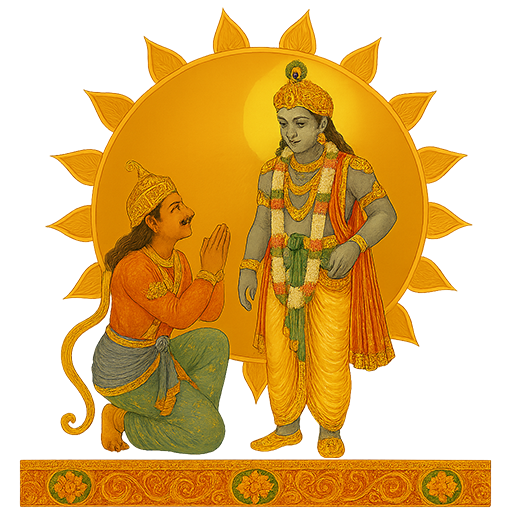
Just think of what Shri Krishna is doing while He speaks these verses. He is the Lord of every Yajna, the One for whom every offering is made, and here He is sitting in the driver’s seat, holding the reins, doing the humble work of a charioteer for His friend. A few verses later, in 3.22, He tells Arjuna that there is nothing in all the three worlds that He has to do, nothing He lacks and nothing He needs to gain, and yet He never stops working. So He is not asking Arjuna to do anything He does not do Himself. Everything He does is for the good of the world and for those who love Him.
That is the reassurance hidden in these verses. Shri Krishna does not ask Arjuna to become a different person before he begins. He accepts him just as he is, with his duties, his love for his family, his doubts and his fears. And our work does not have to be grand either. It only has to be done sincerely and offered to Him. The kitchen, the office, the classroom and the hospital can all become places of Yajna. And the One who receives our offering is sitting right beside us, holding the reins. Can there be anything more reassuring than that?
Keywords: secret alchemy of actions that liberate us, yajna as sacred offering, karma yoga transformation, work as worship Gita, action without bondage, selfless service path, duty as doorway to freedom, sacred action philosophy, how action becomes liberation instead of bondage, turning everyday work into spiritual alchemy, why Krishna rejects escape as the answer, the hidden secret of acting without accumulating karma, transforming ordinary duty into sacred offering, what is the secret of action that does not bind, how can work liberate instead of trap us, why did Krishna tell Arjuna not to run away, what transforms ordinary karma into yajna, how do I engage fully without being chained to results, Bhagavad Gita chapter 3, verses 3.8 3.9 meaning, niyatam karma, svadharma, Bhagavad Gita 3.8 meaning, Bhagavad Gita 3.9 explained, Bhagavad Gita Chapter 3 verses 8 and 9, Bhagavad Gita Chapter 3 commentary, Karma Yoga explained, Karma Yoga in daily life, Krishna’s teachings on duty and action, action versus inaction in Bhagavad Gita, why action is better than inaction, how to practice Karma Yoga, performing duty without attachment, selfless action in Bhagavad Gita, Nishkama Karma, Niyatam Karma meaning, Niyatam Kuru Karma Tvam, Svadharma and personal duty, Yajna meaning in Bhagavad Gita, Yajna as selfless service, Yajnarthat Karmano Nyatra meaning, Karma Bandhana and liberation, how karma creates bondage, freedom from karmic bondage, work as worship in Bhagavad Gita, offering actions to Lord Krishna, how to surrender the fruits of action, detachment from results, spiritual significance of everyday duties, balancing spirituality and worldly responsibilities, duty versus renunciation, transforming ordinary work into spiritual practice, Karma Yoga and Bhakti Yoga, Idam Na Mama meaning, Tyaga and selfless offering, overcoming laziness and tamas, attachment and ego in spiritual life, mindful action and spiritual growth, Japa Yajna and Nama Japa, Bhagavad Gita teachings for modern life, practical spirituality through Karma Yoga, Krishna’s wisdom on work and responsibility, how to perform actions without creating karma
kṛṣṇadaasa
Servant of Krishna