 Pragmatic Gita

Controlling the Mind through Devotion: Sankhya Yoga
Controlling the mind is a universal challenge, and the Bhagavad Gita offers profound solutions for achieving peace through devotion. In verses 2.61 to 2.66, Shri Krishna teaches how sensory distractions lead to attachment, anger, and delusion, ultimately resulting in self-destruction. The antidote lies in anchoring the mind to God, replacing fleeting desires with eternal devotion.
This reflection explores the transformative power of Controlling the Mind through Devotion, supported by stories from Srimad Bhagavatam. King Bharata’s attachment to a deer highlights the dangers of sensory distractions, while King Ambarish exemplifies how aligning the senses with God-consciousness brings tranquility.
Shri Krishna’s insights emphasize that replacing thoughts of worldly pleasures with devotion leads to divine grace and liberation. The process involves self-discipline, mindfulness, and cultivating a deeper connection with the divine. Drawing parallels to Patanjali’s Yoga Sutras, this episode underscores the importance of calming mental fluctuations to achieve spiritual progress.
Practical steps include replacing negative or distracting thoughts with God’s name, engaging the senses in devotional acts, and cultivating serenity through regular spiritual practice. By doing so, the mind transitions from chaos to clarity, creating space for divine bliss.
Dive into this discussion with krsnadaasa (Servant of Krishna) and discover how combining mental discipline with devotion can transform your spiritual journey.
If you have not already done so, I would request you to review the Chapter 1, Arjuna Vishada Yoga before studying chapter 2 as that would help set the right context.
You can find the explanation of shlokas 55 to 60 here. Please go through that to get better understanding of the context.
You can also listen to all the episodes through my Spotify Portal, Apple Podcast, and on YouTube as well.
Keywords: Controlling the Mind through Devotion, Bhagavad Gita teachings on mind control, Shri Krishna’s wisdom, mind and devotion, sense control techniques, overcoming distractions, achieving inner peace, devotional discipline, spiritual focus and tranquility, mastering thoughts through God-consciousness
Verse 2.61 – 2.66
तानि सर्वाणि संयम्य युक्त आसीत मत्पर: |
वशे हि यस्येन्द्रियाणि तस्य प्रज्ञा प्रतिष्ठिता || 61||
tāni sarvāṇi sanyamya yukta āsīta mat-paraḥ
vaśhe hi yasyendriyāṇi tasya prajñā pratiṣhṭhitā
तानि (tāni) – those; सर्वाणि (sarvāṇi) – all; संयम्य (saṃyamya) – controlling; युक्त (yukta) – engaged; आसीत (āsīta) – should be; मत्पर: (matparaḥ) – focused on Me (referring to Krishna or God); वशे (vaśe) – in control; हि (hi) – indeed; यस्य (yasya) – whose; इन्द्रियाणि (indriyāṇi) – senses; तस्य (tasya) – his; प्रज्ञा (prajñā) – wisdom; प्रतिष्ठिता (pratiṣṭhitā) – established.
Those who control their senses and remain engaged, focused on Me, Indeed, they are established in wisdom.
ध्यायतो विषयान्पुंस: सङ्गस्तेषूपजायते |
सङ्गात्सञ्जायते काम: कामात्क्रोधोऽभिजायते || 62||
dhyāyato viṣhayān puṁsaḥ saṅgas teṣhūpajāyate
saṅgāt sañjāyate kāmaḥ kāmāt krodho ’bhijāyate
ध्यायतो (dhyāyato) – contemplating; विषयान् (viṣayān) – objects of senses; पुंसः (puṃsaḥ) – of a person; सङ्गः (saṅgaḥ) – attachment; तेषु (teṣu) – in them; उपजायते (upajāyate) – arises; सङ्गात (saṅgāt) – from attachment; सञ्जायते (sañjāyate) – arises; कामः (kāmaḥ) – desire; कामात (kāmāt) – from desire; क्रोधः (krodhaḥ) – anger; अभिजायते (abhijāyate) – is born.
Contemplating on the objects of senses, a person develops attachment to them; from attachment, lust arises; and from lust, anger is born.
क्रोधाद्भवति सम्मोह: सम्मोहात्स्मृतिविभ्रम: |
स्मृतिभ्रंशाद् बुद्धिनाशो बुद्धिनाशात्प्रणश्यति || 63||
krodhād bhavati sammohaḥ sammohāt smṛiti-vibhramaḥ
smṛiti-bhranśhād buddhi-nāśho buddhi-nāśhāt praṇaśhyati
क्रोधाद्भवति – (krodhādbhavati) – arises from anger; सम्मोह: – (sammohaḥ) – delusion; सम्मोहात् – (sammohāt) – from delusion; स्मृतिविभ्रम: – (smṛiti-vibhramaḥ) – loss of memory/knowledge; स्मृतिभ्रंशात् – (smṛiti-bhraṁśāt) – from the loss of memory/knowledge; बुद्धिनाशो – (buddhi-nāśaḥ) – destruction of intellect; बुद्धिनाशात् – (buddhi-nāśāt) – from the destruction of intellect; प्रणश्यति – (praṇaśyati) – one perishes
Anger leads to clouding of judgment, which results in bewilderment of memory. When memory is bewildered, the intellect gets destroyed; and when the intellect is destroyed, one is ruined.
रागद्वेषवियुक्तैस्तु विषयानिन्द्रियैश्चरन् |
आत्मवश्यैर्विधेयात्मा प्रसादमधिगच्छति || 64||
rāga-dveṣha-viyuktais tu viṣhayān indriyaiśh charan
ātma-vaśhyair-vidheyātmā prasādam adhigachchhati
रागद्वेषवियुक्तैस्तु (rāgadveṣaviyuktaiṣtu) – free from attachment and aversion, विषयान् (viṣayān) – objects, इन्द्रियैः (indriyaiḥ) – with senses, चरन् (caran) – acting, आत्मवश्यैः (ātmavaśyaiḥ) – self-controlled, विधेयात्मा (vidheyātmā) – disciplined self, प्रसादम् (prasādam) – tranquility, अधिगच्छति (adhigacchati) – attains.
But one who controls the mind, and is free from attachment and aversion, even while using the objects of the senses, attains the Grace of God.
प्रसादे सर्वदु:खानां हानिरस्योपजायते |
प्रसन्नचेतसो ह्याशु बुद्धि: पर्यवतिष्ठते || 65||
prasāde sarva-duḥkhānāṁ hānir asyopajāyate
prasanna-chetaso hyāśhu buddhiḥ paryavatiṣhṭhate
प्रसादे (prasāde) – by God’s grace, सर्वदुःखानां (sarvaduḥkhānāṃ) – all sorrows, हानिः (hāniḥ) – destruction, अस्य (asya) – his, उपजायते (upajāyate) – arises, प्रसन्नचेतसो (prasannachetaso) – of the serene-minded, हि (hi) – indeed, आशु (āśu) – quickly, बुद्धिः (buddhiḥ) – intellect, पर्यवतिष्ठते (paryavatiṣṭhate) – becomes steady.
By divine grace comes the tranquility in which all sorrows end, and the intellect of such a person of serene mind soon becomes firmly established in God.
नास्ति बुद्धिरयुक्तस्य न चायुक्तस्य भावना |
न चाभावयत: शान्तिरशान्तस्य कुत: सुखम् || 66||
nāsti buddhir-ayuktasya na chāyuktasya bhāvanā
na chābhāvayataḥ śhāntir aśhāntasya kutaḥ sukham
नास्ति (nāsti) – there is no, बुद्धिः (buddhiḥ) – intellect, अयुक्तस्य (ayuktasya) – of the unsteady, न (na) – nor, च (ca) – and, अयुक्तस्य (ayuktasya) – of the unsteady, भावना (bhāvanā) – contemplation, न (na) – nor, च (ca) – and, अभावयतः (abhāvayataḥ) – for the one not contemplating, शान्तिः (śāntiḥ) – peace, अशान्तस्य (aśāntasya) – of the restless, कुतः (kutaḥ) – where, सुखम् (sukham) – happiness.
An individual lacking discipline, who has not mastered their mind and senses, cannot possess a determined intellect or consistent meditation on God. Without connecting the mind to God, peace remains unattainable; and without peace, happiness cannot be achieved.
In 2.60, Shri Krishna gave us that startling warning, that these senses are so turbulent that they can carry away by force even the mind of a wise man who is striving.
Now think about the position that leaves us in. If even the striving sage can be swept away, what hope is there for people like us, with our jobs and our phones and our long lists of worries?
That is the exact question these six verses answer. And Shri Krishna answers it by telling us, first, the one thing that actually works, then by laying out step by step how a person falls, and then by showing us that the very same staircase can be climbed in the other direction.
From Sense Control to Inner Peace
Shri Krishna begins with तानि सर्वाणि संयम्य (tāni sarvāṇi saṃyamya), having brought all the senses under control.
All of what? All those senses he has been speaking about since 2.58. The senses that the tortoise withdraws when necessary, and the senses that can carry away even the mind of a wise person who is sincerely striving.
So restraint is necessary. Shri Krishna does not avoid that truth. But if he had stopped with restraint, most of us would be in trouble, because we already know how difficult it is to control the senses merely by force.
So he adds युक्त आसीत (yukta āsīta), remain united, and then the most important expression in this verse, मत्परः (mat-paraḥ), having Me as the highest goal.
The senses need direction. The mind needs somewhere higher to rest. Shri Krishna does not merely tell Arjuna what to turn away from. He tells him whom to turn towards. A useful way to remember this is that spiritual life is not just about छोड़ना (chhoḍnā), leaving. It is also about जोड़ना (joḍnā), joining the mind to Shri Krishna.
Focus your thoughts on the Lord and tie your senses to the yoke of God consciousness.
This is the key to liberation.
Anandamayi Ma has beautifully said that “जहाँ दो है वहीँ दुःख है (jahan do hai wahi dukh Hai)”. Which means there is unhappiness whenever there is a sense of separation from God. There cannot be unhappiness when our thoughts and actions are aligned and united with God consciousness.
Then comes वशे हि यस्येन्द्रियाणि (vaśe hi yasyendriyāṇi), whose senses are under control, and तस्य प्रज्ञा प्रतिष्ठिता (tasya prajñā pratiṣṭhitā), that person’s wisdom is firmly established.
The sthitaprajña has not become dull or afraid of the world. The senses still function. They simply no longer control the person and what destination they are going towards.
Ambarisha Maharaja and the senses
The Shrimad Bhagavatam gives us the beautiful example of King Ambarisha.
स वै मनः कृष्णपदारविन्दयोर्वचांसि वैकुण्ठगुणानुवर्णने ।
करौ हरेर्मन्दिरमार्जनादिषु श्रुतिं चकाराच्युतसत्कथोदये ॥ ९.४.१८ ॥
sa vai manaḥ kṛṣṇa-padāravindayor vacāṃsi vaikuṇṭha-guṇānuvarṇane
karau harer mandira-mārjanādiṣu śrutiṃ cakārācyuta-sat-kathodaye
He engaged his mind in the lotus feet of Shri Krishna, his words in describing the Lord’s glories, his hands in service, and his ears in hearing about Him.
The next verses continue with the eyes, touch, smell, tongue, feet, head, and finally desire itself. Nothing is shut down. Every faculty is given a sacred direction.
That is what संयम्य (saṃyamya) followed by मत्परः (mat-paraḥ) looks like in daily life.
Restraint is necessary, but it becomes much stronger when the senses have a higher direction. Shri Krishna tells us to bring them under control and turn them towards Him.
The first half of the descent
Having told us what steadiness looks like, Shri Krishna now explains how the opposite happens.
He begins with ध्यायतो विषयान्पुंसः (dhyāyato viṣayān puṃsaḥ), when a person keeps dwelling on the objects of the senses.
Notice where the problem begins. Not with seeing something, hearing something, or even enjoying something. It begins with repeated dwelling or contemplating.
The word ध्यायतः (dhyāyataḥ) is related to the root from which we get ध्यान (dhyāna), meditation. In that sense, we are all meditating much of the day. The question is what the mind repeatedly gets drawn towards.
Then सङ्गस्तेषूपजायते (saṅgas teṣūpajāyate), attachment arises.
Then सङ्गात्सञ्जायते कामः (saṅgāt sañjāyate kāmaḥ), from attachment comes काम (kāma).
Here काम (kāma) is much broader than sexual lust. It is craving, the compelling desire that says, “I need this in order to be happy.”
There is a great difference between enjoying something and needing it for our inner balance.
You may enjoy appreciation. But what happens when someone criticises you? You may love a person deeply. Beautiful. But what happens when the mind begins to say, “You must behave as I expect, you must reciprocate as I expect, otherwise I cannot be peaceful”?
That is where attachment becomes a compelling desire.
Then कामात्क्रोधोऽभिजायते (kāmāt krodho ‘bhijāyate), from unfulfilled desire comes anger.
Why? Because we learned in the previous section that by nature, desires can never be satisfied by fulfilling them. They only grow stronger and make us feel frustrated eventually.
Shri Krishna is not condemning the senses, ordinary enjoyment, or love.
Love and attachment are not the same.
Love gives. Whereas, attachment begins to demand.
The problem is not that we enjoy family, work, music, food, beauty or friendship. The problem begins when the mind hands over its control to them.
From anger to spiritual ruin
In 2.63 Shri Krishna continues the sequence.
क्रोधाद्भवति सम्मोहः (krodhād bhavati sammohaḥ), from anger comes delusion.
सम्मोहः (sammohaḥ) is the state where wrong action feels justified, which is why we cannot rely on our own judgement while angry.
We all know this. In anger we can say something cruel to someone we love, and then feel bad for reacting that way.
Then comes सम्मोहात्स्मृतिविभ्रमः (sammohāt smṛti-vibhramaḥ), from delusion comes the disturbance of memory.
This is not merely forgetting facts. Here स्मृति (smṛti) is the living memory of what we know to be true, our teachings, values, previous understanding and spiritual resolutions.
We may have studied the Gita for years and still say or do something in two angry minutes that we regret our entire lifetime.
Then स्मृतिभ्रंशाद् बुद्धिनाशः (smṛti-bhraṃśād buddhi-nāśaḥ), from the collapse of that memory comes the destruction of the discriminating intellect.
The बुद्धि (buddhi) distinguishes what is right from what is merely pleasant, what is lasting from what is passing, and what serves our higher purpose from what satisfies the immediate impulse.
Finally बुद्धिनाशात्प्रणश्यति (buddhi-nāśāt praṇaśyati), when discrimination is destroyed, the person is ruined. Game over.
How to apply this today
Make one rule for moments of strong anger. Feel the anger, but delay the action. Do not send the message, make the call or take the irreversible decision until some clarity has returned.
This is the practice of the pause. When you feel angry or disturbed, pause before saying anything. Don’t let your actions be driven by anger.
Living among things without being owned by them
In 2.64 Shri Krishna gives us the positive picture.
रागद्वेषवियुक्तैस्तु (rāga-dveṣa-viyuktais tu), free from attachment and aversion.
Then विषयानिन्द्रियैश्चरन् (viṣayān indriyaiś caran), moving among sense objects through the senses.
This matters greatly. The spiritually steady person is still living in the world.
Shri Krishna is not teaching escape from ordinary life. Freedom means that the senses are no longer constantly running towards what they like and running away from what they dislike.
Then आत्मवश्यैर्विधेयात्मा (ātma-vaśyair vidheyātmā), with the senses under direction and the inner nature disciplined.
This is an important aspect. By the time we reach the stage of krodha / anger, it is already late in the chain. What is required is that we catch our thoughts right at the first stage, which is contemplation. If we can use the technique of substitution right at that point and direct the mind towards God, then we can completely avoid the downward spiral. This is the inner discipline being taught here, not just external control.
Anyone who has fasted while thinking about food all day knows the difference between outer restraint and inner freedom.
The Zen story of two monks and a woman
There is a very interesting and insightful story that is often taught by Zen masters. It goes like this:
A senior monk and a junior monk were traveling together. At one point, they came to a river with a strong current. As the monks were preparing to cross the river, they saw a very young and beautiful woman also attempting to cross. The young woman asked if they could help her cross to the other side.
The two monks glanced at one another because they had taken vows not to touch a woman.
Then, without a word, the older monk picked up the woman, carried her across the river, placed her gently on the other side, and carried on with his journey.
The younger monk couldn’t believe what had just happened. After rejoining his companion, he was speechless, and an hour passed without a word between them.
Two more hours passed, then three, finally the younger monk could not contain himself any longer, and confronted the older monk “As monks, we are not permitted to touch a woman, how could you then carry that woman on your shoulders?”
The older monk looked at him and replied, “Brother, I set her down on the other side of the river many hours ago, why are you still carrying her?”
Such a beautiful lesson. The problem is not with the sensory objects themselves. The problem is when we start contemplating upon or thinking upon those sensory objects and get attached to them.
Once our attention is caught by some such sensory objects (people or things), it is futile to try and fight those thoughts. Because it doesn’t matter whether you say ‘I want’ or ‘I don’t want’, either way, you end up focusing on the object that you want or don’t want. So, trying to fight those thoughts only makes those thoughts stronger.
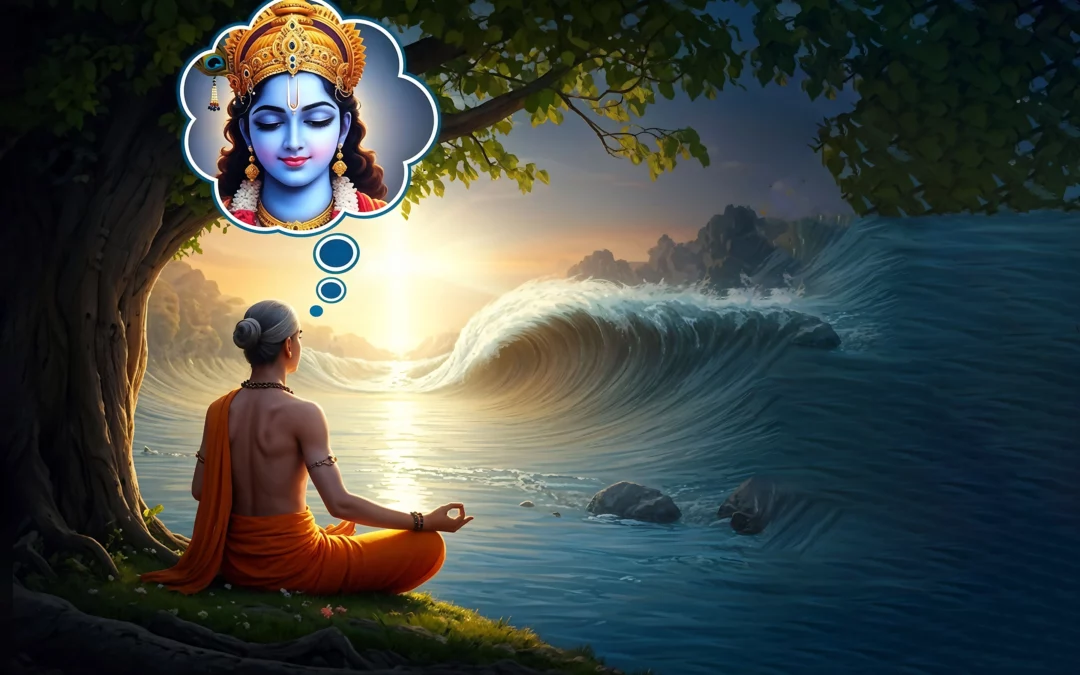
Instead, the trick that Lord Kṛṣṇa explains is to ‘replace’ those thoughts with the thoughts of God and service to God. Every time a name comes to your mind, replace it with the name of God, every time a face comes to your mind, replace it with the face of the Lord. That is the best and only way to escape from the clutches of all self-destructive thoughts.
Pragma 4: Let thoughts of God & service to God replace your thoughts of sensory pleasures.
Then comes प्रसादमधिगच्छति (prasādam adhigacchati), such a person attains प्रसाद (prasāda).
Here प्रसाद (prasāda) carries the sense of serenity, clarity and inward purity. For a devotee it also naturally carries the sense of divine grace.
What does grace often look like within us? A mind that is no longer thrown around by every attraction and irritation.
This does not mean Shri Krishna will arrange every circumstance according to our preference. If grace meant getting everything we wanted, grace itself would become another object of craving.
Sometimes the outer difficulty remains, but it no longer controls the mind. Any difficulty can then become sadhana. Facing life’s challenges with a calm and faithful mind itself becomes a great tapasya.
What prasada does to the mind
In 2.65 Shri Krishna tells us what follows.
प्रसादे सर्वदुःखानां हानिरस्योपजायते (prasāde sarva-duḥkhānāṃ hānir asyopajāyate), in that serenity and grace, sorrow loses its hold.
This does not mean that the devotee will never experience physical pain, loss or difficult circumstances. Arjuna himself still has to face a terrible war.
The deeper teaching is that the bondage of sorrow weakens when the mind is no longer ruled by attachment and aversion.
Spiritually the verse goes further. As attachment loosens and the mind becomes clear, we become capable of recognising our deeper nature and our dependence on the Divine.
Then प्रसन्नचेतसो ह्याशु (prasanna-cetaso hy āśu), for one whose mind has become serene, very quickly, बुद्धिः पर्यवतिष्ठते (buddhiḥ paryavatiṣṭhate), the intellect becomes firmly established.
This is the reversal of 2.63. There we had बुद्धिनाश (buddhi-nāśa), destruction of discrimination.
Here we get to बुद्धिः पर्यवतिष्ठते (buddhiḥ paryavatiṣṭhate), buddhi becomes steady and firmly established.
The same mind that can take us towards destruction through desire, anger and delusion can also take us towards evolution through discipline, non attachment and devotion.
Without inner union, where can happiness come from?
And now Shri Krishna gives us the whole thing from the other end, in a verse built out of four denials.
नास्ति बुद्धिरयुक्तस्य (nāsti buddhir ayuktasya), there is no steady intellect for the one who is not united. And here, listen to the word he chooses. अयुक्तस्य. Not united. It is the exact negative of the word he used in 2.61, युक्त आसीत. He opened this whole teaching with युक्त and closes it with अयुक्त. Everything in between is held inside those two words.
न चायुक्तस्य भावना (na cāyuktasya bhāvanā), and for the unyoked there is no भावना. This is a rich word. Sustained contemplation, the capacity to hold Him steadily in mind. Without uniting the mind such capacity is not possible.
न चाभावयत: शान्ति: (na cābhāvayataḥ śāntiḥ), and for one without the capacity for that bhavana, there is no peace.
अशान्तस्य कुत: सुखम् (aśāntasya kutaḥ sukham), and for the one without peace, how can there be happiness?
Notice that he does not say the restless person will be less happy. He asks a question. Where would it even come from? What would it be made of? That question is the last word of the chapter’s teaching on the sthitaprajña, and it is meant to make us deeply introspect.
We spend so much of life trying to create happiness by rearranging outer conditions. Shri Krishna asks us to look deeper.
If the mind itself is restless, what will it do even with the thing we thought would make us happy?
It will worry about losing it, compare it with what someone else has, want more, or eventually become bored.
Without peace, even pleasure becomes unstable.
kṛṣṇadaasa
(Servant of Krishna)