 Pragmatic Gita

Facing Death with Wisdom of the Eternal Soul in Bhagavad Gita 2.25–2.30
The fear of death is one of humanity’s most profound anxieties, yet the Bhagavad Gita offers a powerful spiritual technology for transcending it. Shri Krishna’s teachings to Arjuna provide a clear path for Facing Death with Wisdom of the Eternal Soul.
This ancient knowledge empowers us to look beyond the temporary nature of the physical body and connect with our true, indestructible essence. By understanding the soul, or Atman, we can navigate life’s greatest certainties, birth and death, with courage and tranquility. The practice of Facing Death with Wisdom of the Eternal Soul is not about morbid fascination; it is about living a life free from the paralyzing grip of fear and grief.
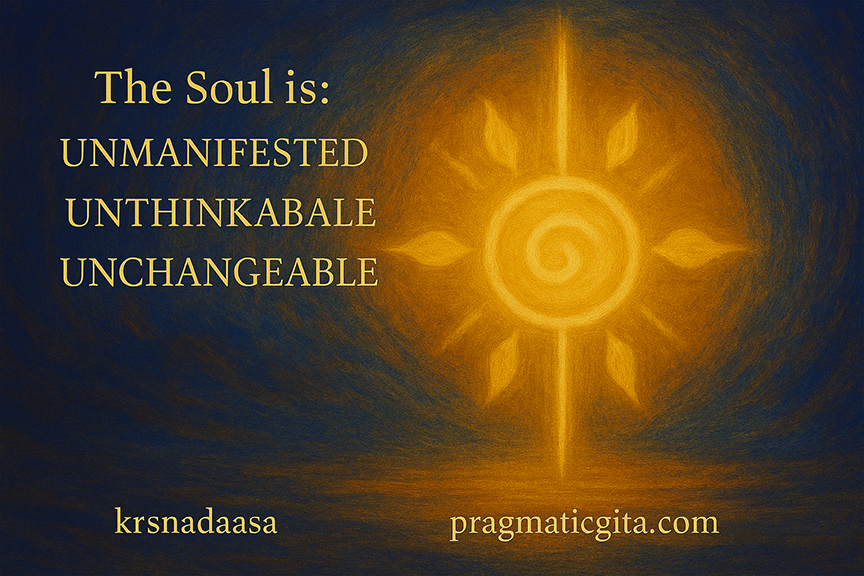
Krishna explains that the soul has three core attributes: it is unmanifest (avyaktaha), unthinkable (achintyaha), and unchangeable (avikaryaha). It is unmanifest because material senses cannot perceive this divine spark. It is unthinkable because the logical mind cannot fully define its limitless nature.
Finally, it is unchangeable because it is never subject to decay, birth, or death. Grasping this is fundamental to Facing Death with Wisdom of the Eternal Soul. Krishna then presents a masterful argument to Arjuna: if you know the soul is eternal, you have no reason to grieve. Even if you believe the soul perishes with the body, grief is still misplaced, because the cycle of birth and death is inevitable for all beings. This insight lies at the heart of Facing Death with Wisdom of the Eternal Soul.
Vedanta expands this truth by describing the Atman as sarva-gata, all-pervading. The Facing Death with Wisdom of the Eternal Soul perspective helps us recognize that life is not extinguished at death but simply transitions into new forms. This realization erases despair and grounds us in faith that our essence is untouched by the body’s demise.
This concept is memorably illustrated in the Mahabharata when Yudhishthir is asked, “What is the most surprising thing in the world?” He replies that day after day, countless beings go to the abode of death, yet those who remain alive think they will live forever. This denial prevents us from truly Facing Death with Wisdom of the Eternal Soul. We remain attached to the temporary body, forgetting the immortal resident within.
Our perception is further clouded by samskaras, the deep mental imprints from past actions that shape karma and reality. Samskaras bind us to patterns of rebirth and to the anxieties surrounding death. Purifying these samskaras through spiritual practice is essential for clarity. Through practices like bhakti yoga, we can dissolve negative samskaras and cultivate positive ones. In this way, Facing Death with Wisdom of the Eternal Soul is not passive acceptance but active spiritual transformation.
By shifting from body-consciousness to soul-consciousness, we move toward a fearless life filled with meaning and inner peace. True spiritual living is the art of Facing Death with Wisdom of the Eternal Soul in every moment. This liberating vision allows us to perform our duties with steadiness, as Krishna urged Arjuna. The entire message of the Gita is a step-by-step guide to Facing Death with Wisdom of the Eternal Soul and attaining liberation beyond the cycle of grief and rebirth.
📚 References
Bhagavad Gita 2.25–2.30
Mahabharata, Vana Parva 313.116
Kaṭhopaniṣhad 1.2.7
Vedantic commentaries on Atman and samskaras
Continue reading for the expanded narrative and explanation of shlokas 2.25 to 2.30
If you have not already done so, I would request you to review the Chapter 1, Arjuna Vishada Yoga before studying chapter 2 as that would help set the right context.
You can find the explanation of shlokas 19 to 24 here. Please go through that to get better understanding of the context.
You can also listen to all the episodes through my Spotify Portal, Apple Podcast, and on YouTube as well.
Keywords: All pervading nature of the soul, eternal soul explained, invisible and immutable soul, samskaras and karma insights, spiritual growth through bhakti yoga, cycle of birth and death explained, unmanifested soul understanding, soul consciousness journey, attributes of the soul, inner peace through spirituality
Verses 2.25 to 2.30
अव्यक्तोऽयमचिन्त्योऽयमविकार्योऽयमुच्यते |
तस्मादेवं विदित्वैनं नानुशोचितुमर्हसि || 25||
avyakto ’yam achintyo ’yam avikāryo ’yam uchyate
tasmādevaṁ viditvainaṁ nānuśhochitum arhasi
अव्यक्तः avyaktaḥ unmanifested अयम् ayaṁ this (self) अचिन्त्यः acintyaḥ unthinkable अयम् ayaṁ this अविकार्यः avikāryaḥ unchangeable अयम् ayaṁ this उच्यते ucyate is said तस्मात् tasmāt therefore एवम् evaṁ thus विदित्वा viditvā having known एनम् enaṁ this न na not अनुशोचितुम् anuśocituṁ to grieve अर्हसि arhasi (thou) oughtest
This Atman is said to be unmanifested, unthinkable and immutable. Therefore, knowing it as such, you should not grieve.
अथ चैनं नित्यजातं नित्यं वा मन्यसे मृतम् |
तथापि त्वं महाबाहो नैवं शोचितुमर्हसि || 26||
atha chainaṁ nitya-jātaṁ nityaṁ vā manyase mṛitam
tathāpi tvaṁ mahā-bāho naivaṁ śhochitum arhasi
अथ atha now च ca and एनम् enaṁ this (self) नित्यजातम् nityajātaṁ constantly born नित्यम् nityaṁ constantly वा vā or मन्यसे manyase thinkest मृतम् mṛtaṁ dead तथा अपि tathā api even then त्वम् tvaṁ thou महाबाहो mahābāho mightly armed न na not एनम् enaṁ this शोचितुम् śocituṁ to grieve अर्हसि arhasi (thou) oughtest
Or if you think that the self is subject to constant birth and death, O mighty-armed Arjuna, even then you should not grieve like this.
जातस्य हि ध्रुवो मृत्युर्ध्रुवं जन्म मृतस्य च |
तस्मादपरिहार्येऽर्थे न त्वं शोचितुमर्हसि || 27||
jātasya hi dhruvo mṛityur dhruvaṁ janma mṛitasya cha
tasmād aparihārye ’rthe na tvaṁ śhochitum arhasi
जातस्य jātasya of the born हि hi for ध्रुवः dhruvaḥ certain मृत्युः mṛtyuḥ death ध्रुवम् dhruvaṁ certain जन्म janma birth मृतस्य mṛtasya of the dead च ca and तस्मात् tasmāt therefore अपरिहार्ये aparihārye inevitable अर्थे arthe in matter न na not त्वम् tvaṁ thou शोचितुम śocituṁ to grieve अर्हसि arhasi (thou) oughtest
Death is certain for one whatever was born, and birth is inevitable for whatever has died. Therefore, you should not lament over the inevitable.
अव्यक्तादीनि भूतानि व्यक्तमध्यानि भारत |
अव्यक्तनिधनान्येव तत्र का परिदेवना || 28||
avyaktādīni bhūtāni vyakta-madhyāni bhārata
avyakta-nidhanānyeva tatra kā paridevanā
अव्यक्तादीनि avyaktādīni unmanifested in the beginning भूतानि bhūtāni beings व्यक्तमध्यानि vyakta madhyāni manifested in their middle state भारत bhārata O Bharata अव्यक्तनिधनानि avyakta nidhanāni unmanifested again in the end एव eva also तत्र tatra there का kā what परिदेवना paridevanā grief
O Bharata, all created beings are unmanifest before birth, manifest in life, and again unmanifest on death. What is the point then in grieving?
(Bharata → Hastin → Ajamidha → Kuru → Shantanu → Vichitravirya → Pandu → Arjuna)
आश्चर्यवत्पश्यति कश्चिदेन
माश्चर्यवद्वदति तथैव चान्य: |
आश्चर्यवच्चैनमन्य: शृ्णोति
श्रुत्वाप्येनं वेद न चैव कश्चित् || 29||
āśhcharya-vat paśhyati kaśhchid enan
āśhcharya-vad vadati tathaiva chānyaḥ
āśhcharya-vach chainam anyaḥ śhṛiṇoti
śhrutvāpyenaṁ veda na chaiva kaśhchit
आश्चर्यवत् āścaryavat as a wonder पश्यति paśyati sees कश्चित् kaścit someone एनम् enaṁ this (self) आश्चर्यवत् āścaryavat as a wonder वदति vadati speaks of तथा tathā so एव eva also च ca and अन्यः anyaḥ another आश्चर्यवत् āścaryavat as a wonder च ca and एनम् enaṁ this अन्यः anyaḥ another शृणोति śṛṇoti hears श्रुत्वा śrutvā having heard अपि api even एनम् enaṁ this वेद veda knows न na not च ca and एव eva also कश्चित् kaścit any one
Some see the soul as amazing, some describe it as amazing, and some hear of the soul as amazing, while others, even on hearing, cannot understand it at all.
देही नित्यमवध्योऽयं देहे सर्वस्य भारत |
तस्मात्सर्वाणि भूतानि न त्वं शोचितुमर्हसि || 30||
dehī nityam avadhyo ’yaṁ dehe sarvasya bhārata
tasmāt sarvāṇi bhūtāni na tvaṁ śhochitum arhasi
देही dehī indweller नित्यम् nityaṁ always अवध्यः avadhyaḥ indestructible अयम् ayaṁ this देहे dehe in the body सर्वस्य sarvasya of all भारत bhārata O Bharata तस्मात् tasmāt therefore सर्वाणि sarvāṇi (for) all भूतानि bhūtāni creatures न na not त्वम् tvaṁ thou शोचितुम् śocituṁ to grieve अर्हसि arhasi (thou) shouldest
This, the Indweller in the bodies of all is immortal, O Bharata. Therefore you should not grieve for the loss of any mortal body.
The Sacred Moment on Kurukshetra
Let us recap the situation.
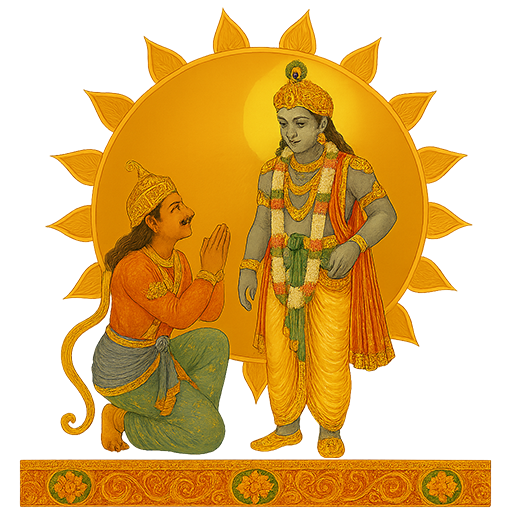
The morning sun climbs over Kurukshetra, casting long shadows across a field that trembles with the energy of countless warriors. The air carries the metallic scent of armor mixed with the dust stirred by restless horses. At the heart of this gathering storm, Arjuna stands frozen in his chariot, the legendary Gandiva bow slipping from his sweat-drenched hands. His shoulders slump under a weight no armor can protect against.
In the midst of this emotional collapse, Shri Krishna speaks.
Having already revealed that the eternal Self, the Atman, cannot be slain by any weapon, burned by fire, wetted by water, or dried by wind, Shri Krishna now prepares to take the teaching deeper. He shows Arjuna not only that the Self cannot be destroyed, but also why it cannot be grasped by the ordinary tools through which we understand the material world.
Three Ways Krishna Describes the Self
Shri Krishna begins by presenting the Self through three profound attributes that challenge everything our material mind thinks it knows.
अव्यक्तः अयम् अचिन्त्यः अयम् अविकार्यः अयम् उच्यते |
तस्मात् एवम् विदित्वा एनम् न अनुशोचितुम् अर्हसि || 25||
avyakto ’yam achintyo ’yam avikāryo ’yam uchyate
tasmādevam viditvainam nānuśhochitum arhasi
अव्यक्तः (avyaktaḥ) – Unmanifested / Invisible;
अचिन्त्यः (acintyaḥ) – Unthinkable / Inconceivable;
अविकार्यः (avikāryaḥ) – Unchangeable / Immutable;
अयम् (ayam) – this;
This Atman is said to be unmanifested, inconceivable, and unchangeable. Therefore, knowing it as such, you should not grieve.
These three qualities open doorways to understanding that transcend ordinary material consciousness.
The Unmanifested Self – Avyaktaḥ
When Shri Krishna declares the Self as avyakta, unmanifest, He points to a reality that exists beyond the range of the senses. You cannot catch the Self. You cannot see it as an object. You cannot place it on a table, measure it with a ruler, weigh it on a scale, or capture it through any instrument.
The Self is not invisible in the same way that a very small physical particle is invisible. It is not hidden somewhere inside the body, waiting for a more powerful microscope to discover it. It is unmanifest because it does not belong to the category of material objects at all.
This is not a defect in our instruments that better technology will one day overcome. The Self cannot be detected as a physical object. It is the conscious subject because of which all objects, measurements, sensations, and experiences are known.
The eyes can see many things, but the eyes cannot see the seer.
The intellect can analyze many subjects, but the Self is the very source that makes such analysis possible.
One analogy may help, though every analogy has limits. Think of the source code behind a computer program. Users interact with buttons, menus, and displays, but the underlying code that makes the program function remains hidden from the ordinary user. You cannot understand the whole program merely by staring at the screen.
Similarly, the Self is not visible to the ordinary person, but without the Self, the body and mind cannot function as living instruments of experience.
But the analogy must not be pushed too far. Source code is still an object. It can be written, copied, deleted, corrupted, or modified. The Self is not like that. The analogy only shows that something unseen may still be the basis of visible functioning. The Self is not a hidden material mechanism. It is consciousness itself.
The Inconceivable Reality – Acintyaḥ
When Shri Krishna says that the Self is acintya, inconceivable, it means that we cannot capture the Self fully through ordinary thought, theory, argument, or imagination.
It does not mean that we should stop thinking. Shri Krishna never asks us to abandon intelligence. He repeatedly teaches Arjuna to think clearly, discriminate properly, and understand deeply.
But the Self cannot be reduced to a concept that can be conceived through thought alone.
So the mind can point toward the Self.
The scriptures can guide us toward the Self.
The guru can help remove the ignorance that is covering the Self.
But we cannot know the self until it reveals itself to us.
Another helpful example is the idea of the map-territory relationship, made famous by the Polish-American thinker Alfred Korzybski, best known for his work Science and Sanity. His famous point was that the map is not the territory.
A map of a city is useful. It shows roads, landmarks, and directions. It helps us navigate. But the map is not the city. It does not contain the smell of the streets, the sound of people, the experience of walking through a market, the feeling of rain on the pavement, or the living complexity of the place itself.
The map points to the city, but it is not the city.
In the same way, our concepts of the Self are like maps. They may be useful. They may guide us. They may prevent us from getting lost. But they are not the direct realization of the Self.
Just like that, no theoretical or conceptual representation of the Self can fully capture what the Self is. It is only through direct spiritual realization that we truly understand.
This is why Krishna calls the Self acintya.
The Unchanging Witness – Avikarya
And the Self is avikārya, immutable, meaning it does not undergo any changes.
Everything in the manifest world changes. The body changes. The senses change. The mind changes. Emotions change. Opinions change. Relationships change. Circumstances change. Even our personality changes over time.
Classical Vedanta often speaks of the six transformations of embodied existence:
Birth.
Existence for a while.
Growth.
Modification.
Decline.
Death.
Everything in prakṛti, everything in the field of nature, passes through change. But the Self is beyond prakṛti and is the witness of change.
Picture a movie screen. On the screen, there may be scenes of raging fire, flowing water, intense joy, deep sorrow, birth, death, war, love, and loss. But the screen itself remains unaffected by the scenes projected upon it.
The Self is like that unchanging screen upon which life’s entire drama appears.
There have always been some philosophers who have believed that there is no such thing as a soul and that we perish along with our body. Such philosophers were known as the Lokayatikas and Vaibhasikas. Such people existed even during Kṛṣṇa’s time.
So, Shri Krishna then tells Arjuna that if he thinks that the soul also dies with the body then also there is no reason to be worried because death is anyways certain.
Or if you think that the self is subject to constant birth and death, O mighty-armed Arjuna, even then you should not grieve like this. 2.26.
A good philosophy which we can try to follow is:
If there’s a solution to your problem, there’s no need to be overwhelmed.
If there’s no solution to your problem, there’s no point in being overwhelmed.
So in the context of these verses, if the soul is eternal and never dies, there is no need to be overwhelmed about death. And if the soul is not eternal and if death is certain, then there is no point in being overwhelmed about death.
Death Is Certain for the Born
In verse 2.27, Shri Krishna follows it up and says:
Death is certain for one who is born, and birth is certain for one who has died. Therefore, you should not lament over the inevitable.
Whatever is born will die.
Whatever dies will be born again.
At one level, this is obvious. We all know it. And yet we live as if it is not true. We behave as if death is an exception, as if it happens only to others, as if somehow we will remain untouched.
Shri Krishna is not saying this to make life depressing. He is not saying, “Everyone will die, so nothing matters.”
He is saying the opposite.
Because death is certain, life must be lived wisely.
Because time is limited, dharma and devotion must not be postponed.
Because the body is temporary, the opportunity of human birth must not be wasted.
Because change is inevitable, attachment must be purified.
The inevitability of death should not make life meaningless. It should make life sacred and purposeful.
Thus, we should get out of body consciousness and endeavour to get into soul consciousness. We should not live as if the body is the whole story. We should use the body as an instrument for dharma, bhakti, service, and realization.
The Cosmic Rhythm
In 2.28, Shri Krishna says O Bharata, all created beings are unmanifest before birth, manifest in life, and again unmanifest on death. What is the point, then, in grieving?
(Bharata → Hastin → Ajamidha → Kuru → Shantanu → Vichitravirya → Pandu → Arjuna)
Shri Krishna says that all beings are unmanifested in the beginning, manifested in the middle and then unmanifested again in the end. It is a cycle. So just as life is temporary, death is also temporary. The soul will find another body, maybe within a few seconds or within a few years after death. So Krishna is again telling Arjuna not to get so attached to the physical body.
आश्चर्यवत्पश्यति कश्चिदेन
माश्चर्यवद्वदति तथैव चान्यः |
आश्चर्यवच्चैनमन्यः शृणोति
श्रुत्वाप्येनं वेद न चैव कश्चित् || 29||
āśhcharya-vat paśhyati kaśhchid enan
āśhcharya-vad vadati tathaiva chānyaḥ
āśhcharya-vach chainam anyaḥ śhṛiṇoti
śhrutvāpyenaṁ veda na chaiva kaśhchit
Some see the soul as amazing, some describe it as amazing, and some hear of the soul as amazing, while others, even on hearing, cannot understand it at all.
As discussed earlier, we have three bodies. Gross body, Subtle body and Causal body. And the soul is beyond these bodies.
The Kaṭhopaniṣhad states:
śhravaṇāyāpi bahubhiryo na labhyaḥ śhṛiṇvanto ’pi bahavo yaṁ na vidyuḥ
āśhcharyo vaktā kuśhalo ’sya labdhā ’ścharyo jñātā kuśhalānuśhiṣhṭaḥ (1.2.7) [v32]
A teacher who is self-realized is very rare. The opportunity to hear instructions about the science of self-realization from such a teacher is even rarer. If, by great good fortune, such an opportunity presents itself, students who can comprehend this topic are the rarest.
Swami Ranganathananda says that the soul, our higher self, is the ultimate teacher and acharya. And to realize that truth within us, we have to elevate ourselves and become an ultimate student. Then self realization happens. And this has to be the pursuit of our lives.
How to elevate ourselves to that level? That is the teaching of the whole of Bhagavad gita, so we need to pay close attention and make the most of the opportunity to understand each verse and internalize it.
Therefore, Krishna asks:
तत्र का परिदेवना
What is the point of excessive lamentation here?
Again, He is not forbidding human sadness. He is questioning deluded grief that comes from taking the temporary visible form to be the whole truth of existence.
The Most Surprising Thing in the World
The Mahabharata relates a beautiful and relevant incident regarding this.
During the period of their exile in the forest, the five Pandavas were once very thirsty. Yudhishthira asked one of his brothers to go and fetch water. When the brother reached a lake, a Yaksha, a powerful celestial being, began speaking from the lake:
“You may drink this water only after answering my questions.”
But the brother ignored the warning and drank the water. As soon as he did, he fell lifeless. When he did not return, Yudhishthira sent another brother. The same warning was given, the same warning was ignored, and the same fate followed. In this way, Bhima, Arjuna, Nakula, and Sahadeva all fell lifeless near the lake.
Finally, Yudhishthira himself came there. The Yaksha warned him too:
“Answer my questions if you want to drink this water. Otherwise, you will meet the same fate as your brothers.”
Yudhishthira agreed to answer the questions. The Yaksha was in fact Yama, the lord of dharma and death, who was also Yudhishthira’s divine father. That is why this dialogue carries such weight in our tradition.
He asked many questions, and Yudhishthira answered them with wisdom and composure.
One of the important questions was:
kim āścaryam?
“What is the most surprising thing in this world?”
To this, Yudhishthira replied:
अहन्यहनि भूतानि
गच्छन्तीह यमालयम् |
शेषाः स्थावरमिच्छन्ति
किमाश्चर्यमतः परम् ||
ahany ahani bhūtāni
gacchantīha yamālayam
śeṣāḥ sthāvaram icchanti
kim āścaryam ataḥ param
“Day after day, countless living beings go to the abode of Yama, the kingdom of death. Yet those who remain alive think that they themselves will remain forever. What could be more astonishing than this?”
(Maharaja Yudhishthira speaking to Yama, Mahabharata, Vana Parva, 313.116)
Here is the same word again: aashcharya.
Krishna says the Self is a wonder.
Yudhishthira says our denial of death is a wonder.
Put the two together and we see the full picture.
The greatest wonder is the immortal Self within us.
The second wonder is that, surrounded by death every single day, we still manage to live as though death applies only to others.
The first wonder is the cure for the second.
When we realize the immortal Self, our denial of death becomes unnecessary. We do not need to pretend that death does not exist. We can face death honestly because we have discovered that the deepest truth of who we are is not destroyed by death.
Shri Krishna explains in these verses that life in this body has a certain end that we cannot escape from. Therefore, instead of being paralysed by fear or denial, we should focus on making the most of our journey.
So in the context of these verses, if the soul is eternal and never dies, there is no need to be overwhelmed about death.
And if the soul is not eternal and if death is certain, then there is no point in being overwhelmed about death.
Shri Kṛṣṇa says that all beings are unmanifested in the beginning, manifested in the middle and then unmanifested again in the end. It is a cycle. So just as life is temporary, death is also temporary. The soul will find another body, maybe within a few seconds or within a few years after death. So Kṛṣṇa is again telling Arjuna not to get so attached to the physical body.
The Indestructible Indweller
This indweller in the bodies of all is always indestructible, O Bharata. Therefore, you should not grieve for any being. 2.30
Shri Krishna uses the profound term dehī, the embodied one, the indweller (dehī nityam avadhyo ’yaṁ dehe sarvasya bhārata).
This is not merely the soul as an abstract idea. This is consciousness as it takes temporary residence in a body. The body is visible, but the dehī is the conscious principle that gives life to it.
A helpful analogy is electricity flowing through a lightbulb. When electricity flows through the bulb, the bulb shines. When the bulb breaks, the light of that particular bulb is gone, but electricity itself is not destroyed.
We should notice the small but powerful word sarvasya – “of all.”
Shri Krishna does not say that the indweller is present only in noble people, spiritual people, learned people, or rich people. He says the indweller is in the body of all.
This is where metaphysics quietly becomes ethics.
If the same indestructible indweller is present in all bodies, then no being can be dismissed as spiritually worthless. No one can be reduced merely to caste, race, gender, nationality, wealth, education, religion, profession, success, failure, or outer behaviour.
Swami Vivekananda thundered this truth across the world: each soul is potentially divine, and the goal is to manifest this divinity within. When Shri Krishna says the indweller is in the body of all, He is laying the foundation not only for fearlessness but also for universal compassion.
The Samskaras and Their Influence in Our Lives
We have spoken about karma and how it keeps the cycle of birth and death moving. We will dive deeper into karma in future sessions. Before that, we should understand the concept of samskara, which is also important to understand. Samskaras are connected to the development of karma and the tendencies that shape our journey.
The Sanskrit word samskara can be understood as an impression, refinement, conditioning, or mental imprint. Every conscious action we perform creates an impression in the mind. The intent behind the action determines how strong these impressions are. These impressions are what we call samskaras.
Some people tend to think negatively even during normal circumstances. Some people tend to react with anger. Some tend to be fearful. Some tend to be violent. Some tend to be happy-go-lucky and carefree. Some naturally lean toward devotion, kindness, discipline, or truthfulness.
These tendencies are not random. They are shaped by past impressions, repeated thoughts, repeated actions, upbringing, environment, choices, and karma. Samskaras influence our thoughts and actions, and our actions in turn create further karma.
Repeated thoughts and actions strengthen our samskaras. That is why some habits and tendencies are extremely hard to change. A thought repeated again and again becomes a tendency. A tendency repeated again and again becomes a habit. A habit repeated again and again becomes our character. And our character shapes our destiny.
Since samskaras influence our karma and our experience of life, the aim of spiritual practice should be to recognize and strengthen those samskaras that support spiritual growth, while gradually weakening and purifying those that keep us bound.
Samskaras are like inner programming. They quietly push us toward certain choices, reactions, attractions, fears, and environments until we consciously purify them.
If we cultivate violence, deceit, greed, exploitation, or selfishness, we create inner patterns that keep drawing us into fields of suffering. Karma is not always a visible one-to-one repayment that we can diagnose from outside. We should not look at someone’s suffering and claim to know exactly which past action caused it. Karma is complicated and subtle.
But the broad principle is clear. What we repeatedly think, desire, and do leaves an impression. Those impressions influence what we become, how we act, and what kinds of experiences we are drawn toward.
This is the deeper meaning behind the saying:
“As you sow, so shall you reap.”
God does not have to stand like a policeman waiting to punish every action externally. The moral structure of life is woven into consciousness itself. Our own impressions shape our tendencies, and our tendencies shape our choices.
That is why ahimsa (non-violence) is not only a favour we do for the other person. It is also a favour we do for ourselves. When I refuse to harm another, I am also refusing to strengthen my own samskara of violence.
Take care of your thoughts, because they shape your samskaras.
Take care of your samskaras, because they influence your karma.
Take care of your karma, because it shapes your destiny.
Only then can we steadily move toward liberation.
The good news is that we can purify negative samskaras. We are not helpless prisoners of past conditioning. This is a very important point. The Gita does not teach fatalism. It teaches transformation.
Bhakti Yoga is one of the most powerful and accessible tools for purifying samskaras and getting on the path to liberation. Bhakti replaces selfish desire with divine longing. It replaces ego-centered action with selfless service and offering. It replaces isolation with surrender. It replaces guilt with sincere repentance and renewed commitment.
As Shri Krishna says in the 9th chapter:
अपि चेत्सुदुराचारो भजते मामनन्यभाक् |
साधुरेव स मन्तव्य: सम्यग् व्यवसितो हि स: ||
api chet su-durāchāro bhajate mām ananya-bhāk
sādhur eva sa mantavyaḥ samyag vyavasito hi saḥ
Even if the most sinful person worships Me with undivided attention and focus, he too must be deemed righteous and saintly, for he has rightly resolved and is properly situated.
And Shri Krishna immediately continues:
क्षिप्रं भवति धर्मात्मा शश्वच्छान्तिं निगच्छति |
कौन्तेय प्रतिजानीहि न मे भक्त: प्रणश्यति ||
kṣipraṁ bhavati dharmātmā śaśvac-chāntiṁ nigacchati
kaunteya pratijānīhi na me bhaktaḥ praṇaśyati
Very quickly, such a person becomes righteous and attains lasting peace. O son of Kunti, declare it boldly: My devotee never perishes.
This is a very reassuring message from Krishna. It does not mean bad conduct does not matter. It does not mean we can continue living wrongly and hide behind devotion. Shri Krishna is not excusing wrongdoing. He is revealing the transforming power of sincere devotion.
When devotion becomes real, it redirects the person’s life. It purifies past tendencies. It gives strength to change. It gives hope to the fallen. It tells us that no one is spiritually hopeless if they sincerely turn toward the Lord.
It does not matter how much we have sinned or how badly we have lived in the past. We still have the potential to transform, purify our samskaras, redirect our karma, and reach the Lord’s abode through sincere devotion, right effort, and Krishna’s grace.
Living the Teaching
These six verses form a complete meditation on existence.
First, Shri Krishna tells us what the Self is:
It is unmanifest.
It is inconceivable.
It is unchanging.
He says how all beings are unmanifest in the beginning, manifest in the middle, and unmanifest again in the end.
Then He tells us that this truth is a wonder. Some see it as a wonder, some speak of it as a wonder, some hear of it as a wonder, but even after hearing, very few truly understand.
Finally, He concludes:
The dehī, the indweller in every body, is indestructible. Therefore, Arjuna should not collapse into grief over the perishable body.
For Arjuna and for us, this teaching addresses the deepest existential anxiety. Death loses its absolute sting when we understand our true nature. Fear begins to dissolve into wonder. Life becomes a conscious participation in the eternal instead of a desperate clinging to the temporary.
This is exactly why Swami Vivekananda placed such emphasis on strength and fearlessness as the practical fruit of this knowledge. The knowledge of the immortal soul is not meant to stay locked inside scripture. It is meant to walk out into daily life as courage, steadiness, compassion, and fearlessness.
As this contemplation closes, imagine Arjuna’s transformation. The sun has climbed higher over Kurukshetra. The morning shadows have shortened. But the darkness in his heart begins to lift. Shri Krishna’s words begin their work, preparing him not just for battle, but for the greater war within: the conquest of ignorance by wisdom, of delusion by clarity, of death by immortality.
When we truly know ourselves as the eternal, indestructible Self rather than the temporary body, everything changes.
We are not temporary beings seeking immortality.
We are immortal beings who have come to experience mortality but then have forgotten our true nature.
That is the practical purpose of Krishna’s teaching. To awaken.
To awaken from body-identification.
To awaken from fear.
To awaken from careless living.
To awaken from the illusion that the temporary is permanent.
To awaken to the indwelling Self.
To awaken to Shri Krishna.
That is why these verses are so powerful. They do not merely tell us that the soul is immortal. They invite us to live as people who realize it.
kṛṣṇadaasa
(Servant of Krishna)