

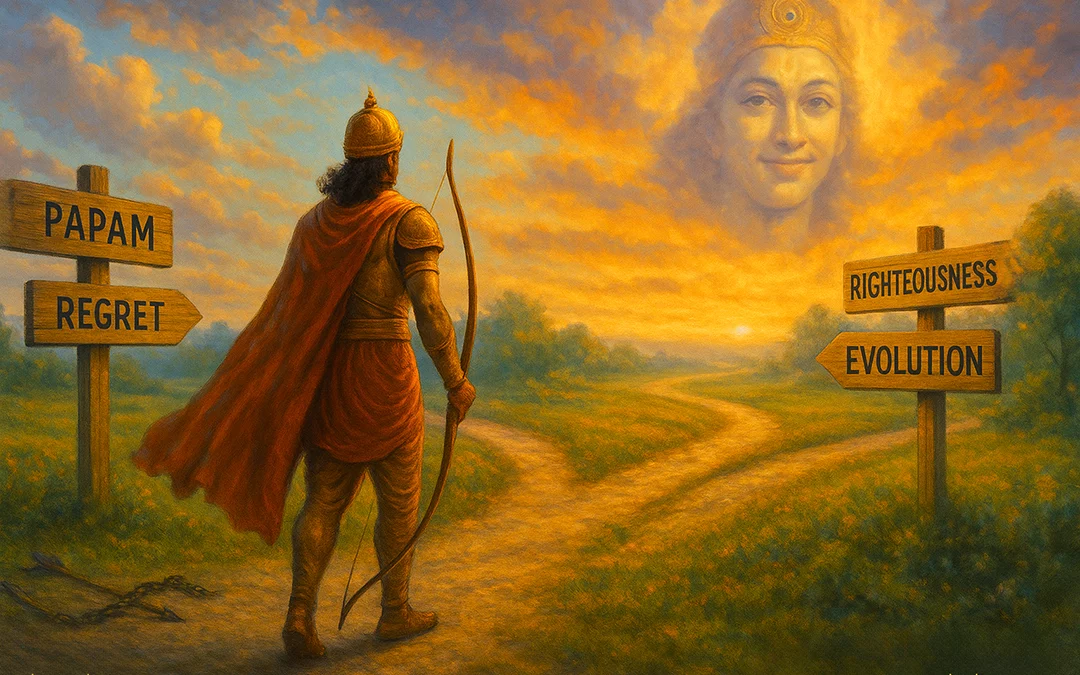

Understanding Dharma and Karma and Specifically Svadharma
This section of the Bhagavad Gita presents timeless teachings on dharma and karma, offering practical insights to navigate life’s challenges while pursuing spiritual progress. In this episode, we unravel the Gita’s wisdom on fulfilling one’s duties (dharma) and the impact of our actions (karma) on shaping our destiny. We will also learn about swadharma / svadharma, yuga dharma, para dharma, apara dharma.
Learn about the three categories of karma, Sanchita karma (past accumulation), Prarabdha karma (current experience), and Kriyamana karma (current actions) and how they interact to determine our life’s circumstances. Understand why Krishna encourages Arjuna to face his challenges with courage and why abandoning one’s dharma leads to spiritual stagnation.
This episode also explores the practical process of spiritual growth: Shravan (hearing divine wisdom), Manan (reflecting deeply), and Nidhidhyasan (internalizing and living the knowledge). Using real-life examples, such as Arjuna’s humility versus Karna’s pride, we see how our intent and responses to situations profoundly shape our karmic future.
Whether you’re seeking inspiration for your spiritual journey or practical guidance to tackle everyday dilemmas, Krishna’s teachings on karma and dharma offer a profound yet accessible roadmap to personal and spiritual evolution.
Listen now and start aligning your actions with your higher purpose.
If you have not already done so, I would request you to review the Chapter 1, Arjuna Vishada Yoga before studying chapter 2 as that would help set the right context.
You can find the explanation of shlokas 25 to 30 here. Please go through that to get better understanding of the context.
You can also listen to all the episodes through my Spotify Portal, Apple Podcast, and on YouTube as well.
Keywords: dharma and karma, Bhagavad Gita lessons, understanding dharma, karma yoga principles, good karma examples, dharma in action, spiritual progress steps, karmic cycle explained, practical vedanta teachings, duty and destiny
Verse 2.31 – 2.37
स्वधर्ममपि चावेक्ष्य न विकम्पितुमर्हसि |
धर्म्याद्धि युद्धाच्छ्रेयोऽन्यत्क्षत्रियस्य न विद्यते || 31||
swa-dharmam api chāvekṣhya na vikampitum arhasi
dharmyāddhi yuddhāch chhreyo ’nyat kṣhatriyasya na vidyate
स्वधर्मम् svadharmaṁ own duty अपि api also च ca and अवेक्ष्य avekṣya looking at न na not विकम्पितुम् vikampituṁ to waver अर्हसि arhasi (thou) oughtest धर्म्यात् dharmyāt than righteous हि hi indeed युद्धात् yuddhāt than war श्रेयः śreyaḥ higher अन्यत् anyat other क्षत्रियस्य kṣatriyasya of a Kshatriya न na not विद्यते vidyate is
As a warrior, it’s your duty to stay steadfast and unwavering. In fact, there’s no greater calling for a warrior than to fight for the sake of righteousness (dharma).
यदृच्छया चोपपन्नं स्वर्गद्वारमपावृतम् |
सुखिन: क्षत्रिया: पार्थ लभन्ते युद्धमीदृशम् || 32||
yadṛichchhayā chopapannaṁ swarga-dvāram apāvṛitam
sukhinaḥ kṣhatriyāḥ pārtha labhante yuddham īdṛiśham
यदृच्छया yadṛcchayā of itself च ca and उपपन्नम् upapannaṁ come स्वर्गद्वारम् svargadvāraṁ the gate of heaven अपावृतम् apāvṛtaṁ opened सुखिनः sukhinaḥ happy क्षत्रियाः kṣatriyāḥ Kshatriyas पार्थ pārtha O Partha लभन्ते labhante obtain युद्धम् yuddhaṁ battle ईदृशम् īdṛśaṁ such
O Partha, happy are the warriors to whom such opportunities to fight for the sake of dharma come unsought, opening for them the gateway to the heavens.
अथ चेतत्त्वमिमं धर्म्यं संग्रामं न करिष्यसि |
तत: स्वधर्मं कीर्तिं च हित्वा पापमवाप्स्यसि || 33||
atha chet tvam imaṁ dharmyaṁ saṅgrāmaṁ na kariṣhyasi
tataḥ sva-dharmaṁ kīrtiṁ cha hitvā pāpam avāpsyasi
अथ चेत् atha cet but if त्वम् tvaṁ thou इमम् imaṁ this धर्म्यम् dharmyaṁ righteous संग्रामम् saṁgrāmaṁ warfare न na not करिष्यासि kariṣyasi will do ततः tataḥ then स्वधर्मम् svadharmaṁ own duty कीर्तिम् kīrtiṁ fame च ca and हित्वा hitvā having abandoned पापम् pāpaṁ sin अवाप्स्यसि avāpsyasi shall incur
But if abandoning your own duty and honor you will not fight this righteous war, you will incur sin.
अकीर्तिं चापि भूतानि, कथयिष्यन्ति तेऽव्ययाम् |
सम्भावितस्य चाकीर्ति, र्मरणादतिरिच्यते || 34||
akīrtiṁ chāpi bhūtāni, kathayiṣhyanti te ’vyayām
sambhāvitasya chākīrtir, maraṇād atirichyate
अकीर्तिम् akīrtiṁ dishonour च ca and अपि api also भूतानि bhūtāni beings कथयिष्यन्ति kathayiṣyanti tell ते te thy अव्ययाम् avyayāṁ everlasting सम्भावितस्य saṁbhāvitasya of the honoured च ca and अकीर्तिः akīrtiḥ dishonour मरणात् maraṇāt than death अतिरिच्यते atiricyate exceeds
People will speak of you as a coward and a deserter. For a respectable person, infamy is worse than death.
भयाद्रणादुपरतं मंस्यन्ते त्वां महारथा: |
येषां च त्वं बहुमतो भूत्वा यास्यसि लाघवम् || 35||
bhayād raṇād uparataṁ mansyante tvāṁ mahā-rathāḥ
yeṣhāṁ cha tvaṁ bahu-mato bhūtvā yāsyasi lāghavam
भयात् bhayāt from fear रणातू raṇāt from the battle उपरतम् uparataṁ withdrawn मंस्यन्ते maṁsyante will think त्वाम् tvāṁ thee महारथाः mahārathāḥ the great car-warriors येषाम् yeṣāṁ of whom च ca and त्वम् tvaṁ thou बहुमतः bahumataḥ much thought of भूत्वा bhūtvā having been यास्यासि yāsyasi will receive लाघवम् lāghavaṁ lightness
The great generals who hold you in high esteem will think that you fled from the battlefield out of fear, and thus will lose their respect for you.
अवाच्यवादांश्च बहून्वदिष्यन्ति तवाहिता: |
निन्दन्तस्तव सामर्थ्यं ततो दु:खतरं नु किम् || 36||
avāchya-vādānśh cha bahūn vadiṣhyanti tavāhitāḥ
nindantastava sāmarthyaṁ tato duḥkhataraṁ nu kim
अवाच्यवादान् avācyavādān words that are improper to be spoken च ca and बहून् bahūn many वदिष्यन्ति vadiṣyanti will say तव tava thy अहिताः ahitāḥ enemies निन्दन्तः nindantaḥ cavilling तव tava thy सामर्थ्यं sāmarthyaṁ power ततः tataḥ than this दुःखतरम् duḥkhataraṁ more painful नु nu indeed किम् kiṁ what
Your enemies will defame and humiliate you with unkind words, disparaging your might. What could be more painful than that?
हतो वा प्राप्स्यसि स्वर्गं जित्वा वा भोक्ष्यसे महीम् |
तस्मादुत्तिष्ठ कौन्तेय युद्धाय कृतनिश्चय: || 37||
hato vā prāpsyasi swargaṁ jitvā vā bhokṣhyase mahīm
tasmād uttiṣhṭha kaunteya yuddhāya kṛita-niśhchayaḥ
हतः hataḥ slain वा vā or प्राप्स्यसि prāpsyasi (thou) will obtain स्वर्गम् svargaṁ heaven जित्वा jitvā having conquered वा vā or भोक्ष्यसे bhokṣyase (thou) wilt enjoy महीम् mahīṁ the earth तस्मात् tasmāt therefore उत्तिष्ठ uttiṣṭha stand up कौन्तेय kaunteya O kaunteya युद्धाय yuddhāya for fight कृत निश्चयः kṛta niścayaḥ resolved
If you fight, you will either be slain on the battlefield and go to the celestial abodes, or you will gain victory and enjoy the kingdom on earth. Therefore arise with determination, O son of Kunti, and be prepared to fight.
Setting the tone and context
Think about a really tough choice. What do you think feels worse in the long run: the pain and struggle of performing your duties and taking care of your responsibilities, or the regret of not having done it? 🤔For example, the pain and struggle of providing the right care and education to your kids vs the regret of not having cared for them when they needed it the most?
That’s a deep question, isn’t it? It’s a feeling we all know. In the verses that follow, Shri Krishna is going to give Arjuna a very clear and powerful answer to this exact problem.
He’s essentially going to tell Arjuna, “I know this feels incredibly hard right now, but I want you to think about the long run.”
Shri Krishna will show him that the immediate pain of the struggle is temporary, but the pain of regret and dishonor from abandoning your duty lasts forever. He’ll argue that the shame you feel inside yourself from not doing the right thing is far worse than any battle.
So, as we go through these verses, you’ll hear Shri Krishna lay out the heavy price of inaction. He’ll then completely reframe the situation to show Arjuna that by stepping up and facing his responsibility, he is victorious no matter what happens.
There is one more thing to keep in mind before we begin, and it will save us from a misunderstanding later. In these particular verses, Shri Krishna is speaking to Arjuna in the language Arjuna already understands, the language of a warrior. He talks about honor, about heaven, about victory on earth. The deeper teaching, the one about acting without any attachment to the fruits of action, is coming very soon, from verse 2.38 onward. So for now, watch how lovingly Shri Krishna uses the warrior’s own mindset to lift him out of his despair.
Svadharma: The Sacred Architecture of Your Unique Purpose
Shri Krishna begins his teaching in verse 2.31 with words that cut straight to the heart: “As a warrior, it’s your duty to stay steadfast and unwavering. In fact, there’s no greater calling for a warrior than to fight for the sake of righteousness (dharma).“
Let us sit with this word, svadharma or Swa-dharma, and truly understand what Krishna is revealing. “Sva” means self, but not the small self of ego. It means your authentic nature based on your predominant gunas. “Dharma” means that which upholds, sustains, and maintains the harmony of existence. Together, svadharma becomes the unique way in which you personally uphold the cosmic order.
Imagine the universe as a vast orchestra. Every instrument has its part to play. The flute cannot become a drum, no matter how much it might admire the drum’s power. The violin cannot become a trumpet, regardless of how it might envy the trumpet’s boldness. The beauty of the symphony depends on each instrument playing its authentic note. If even one refuses its part because the music seems too difficult or too painful, the entire composition loses its harmony.
This is what Krishna is telling Arjuna. You are not just any instrument in this cosmic orchestra. You are a specific instrument with a specific part to play. For Arjuna, born into the kshatriya tradition, that instrument is the warrior’s bow. But understand clearly what this means. The word kshatriya comes from “kshatra,” meaning protection. A true warrior is not one who conquers for glory. A true warrior is one who stands between the innocent and harm, between order and chaos, between dharma and its destruction.
The Layers of Duty: From Universal to Personal
To understand this teaching fully, we must see how dharma operates at different levels.
First, there is Sanatana Dharma, the eternal principles that apply to every conscious being. Truth, compassion, purity of heart, non-violence where applicable. These are the core values that never change, regardless of time, place, or circumstance. They are eternal principles.
Then there is Yuga Dharma, the practice that is especially suited and emphasized for a particular age or yuga. The tradition tells us that in Satya Yuga the path was deep meditation, in Treta Yuga it was sacrifice and yajña, in Dvapara Yuga it was elaborate temple worship, and in our own Kali Yuga the simplest and most powerful path is nāma-saṅkīrtana, the singing and chanting of the holy names of the Lord. The same goal, but a different approach was recommended for each yuga according to the capacity of the people living in it.
Closely related to this, though slightly different, are customs that are bound to a particular time and place. Take the old principle that a brahmin no longer stays a brahmin if he crosses the oceans. This was mostly because travel across the ocean was very hard, time consuming, and a person could not adhere to a brahmin’s diet or a brahmin’s duties during that kind of a trip. Besides, the climate and culture of foreign lands would cause severe impediments in what diet one could follow and what duties one could perform.
That principle was a practical convention bound to its time, and it is no longer applicable in today’s world, because anyone can travel across any ocean comfortably in an airplane and maintain whatever diet they choose.
So you see, some things in our tradition are eternal and never change, whereas others are wisely suited to a particular age or a particular circumstance, and we must have the discernment to differentiate one from the other.
Then there is Varna Dharma, the duties that arise from our particular capacities and roles in society. Some are born with the gift of wisdom and communication. Their dharma involves teaching and preserving knowledge. Some have the gift of strength and leadership. Their dharma involves protecting dharma and the society. Some have the gift of commerce and business sense. Their dharma involves ensuring prosperity flows to all. Some have the gift of service and craftsmanship. Their dharma involves supporting the whole of society through their skills.
There is also Ashrama Dharma, the duties tied to our stage in life. The student’s dharma is to learn with humility. The householder’s dharma is to support family and society. The elder’s dharma is to guide with wisdom. The renunciate’s dharma is to practice total vairagyam and seek the ultimate truth.
For Arjuna at this moment, he was made to remember his eternal duty to uphold truth, his warrior’s duty to protect dharma, and his life stage as a mature warrior. He must fight. Not because fighting is good in itself, but because in this specific moment, his dharma as a kshatriya was to fight for dharma, and his refusal to fight would allow adharma to spread and cause the pain and destruction of society.
The Weight of Abandoning Duty
In verse 2.33, Shri Krishna delivers a warning that might seem harsh to modern ears: तत: स्वधर्मं कीर्तिं च हित्वा पापम् अवाप्स्यसि” If you do not fight this righteous war, abandoning your duty and honor, you will incur sin.”
The word Shri Krishna uses is “papam,” often translated as sin. But let us understand what this really means. Papam is not about punishment from an angry God. It is about the natural consequence of betraying your own truth. It is the wound you inflict on your own soul when you know what is right but choose what is not (preya vs shreya).
This is the eternal tug of war between shreya, what is truly good for us, and preya, what is merely pleasant in the moment.
Modern psychology has a term for this. They call it moral injury. Veterans know it well. It is not the trauma of what happened to you, but the trauma of what you did or failed to do. The soldier who abandoned his post and survived while his friends died. The officer who followed an unjust order against his conscience. These wounds often run deeper than any physical injury, because they are self-inflicted wounds that last a lifetime.
This applies far beyond the battlefield. Think of the teacher who sees a child being bullied but stays silent to avoid complications. Think of the neighbor who hears voices screaming for help next door but doesn’t care enough to even call for help. Each of these moments of failure to act according to our dharma creates what Shri Krishna calls papam. It is not divine punishment. It is the natural consequence of self-betrayal.
Please note that papam is incurred not just by doing what is wrong but also by refusing to do what is right and aligned with your dharma.
Honor and Dishonor: The Mirror of the Soul
Shri Krishna then speaks to Arjuna about something that might seem superficial to our modern minds, the concept of reputation. In verses 2.34 to 2.36, he says that people will speak of Arjuna’s dishonor forever, and for someone like Arjuna, dishonor is worse than death.
We might think, “Why should a spiritual person care what others think?” But Shri Krishna’s wisdom runs deeper. The Sanskrit word is “akirti,” which means more than just bad reputation. It refers to the lasting impact of our actions on the collective memory of humanity.
Take the example of Ravana from Ramayana. He was a very wise, very strong and very devoted person. He was such an accomplished yogi that he could communicate with Shiva. And yet, all the world remembers is his akirti. The wrong deeds he did, which brought his own downfall.
Arjuna and Karna: Two Paths from Similar Pain
The Mahabharata gives us a powerful comparison in the parallel lives of Arjuna and Karna. Both were strong warriors and master archers. Both faced discrimination and challenges. Both had to fight for recognition. But their responses to these similar circumstances created vastly different destinies.
Karna’s life began with abandonment. Born to Kunti before her marriage, he was set afloat in a basket and raised by a charioteer. All his life, he burned with the need to prove himself worthy of the kshatriya status that was denied to him. When Duryodhana offered him friendship and recognition, Karna bound himself to this prince with chains of obligations, even though he knew Duryodhana walked the path of adharma.
Arjuna faced his own trials. Exiled, humiliated, forced to hide in disguise, he too knew the bitter taste of injustice. But instead of letting bitterness shape him, he used each trial to refine his character. Where Karna sought validation from others, Arjuna sought excellence within himself. Where Karna’s loyalty was to the person who recognized him, Arjuna’s loyalty was to dharma itself.
The crucial moment came when Shri Krishna revealed to Karna his true birth, offering him the throne of Hastinapura as the eldest Pandava. Karna refused, choosing to die fighting for the wrong side rather than abandon his benefactor.
His choice seems noble on the surface, but it shows the tragedy of misplaced loyalty. He chose personal obligation over swadharma.
These two great warriors started from similar pain but made different choices with their free will. Karna’s choices bound him to tragedy. Arjuna’s choices, difficult as they were, led him toward liberation. Same soil, different seeds, different fruits.
The Three Layers of Karma: Your Past, Present, and Future
Before we go further, let us pause on a question that naturally arises here. If Arjuna’s duty was shaped by his birth, his lineage, his circumstances, then how much of our life is fixed, and how much is in our hands? The answer lies in understanding karma, and this understanding will give us tremendous courage to act.
Karma is the principle of cause and effect that governs the universe. Every action we perform, whether good or bad, creates a reaction or consequence, which shapes our destiny. As per Vedanta, karma falls into three categories, Sanchit Karma, Prarabdha Karma, and Kriyamana Karma.
Sanchit Karma refers to the accumulated karma of all our past lives. It is the sum total of all the good and bad actions that we have performed in our previous lives. These karmas are stored in our soul as impressions, which shape our present life and our future destiny.
Prarabdha Karma refers to the portion of our Sanchit Karma that has been allocated to our current birth. It is the karma that we have to experience and cannot be avoided.
For example, suppose someone has accumulated a lot of good karma in their past lives through acts of charity and kindness towards others. As a result, they are born into a wealthy and prosperous family in their current life. However, they also had accumulated some bad karma in some of their past lives which gets carried into this current life, and despite their wealth and status, they suffer from a chronic health condition.
In this example, the chronic health condition is the Prarabdha Karma which has been carried over for resolving in the present life. The individual may have no control over the condition itself, but they can choose how they respond to it.
It’s important to note that Prarabdha Karma doesn’t necessarily have to be negative or unpleasant. It could also manifest as positive experiences or situations that we are destined to encounter in our current life due to our past actions. Ultimately, the purpose of understanding Prarabdha Karma is to help us accept and deal with our current life circumstances, and to make conscious choices in our present actions to shape our future.
Acceptance of our hardships, and acknowledging that these are due to our own past karmas, is a very empowering act, and this in itself reduces our karmic burden to a great extent. This is the spirit of what is often attributed to the great poet Rumi, that the moment we truly accept the troubles we have been given, the doors begin to open.
Kriyamana Karma refers to the karma that we are currently creating in our present life through our thoughts, words, and actions. It is the karma that is being created right now and will bear fruit in our future.
For example, if someone volunteers at a charity and helps others in need, they are creating positive Kriyamana Karma, which will bring them good fortune. Conversely, if someone engages in negative activities such as lying or stealing, they are creating negative Kriyamana Karma, which will have painful consequences.
Now here is the part that should fill us with hope. Our prarabdha and sanchita karma are fixed and they determine our destiny. However, our kriyamana karma is not fixed. That is entirely in our hands. We decide whether we create good karmas or bad karmas in our current life. And our kriyamana karma can offset our sanchita karma and prarabdha karma.
This is precisely why Shri Krishna keeps urging Arjuna to act. The circumstances were not in Arjuna’s control, but the response was very much in his control, and the response is where our whole destiny takes shape from.
The Alchemy of Response: Transforming Lead into Gold
There is a beautiful film called “Groundhog Day” that perfectly illustrates how karma works. Bill Murray plays Phil, a cynical weatherman trapped in a time loop, forced to relive the same day over and over. At first, he uses this for selfish purposes. He seduces women using knowledge from previous loops. He robs banks knowing there are no consequences as he will again get to start fresh the next day. He gorges himself on food. But nothing changes. He remains trapped, growing more miserable with each repetition.
Then something shifts. He begins to use the loops to help others. He saves a child from falling. He helps a homeless man. He learns piano. He transforms himself from a selfish cynic into a person of genuine kindness and skill. Only then does the loop break.
This is exactly how karma works. We face the same types of situations repeatedly until we learn to respond differently. That difficult coworker who triggers you? They are not your enemy. They are your teacher, showing you where you still need to grow. That recurring conflict with your spouse? It is not a curse. It is a curriculum, asking you to develop new capacities for patience, understanding, and love.
The universe is not punishing us with these repetitions. It is educating us. And the moment we truly learn the lesson, the moment we respond from wisdom rather than from our old patterns, the cycle breaks and we move to the next level of our evolution.
We’ve seen how Phil transformed his endless loop by changing his response. Now let’s discover what loops are waiting for transformation in your own life. Let’s take 15 minutes to identify where your own Kurukshetra is calling you…
The Story of the Wall: When Intention Aligns with Divine Will
In a small village in Tamil Nadu, there lived a wealthy landlord named Krishnan. He had just finished painting the compound wall around his property a pristine white. This wall was his pride. He would walk along it every morning, admiring its perfection. He put up signs: “Do not touch this wall. Do not write on this wall. Violators will be prosecuted.”
The village children were terrified of him. They would cross to the other side of the street rather than walk too close to his precious wall. Parents warned their children, “Stay away from Krishnan’s wall or there will be trouble.”
One day, a young boy named Ravi, perhaps seven years old, was walking home from school. He carried a piece of charcoal he had found. As he passed the famous wall, an idea struck him. He stood there for a long moment, charcoal in hand, knowing he was forbidden to write anything on this wall.
But Ravi had been taught by his grandmother to always think of others. He thought about how proud Krishnan was of his wall. He thought about how upset Krishnan got when people dirtied it. And then, with these thoughts, he scribbled something on the wall.
When Krishnan saw a kid writing something on his wall, he got furious and he ran towards him with a stick in hand. But then he read the words that were written on the wall. “Please keep this wall clean and beautiful. Thank you.”
This child had not defiled his wall. This child had joined him in protecting it. The message aligned perfectly with his own wishes.
Krishnan’s anger melted. He actually smiled, something the villagers rarely saw. He found young Ravi and instead of punishment, gave him sweets and a small reward. He even had Ravi’s message painted permanently on the wall in beautiful letters.
Now imagine if Ravi had written an insult. Or drawn a crude picture. The physical act would have been identical. Charcoal on the wall. But the karma would have been completely different. Why? Because in writing a message of care and protection, Ravi aligned his action with the landlord’s will. In the same way, when we align our actions with divine will, with dharma, even difficult actions become liberating rather than binding.
This is what Shri Krishna is teaching Arjuna. Fighting is Arjuna’s wall. He cannot avoid it. But what he writes on that wall with his actions, whether he fights from ego and anger or from duty and dharma, that determines whether the battle binds him or liberates him.
The Heaven and the Earth, Reading Verse 2.37 Rightly
Then comes verse 2.37, and at first hearing it can feel very materialistic. Slain, you reach heaven. Victorious, you rule the earth. So rise, son of Kunti, and fight.
What had stopped Arjuna in the first place? Fear of death, his own and theirs. Fear of carrying the weight of victory. Fear, underneath all of it, that whichever way he turned there was only loss. And so Shri Krishna speaks straight into that fear, in the only language a warrior in that moment can still relate with. If you fall here, doing the very thing you were born to do, you have lost nothing. And if you stand and prevail, the earth itself is yours to serve. There is no doorway in front of you that leads to ruin.
Notice that he speaks of heaven and honor and not kingdoms, the whole vocabulary Arjuna already lives and breathes. This is not yet the highest teaching, and Krishna knows it. He is giving a trembling man something solid under his feet before asking him to look up.
From the very next verse, Shri Krishna begins to turn Arjuna’s gaze past heaven and earth altogether, toward a stillness that treats pleasure and pain, gain and loss, victory and defeat as one and the same, and acts without being attached to the fruits. But you cannot ask a trembling , falling man to admire the sky. First you give him firm ground to stand on. Then you ask him to look up and see the glory of the sky above.
The Call of Kunti: Maternal Strength in Warrior Form
Notice how Shri Krishna addresses Arjuna as “Kaunteya,” son of Kunti. This is not random. In Arjuna’s moment of weakness, Shri Krishna invokes his mother’s strength. And what strength it was.
Kunti’s life was one long trial of courage. Abandoned with a secret pregnancy, she gave up her firstborn. Married to a king who could not father children, she used divine boons to conceive. Widowed young, she protected five sons from a murderous cousin. Exiled to the forest, she maintained their royal dignity and training. Through it all, she never wavered from dharma.
When Shri Krishna calls Arjuna “son of Kunti,” he is saying, “Remember whose blood flows in your veins. Your mother faced abandonment, widowhood, exile, assassination attempts. Did she run? Did she break? No. She stood firm in dharma through it all. You are her son. Rise to your inheritance.”
This is the power of lineage, not as mere genetics but as inherited strength. We all carry such strength from those who came before us. In our moments of weakness, we can draw on their courage. That grandmother who survived partition. That grandfather who built a life from nothing. That ancestor who stood for justice when it cost everything. Their strength is our inheritance, if we choose to claim it.
Why Life Must Not Be Abandoned
This teaching also illuminates why the dharmic traditions consider suicide the ultimate abandonment of duty. When Shri Krishna says fleeing the battlefield would be sin, he is establishing a principle that extends to life itself.
Life is a school. Every situation is a classroom. Every challenge is a curriculum designed specifically for our growth. To leave by our own hand is to drop out of school before graduation. It solves nothing, because the soul must return to learn the lessons it set aside.
But let me be very clear, and please hear this gently, because it matters more than any philosophy. This is not about judgment or condemnation. Those who struggle with thoughts of ending their life are not weak or sinful. They are in pain that feels unbearable. Depression is real. Mental illness is real. These are medical conditions that call for compassion and treatment, not moral lectures.
And here is something I want to say with all the warmth I have. If you are carrying that kind of pain, reaching out for help is not a weakness. It is your svadharma. To ask for help, to speak to a doctor, to a counselor, to a trusted friend or family member, takes real courage. That is a warrior’s act, not a coward’s. The warrior does not fight alone, and neither must you. Holding on, asking for support, letting others stand beside you, all of this is exactly the kind of steadfastness Shri Krishna is praising.
The principle Shri Krishna teaches is about the purpose of life itself. Even in our darkest moments, life offers opportunities for growth, for service, for transformation. The severely ill can teach us about courage. The heartbroken ones can teach us about love. The struggling ones can teach us about resilience. Everyone has something to offer, some role to play in the cosmic orchestra. Your life is important.
The Warrior Spirit for Our Times
As we conclude this exploration of verses 2.31 to 2.37, we see that Krishna’s message to Arjuna is his message to us. We are all warriors on the battlefield of life. Our enemies are not other people but our own fears, doubts, and tendencies to abandon our post when things get difficult.
The warrior spirit Krishna invokes is not about violence or aggression. It is about courage in the face of fear, integrity in the face of temptation, persistence in the face of obstacles. It is about standing for something greater than our own comfort.
Your Kurukshetra is wherever you are right now. Your Arjuna moment is whatever difficult choice you face today. Krishna’s timeless wisdom speaks across the centuries. Do not waver. Your duty is your path to the divine. Your challenges are your opportunities. Your fears are your teachers.
Rise up. Take your position. Act from dharma. Let the results be what they will be. In this alignment of action with eternal principles, you find not just success or failure but something far greater, the peace that comes from living your truth.
The battlefield awaits. But now you understand. It was never about the battle. It was always about becoming who you were meant to be.
If you or someone you know is struggling with thoughts of self-harm, please reach out to a qualified mental health professional or a local crisis helpline. Speaking to someone is a sign of strength, and support is available.
Experiential Exercise: The Three Gateways Practice (15 minutes)
Purpose: To experientially understand how duty becomes a spiritual gateway
Instructions:
- Centering (2 minutes):
- Sit comfortably with journal and pen nearby
- Take five deep breaths, feeling your connection to the earth
- Set the intention to discover wisdom about your duties
- Gateway Identification (5 minutes):
- Write down three current duties or responsibilities you find challenging
- For each, honestly note what you resist about it
- Rate your resistance level from 1-10
- Notice any patterns in what you resist
- Sacred Reframing (5 minutes):
- Choose the duty with highest resistance
- Write responses to these prompts:
- “What quality or virtue could this duty help me develop?”
- “Who benefits when I perform this duty with love?”
- “How does this connect to my deepest purpose?”
- “What would Krishna say to me about this duty?”
- Close your eyes and visualize yourself performing this duty with full presence and joy
- Integration Commitment (3 minutes):
- Write one specific way you’ll approach this duty differently this week
- Create a personal affirmation like: “My duty is my doorway to the divine”
- If in a group, share your commitment with a partner for accountability
- Place your hand on your heart and make this commitment to yourself
The next set of shlokas, 38 to 44 can be found here.
kṛṣṇadaasa
Servant of Krishna
Aka +Vinayak Raghuvamshi