 Pragmatic Gita
Discover the True Meaning of Ayam Sanatanaha The Causeless Eternal Soul
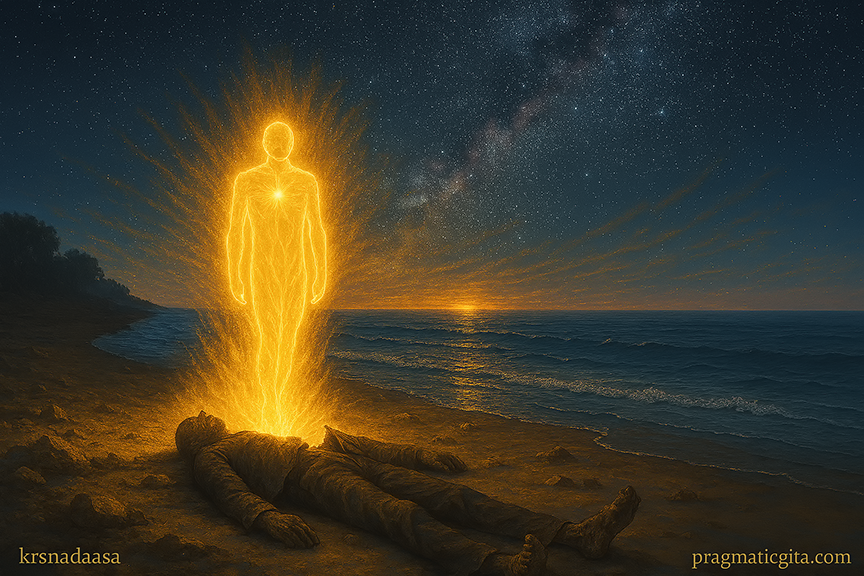
Within the sacred verses of the Bhagavad Gita lies a profound declaration of our true identity: Ayam Sanatanaha the causeless eternal soul. This is not just a philosophical statement but the very foundation of Sanatana Dharma teachings. It is Lord Krishna’s ultimate answer to Arjuna’s despair, a key that unlocks a life free from the fear of death and suffering. Understanding this phrase is to understand the core of your own existence.
What is the Meaning of Sanatanaha?
In Sanskrit, Sanatanaha means eternal, primordial, unchangeable, and ancient. When Krishna declares “Ayam Sanatanaha,” He is stating that this Self, this soul, is everlasting. It is Nityaḥ sarva-gataḥ—eternal and all-pervading. The Gita explains that this soul cannot be cut by weapons, burned by fire, moistened by water, or dried by the wind. This is the essence of the Indestructible Atman. It is without beginning and without end, a constant, silent witness to the endless changes of the material world.
The Soul as Unborn and Causeless
The eternal nature of the soul is directly linked to another of its attributes: it is ajaḥ, or “unborn.” Because the soul was never created, it cannot be destroyed. This is what makes it “causeless.” Unlike the body, which has a clear beginning and end, the soul transcends the entire cycle of birth and death. The soul transcends the body and mind, remaining untouched by their experiences. When we ask, “Who am I according to Vedanta?” the answer lies in this realization: we are not the temporary stories of our lives, but the timeless consciousness that experiences them.
How to Live as the Eternal Soul
Embracing the truth of Ayam Sanatanaha has profound practical applications. The Gita outlines four primary paths of Yoga (Bhakti, Karma, Jnana, Raja) as methods for how to live as the eternal soul. These practices help us purify the mind, dissolve the ego, and shift our identification away from the temporary body to our true, unchanging Self. By doing so, we overcome the five kleshas (afflictions) like attachment and fear, allowing the peace and stability of our eternal nature to shine through in our daily lives.
If you have not already done so, I would request you to review the Chapter 1, Arjuna Vishada Yoga before studying chapter 2 as that would help set the right context.
You can find the explanation of shlokas 14 to 18 here. Please go through that to get better understanding of the context.
You can also listen to all the episodes through my Spotify Portal, Apple Podcast, and on YouTube as well.
Verse 2.19 – 2.24
य एनं वेत्ति हन्तारं यश्चैनं मन्यते हतम् |
उभौ तौ न विजानीतो नायं हन्ति न हन्यते || 19||
ya enaṁ vetti hantāraṁ yaśh chainaṁ manyate hatam
ubhau tau na vijānīto nāyaṁ hanti na hanyate
यः (yaḥ) – he who; एनम् (enam) – this (self); वेत्ति (vetti) – knows; हन्तारम् (hantāram) – slayer; यः (yaḥ) – he who; च (ca) – and; एनम् (enam) – this; मन्यते (manyate) – thinks; हतम् (hatam) – slain; उभौ (ubhau) – both; तौ (tau) – those; न (na) – not; विजानीतः (vijānītaḥ) – know; न (na) – not; अयम् (ayam) – this; हन्ति (hanti) – slays; न (na) – not; हन्यते (hanyate) – is slain.
Neither the one who thinks the soul can slay nor the one who thinks the soul can be slain are having true knowledge. For truly, the soul can neither be killed nor does it kill.
न जायते म्रियते वा कदाचि
नायं भूत्वा भविता वा न भूय: |
अजो नित्य: शाश्वतोऽयं पुराणो
न हन्यते हन्यमाने शरीरे || 20||
na jāyate mriyate vā kadāchin
nāyaṁ bhūtvā bhavitā vā na bhūyaḥ
ajo nityaḥ śhāśhvato ’yaṁ purāṇo
na hanyate hanyamāne śharīre
न (na) – not; जायते (jāyate) – is born; म्रियते (mriyate) – dies; वा (vā) – or; कदाचित् (kadācit) – at any time; न (na) – not; अयम् (ayam) – this (self); भूत्वा (bhūtvā) – having been; भविता (bhavitā) – will be; वा (vā) – or; न (na) – not; भूयः (bhūyaḥ) – (any) more; अजः (ajaḥ) – unborn; नित्यः (nityaḥ) – eternal; शाश्वतः (śāśvataḥ) – changeless; अयम् (ayam) – this; पुराणः (purāṇaḥ) – ancient; न (na) – not; हन्यते (hanyate) – is killed; हन्यमाने (hanyamāne) – being killed; शरीरे (śarīre) – in body.
The soul is neither born, nor does it ever die; nor having once existed, does it ever cease to be. The soul is without birth, eternal, immortal, and ageless. It is not destroyed when the body is destroyed.
वेदाविनाशिनं नित्यं य एनमजमव्ययम् |
कथं स पुरुष: पार्थ कं घातयति हन्ति कम् || 21||
vedāvināśhinaṁ nityaṁ ya enam ajam avyayam
kathaṁ sa puruṣhaḥ pārtha kaṁ ghātayati hanti kam
वेद (veda) – knows; अविनाशिनम् (avināśinaṁ) – indestructible; नित्यम् (nityam) – eternal; यः (yaḥ) – who; एनम् (enam) – this (self); अजम् (ajam) – unborn; अव्ययम् (avyayam) – inexhaustible; कथम् (katham) – how; सः (saḥ) – he (that); पुरुषः (puruṣaḥ) – man; पार्थ (pārtha) – O Partha; कम् (kam) – whom; घातयति (ghātayati) – causes to be slain; हन्ति (hanti) – kills; कम् (kam) – whom.
O Partha, how can one who knows the soul to be imperishable, eternal, unborn, and immutable kill anyone or cause anyone to kill?
वासांसि जीर्णानि यथा विहाय
नवानि गृह्णाति नरोऽपराणि |
तथा शरीराणि विहाय जीर्णानि
न्यन्यानि संयाति नवानि देही || 22||
vāsānsi jīrṇāni yathā vihāya
navāni gṛihṇāti naro ’parāṇi
tathā śharīrāṇi vihāya jīrṇānya
nyāni sanyāti navāni dehī
वासांसि (vāsāṁsi) – clothes; जीर्णानि (jīrṇāni) – worn out; यथा (yathā) – as; विहाय (vihāya) – having cast away; नवानि (navāni) – new; गृह्णाति (gṛhṇāti) – takes; नरः (naraḥ) – man; अपराणि (aparāṇi) – others; तथा (tathā) – so; शरीराणि (śarīrāṇi) – bodies; विहाय (vihāya) – having cast away; जीर्णानि (jīrṇāni) – worn out; अन्यानि (anyāni) – others; संयाति (saṁyāti) – enters; नवानि (navāni) – new; देही (dehī) – the embodied (one).
As a person sheds worn-out garments and wears new ones, likewise, at the time of death, the soul casts off its worn-out body and enters a new one.
नैनं छिन्दन्ति शस्त्राणि नैनं दहति पावक: |
न चैनं क्लेदयन्त्यापो न शोषयति मारुत: || 23||
nainaṁ chhindanti śhastrāṇi nainaṁ dahati pāvakaḥ
na chainaṁ kledayantyāpo na śhoṣhayati mārutaḥ
न (na) – not; एनम् (enam) – this (self); छिन्दन्ति (chindanti) – cut; शस्त्राणि (śastrāṇi) – weapons; न (na) – not; एनम् (enam) – this; दहति (dahati) – burns; पावकः (pāvakaḥ) – fire; न (na) – not; च (ca) – and; एनम् (enam) – this; क्लेदयन्ति (kledayanti) – wet; आपः (āpaḥ) – waters; न (na) – not; शोषयति (śoṣayati) – dries; मारुतः (mārutaḥ) – wind.
Weapons cannot shred the soul, nor can fire burn it. Water cannot wet it, nor can the wind dry it.
अच्छेद्योऽयमदाह्योऽयमक्लेद्योऽशोष्य एव च |
नित्य: सर्वगत: स्थाणुरचलोऽयं सनातन: || 24||
achchhedyo ’yam adāhyo ’yam akledyo ’śhoṣhya eva cha
nityaḥ sarva-gataḥ sthāṇur achalo ’yaṁ sanātanaḥ
अच्छेद्यः (acchedyaḥ) – cannot be cut; अयम् (ayam) – this self; अदाह्यः (adāhyaḥ) – cannot be burnt; अयम् (ayam) – this; अक्लेद्यः (akledyaḥ) – cannot be wetted; अशोष्यः (aśoṣyaḥ) – cannot be dried; एव (eva) – also; च (ca) – and; नित्यः (nityaḥ) – eternal; सर्वगतः (sarvagataḥ) – all-pervading; स्थाणुः (sthāṇuḥ) – stable; अचलः (acalaḥ) – immovable; अयम् (ayam) – this; सनातनः (sanātanaḥ) – ancient.
The soul is unbreakable and incombustible; it can neither be dampened nor dried. It is everlasting, in all places, unalterable, immutable, and primordial.
The soul is immortal
In these profound verses from the second chapter of the Bhagavad Gita, Shri Krishna addresses one of the most fundamental questions that haunts every human heart: What happens when we die? Arjuna, a legendary warrior standing on the battlefield of Kurukshetra, trembles not merely from the fear of war, but he is gripped by the fear of causing death and the fear of his own mortality. It is in this period of despair that Shri Krishna begins to unveil the greatest truth of all existence.
The soul is eternal, indestructible, and beyond the reach of death itself.
The Soul Neither Kills Nor Can Be Killed
Shri Krishna declares that those who believe the soul can kill or be killed fundamentally misunderstand reality. The soul, our true essence, does not kill and cannot be killed. It is never born, nor does it ever die. Only that which is born can die, and the soul is not born.
The various Vedantic schools explain the precise relationship between the individual self and the Supreme differently. Yet they agree on the central teaching of these verses, that our true spiritual nature is not born with the body and does not perish with it.
In 2.19 Shri Krishna says:
He who considers the soul to be either the killer or the killed is ignorant, for the self neither slays nor is slain by anyone.
Only what is born can die. The soul is eternal, never born and so it cannot die.
Shri Krishna is revealing that beneath the changing body and personality lies an eternal Self that no physical act can destroy. Knowledge of that Self removes fear, hatred, and delusion from ethical action.
In 2.20 Shri Krishna says:
न जायते म्रियते वा कदाचि
नायं भूत्वा भविता वा न भूय: |
अजो नित्य: शाश्वतोऽयं पुराणो
न हन्यते हन्यमाने शरीरे || 20||
na jāyate mriyate vā kadāchin
nāyaṁ bhūtvā bhavitā vā na bhūyaḥ
ajo nityaḥ śhāśhvato ’yaṁ purāṇo
na hanyate hanyamāne śharīre
The soul is neither born, nor does it ever die; nor having once existed, does it ever cease to be. The soul is without birth, eternal, immortal, and ageless. It is not destroyed when the body is destroyed.
The same thing is mentioned in the Katha Upanishad, chapter 2.
न जायते म्रियते वा विपश्चिन्नायं कुतश्चिन्न बभूव कश्चित्।
अजो नित्यः शाश्वतोऽयं पुराणो न हन्यते हन्यमाने शरीरे॥
na jāyate mriyate vā vipaścinnāyaṃ kutaścinna babhūva kaścit
ajo nityaḥ śāśvato’yaṃ purāṇo na hanyate hanyamāne śarīre
The atman is never born, nor does it ever die; it did not come from anywhere. It is birthless, eternal, immutable and primeval. The atman is not slain when the body is slain.
The presence of Shri Krishna’s teachings in the Upanishads reveals that through the Bhagavad Gita, He is not presenting a new philosophy but rather articulating the eternal wisdom that has always existed.
Adi Shankaracharya, a renowned Indian philosopher and commentator on the Vedas, provided a commentary on the Katha Upanishad, in which he elaborated on the verse mentioned above. According to Shankaracharya, the verse sheds light on the nature of the atman, which is our true self, and transcends the cycle of birth and death. He explains that the atman is not subject to the physical changes that affect the body, such as growth, aging, and death, but rather is eternal and unchanging.
Furthermore, Shankaracharya refutes the notion that the atman is created or born, which some individuals believe. He asserts that the atman is an intrinsic part of the absolute God, who is Sat, and the source of all life and the foundation of existence itself.
Overall, Shankaracharya’s commentary highlights the fundamental teachings of the Upanishads, which assert that the true Self is not constrained by the body or the mind, but rather is infinite, eternal, and unchanging.
As we discussed in the previous verses, we are not merely the physical body. Our deepest identity is the conscious Self, which is not material in nature and is not destroyed with the body. This is the absolute truth and our ultimate goal of life is to realize this truth. Whether we believe it or not doesn’t change the truth. Just like gravity is not going to change, whether we believe it or not.
Shri Krishna is explaining this truth to all of humanity through his message to Arjuna, that this soul is eternal and it can never be destroyed. It is beyond life and death.
The Human Privilege: Self-Realization
If you ask what is unique about humans and what makes us superior to animals? It is the ability to realize this ultimate truth. Today machines are getting smarter than humans. However neither machines nor any of the animals have this unique ability to realize the ultimate truth, the soul and eternal self. This is the ultimate goal of human life and we should seek God’s blessings and grace to help us achieve this goal.
Using our mind and our senses, we can at the most theorize this truth but we cannot realize this truth. Then how can we realize this truth? That is the teaching of the whole of Gita.
Human beings alone possess an inward capacity to discover the truth of their own nature. The guru and scripture do not manufacture the Self. They remove the ignorance that hides it.
Vedanta teaches that freedom is not foreign to us and it is rooted in our deepest nature. Yet this freedom is hidden and awakened only through spiritual discipline, right knowledge, the guidance of the guru and scripture, and within the bhakti tradition, the grace of the Lord.
The Five Causes of Human Suffering
So, what stops us from living in this truth? Vedanta (particularly the Yoga sutras of Patanjali, 2.3) identifies five primary obstacles, the five kleshas or afflictions, that cloud our perception. By correcting the first cause, ignorance, we become free from the effects of all the others.
- Avidya (Ignorance): Not knowing who we are. This is the root of all suffering, a fundamental misperception of reality. It’s not a lack of facts but a deep-seated spiritual blindness where we mistake the temporary for the permanent and forget our true identity. This ignorance leads to attachment and aversion, which in turn give rise to other mental afflictions such as anger, jealousy, and greed, which further contribute to our suffering.
- Raga (Attachment): This is our compulsive clinging to things that are temporary, like experiences, people, and objects that we believe will bring us happiness. It is a form of bondage that prevents us from experiencing true freedom. Like a person dying of thirst who drinks saltwater, our attachments only increase our thirst for more, leaving us perpetually unfulfilled. To overcome raga, spiritual practices focus on cultivating detachment and contentment through mindfulness, meditation, self-reflection, and service to others.
- Dvesha (Aversion): avoiding and running away from things that cause us unhappiness or discomfort.This is the opposite side of attachment. We spend enormous energy running from people, situations, and experiences that challenge us, yet it is often in these very challenges that our greatest opportunities for growth are hidden.
- Asmita (Egoism): Identifying with the ego and creating a false sense of a separate, isolated identity, making us believe we are individuals competing against the world. When we define ourselves by external factors, we create a false sense of self vulnerable to change. This also gives rise to pride, which becomes the biggest obstacle to growth on the spiritual path.
- Abhinivesha (Fear of Death): The deepest and most universal affliction, this fear permeates all our actions. It is the direct and unavoidable consequence of the primary ignorance, Avidya, where we have mistakenly identified ourselves with the mortal body.
The Four Paths to Liberation
Vedanta also gives us the solutions to overcome these afflictions. It tells us that by correcting the first cause which is ignorance, and realizing who we really are, we become free from the effects of all the other causes.
Recognizing that we each have different personalities and preferences, Vedanta offers us four Paths of Yoga to help us reach the ultimate goal. Each person, depending on their abilities and preferences, can choose any single path or a combination of paths to attain the ultimate goal.
- Bhakti Yoga (The Path of Devotion): For the heart-centric, transforming personal love into divine love through prayer, chanting, and surrender.
- Karma Yoga (The Path of Action): For the active-minded, turning work into worship by performing all actions without attachment to their results.
- Jnana Yoga (The Path of Knowledge): For the intellectual, using the power of inquiry and discrimination, particularly the practice of “Who am I?” (Atma Vichara), to distinguish the real from the unreal.
- Raja Yoga (The Path of Discipline): The “royal path” of mastering the body and mind. It is called this because, just like controlling a kingdom, the Raja Yogi learns to control the vast and complex kingdom of their own mind and body.
Although all of these lead to the same ultimate goal, it is worth noting that Shri Krishna will go on to proclaim in Chapter 6 that the highest among these is Bhakti Yoga.
The soul’s eternal journey
The body is temporary. The soul keeps discarding old bodies and getting into new bodies based on its accumulated karma and desires. How then should we understand our relationship with the body? Shri Krishna offers one of the Gita’s most famous analogies:
वासांसि जीर्णानि यथा विहाय नवानि गृह्णाति नरोऽपराणि |
तथा शरीराणि विहाय जीर्णा न्यन्यानि संयाति नवानि देही || 22||
vāsānsi jīrṇāni yathā vihāya navāni gṛihṇāti naro ’parāṇi
tathā śharīrāṇi vihāya jīrṇānya nyāni sanyāti navāni dehī
As a person sheds worn-out garments and wears new ones, likewise, at the time of death, the soul casts off its worn-out body and enters a new one.
We can see this philosophy embedded in the common language in India, where when someone dies, people say “śarīr choḍ diyā”, “has discarded the body”. Who has left the body? That eternal soul. What remains is just a body.
Sri Ramakrishna offered another brilliant analogy to explain this state of being. He said souls are like coconuts. In a green coconut, the kernel is firmly attached to the hard shell. This is the ordinary state, where we are stuck to the body, feeling its every pain as our own. But in a ripe coconut, the kernel separates from the shell and you can hear it rattle inside. That is spiritual realization, to live inside the body but know, without a doubt, that you are not it.
Please keep in mind that our desires also determine where and how we will be born in the next life. So we should be very careful about what we desire. It is best to always desire only for the ultimate realization and mukti. Otherwise we will keep getting stuck in the cycle of life and death just like the water which is stuck in the cycles of the fountain, going up and down eternally.
The concept of reincarnation based on karmic accounts is very important in vedanta. There is no other explanation for why some people are born into poverty while others are born into rich families, or why some are born sick while others are born strong, etc.
The Indestructible Nature of the Soul
Shri Krishna then provides a beautiful and philosophically profound explanation of the soul’s indestructible nature:
2.23: Weapons cannot cut the Self, fire cannot burn it, water cannot wet it, and wind cannot dry it.
2.24: The Self cannot be cut, burned, wetted, or dried. It is eternal, all-pervading, stable, immovable, and ever-existent.
Here, Shri Krishna takes the most familiar destructive powers of the physical world and shows that none of them can touch the Self.
A weapon can cut a physical object.
Fire can burn a physical object.
Water can wet a physical object.
Wind can dry a physical object.
But the Self is not a physical object.
This is the key point.
The soul is beyond destruction because it does not belong to the category of material objects at all.
This is why, in 2.24, the Self is called:
acchedya — incapable of being cut;
adāhya — incapable of being burned;
akledya — incapable of being wetted;
aśoṣya — incapable of being dried;
nitya — eternal;
sarvagata — all-pervading or present everywhere;
sthāṇu — stable;
acala — unmoving;
sanātana — beginningless and ever-existent.
The word sarvagata, all-pervading, is especially important. Different Vedantic traditions explain this in different ways. In Advaita Vedanta, the true Self is understood as all-pervading consciousness. In devotional Vedantic traditions, the individual soul may be described differently, while the Lord’s all-pervading presence, the soul’s dependence on the Supreme, and the presence of consciousness in the body are emphasized.
But in all interpretations, the central point remains the same, that the Self is not confined to the destructible nature of the body.
We fear death because we think we are the body.
We fear destruction because we think we are something destructible.
We fear loss because we think our identity depends on what can be taken away.
Shri Krishna is saying know yourself correctly. You are not what the weapon cuts. You are not what the fire burns. You are not what water wets. You are not what the wind dries. You are the eternal Self, temporarily associated with the body, but never destroyed with the body.
This understanding does not make us careless about the body. The body is still sacred. It is the instrument through which we perform dharma, serve others, practice devotion, and seek realization. But we must not mistake the instrument for the Self.
The body must be cared for.
The mind must be purified.
The ego must be disciplined.
And more than anything, the Self must be realized.
That is the purpose of this teaching.
Shri Krishna is not merely telling Arjuna, “Do not be sad.” He is showing him why fear and grief lose their absolute power when we realize who we truly are.
And when this teaching moves from the intellect into lived understanding, it gives us tremendous inner strength. The body may age, the world may change, relationships may shift, circumstances may rise and fall, but the witnessing Self remains untouched.
This is why Shri Krishna repeatedly brings Arjuna back to the truth of the Self. Unless Arjuna knows what cannot be destroyed, he will remain paralysed by the fear of destruction. Unless we know what is eternal in us, we will keep living in fear of everything temporary.
Build your life on the knowledge of the eternal Self. Then action becomes clearer, fear becomes weaker, and life becomes an opportunity for dharma, devotion, service, and realization.
The Goal of the Soul: Wisdom from East and West
What is the soul’s ultimate destination? Advaita philosophy suggests it is like a river entering the sea, a complete merger with the Divine, beautifully captured in Khalil Gibran’s poem where the river realizes it is “not about disappearing into the ocean, but of becoming the ocean.”
That’s the advaita philosophy. Our soul is like the river and the super soul is like the ocean. Our soul has to eventually enter and get merged into the super soul.
Other schools of thought, however, maintain that the soul returns to the divine abode while retaining its unique identity, like an eternal wave on that ocean. This debate has continued for ages, and in my humble opinion, it doesn’t really matter who wins the argument. What is important is to realize that there is a super soul and that we need to practice a path like bhakti yoga to help our soul get reunited with that super soul.
A similar concept can be seen in Greek philosophy as well. The famous maxim “Man, know thyself” was inscribed at the entrance of the Temple of Apollo at Delphi, an ancient Greek religious site that was renowned for its oracle.
The phrase “Man, know thyself” is often interpreted as a call to self-awareness and introspection. It is a reminder that the most important knowledge that one can acquire is knowledge of oneself. By understanding one’s own strengths and weaknesses, desires and motivations, one can better navigate the challenges of life and make wise decisions.
The Greek philosopher Socrates was a living embodiment of this truth. As he calmly prepared to drink the hemlock poison, his disciples wept uncontrollably. When his old friend Crito asked, “Socrates, how shall we bury you?” the dying sage greeted the question with a gentle smile. He replied, “Crito, you must first catch me, the real me, before you ask this question”.
This is pure Vedanta spoken in ancient Athens. He understood that the body is just a vessel. The Athenians, however, could not comprehend this higher spiritual dimension of man, and so they condemned their finest citizen to death for “misleading the youth”.
Living the Teaching
These verses provide a blueprint for a fearless and meaningful life. This knowledge is the very foundation of all ethics. When we experience the truth that the same eternal Self resides in everyone, it naturally fosters a “sense of oneness” that gives rise to compassion, love, and a spirit of service. It also contains a profound practical lesson for our daily lives.
Just as the soul cannot stay in one body forever, many aspects of our existence follow this same principle. The air we breathe cannot stay in our lungs and it must be exhaled to make way for fresh air. This natural law of circulation applies to our emotional life as well. Negative emotions like anger and resentment cannot be stored indefinitely without causing illness. They must be released to make room for fresh, positive emotions.
To frame this another way, Vedanta describes two dimensions of reality: Parāk, the outward world perceived by our senses, and Pratyak, the inward reality of the Self, the observer. A complete life, a true philosophy, involves mastering both. We must handle the world outside (parāk), but do so with a growing awareness of our true inner nature (pratyak), allowing that inner light to guide our outer actions.
Ultimately, the message is a call to awaken to our true identity. Every moment we spend identifying with the temporary body and mind is a moment spent in spiritual sleep. Every moment we remember our eternal nature is a moment of awakening. The body will age, the mind will change, circumstances will fluctuate, but the witnessing consciousness that observes all these changes remains forever unchanged. This is our true Self, our real identity, our eternal home. Recognition of this truth is not just the goal of human life, it is our very nature, temporarily forgotten but never, ever lost.
Hare Krishna!
kṛṣṇadaasa
(Servant of Krishna)