 Pragmatic Gita
Master the Art of Kaushalam – Skillful Action
We all know how to be busy, but do we know how to be effective? The Bhagavad Gita offers a timeless secret for transforming our chaotic, stressful work into a source of profound peace and freedom. This secret is captured in a powerful phrase from verse 2.50, yogaḥ karmasu kauśalam, which defines yoga as “skill in action.”
This guide explores that very skill, the art of Kaushalam, as laid out in verses 2.48-2.50. Yogaḥ Karmasu Kauśalam.
The Foundation of Skill is Samatvam (Equanimity)
Before we can act with skill, we must find our footing. Shri Krishna begins in verse 2.48 by instructing Arjuna to be yoga-sthaḥ, or “steadfast in yoga.” He immediately defines this state as samatvaṁ yoga ucyate, meaning “equanimity is called yoga.”
This isn’t about being indifferent. It is about building a stable inner ground that remains undisturbed by the storms of success and failure. When we abandon our desperate clinging, saṅga, to outcomes, we can finally be fully present to the task at hand. This inner balance is the foundation from which all true skill arises.
The Method for Skill is Buddhi Yoga (Awakened Intelligence)
Once our foundation is steady, we need a guide. In verse 2.49, Shri Krishna provides the method, Buddhi Yoga, or uniting our actions with awakened intelligence. He urges us to “seek refuge in divine knowledge and insight” through buddhau śaraṇam anviccha.
He even uses the striking word kṛpaṇāḥ, or “miserly,” for those who act only for the fruits of their work. Why? Because they are like spiritual misers, so focused on hoarding future results that they miss the immense wealth and joy of the action itself in the present moment.
The art of Kaushalam is the direct opposite of this miserly consciousness. It is acting from a place of fullness, guided by clarity rather than by compulsion or fear.
The Fruit is Kaushalam (Perfect Skill in Action)
When the steady state of Samatvam is combined with the clear guidance of Buddhi Yoga, the result is Kaushalam, or true spiritual skill.
Verse 2.50 reveals the incredible promise of this path. A person who acts with this awakened wisdom, jahātīha ubhe sukṛta-duṣkṛte, breaks free from both good and bad karmic reactions in this very life. We often think spirituality is about collecting “good karma,” but Shri Krishna says that even good karma can become a golden chain.
The art of Kaushalam is the skill to act so perfectly and consciously that the action leaves no karmic trace, like a line drawn on water.
This kauśalam isn’t merely technical talent or efficiency. It is the deeper skill of acting with equanimity, awakened intelligence, and freedom from attachment to results. In this way, every action becomes part of our spiritual practice, and ordinary work itself becomes a means to liberation.
If you have not already done so, I would request you to review the Chapter 1, Arjuna Vishada Yoga before studying chapter 2 as that would help set the right context.
You can find the explanation of shlokas 45 to 47 here. Please go through that to get better understanding of the context.
You can also listen to all the episodes through my Spotify Portal, Apple Podcast, and on YouTube as well.
Keywords: The Art of Kaushalam, Yoga Karmasu Kaushalam, Buddhi Yoga, Samatvam Yoga, How to practice spiritual skill, Living with Kaushalam, Meaning of skill in action Gita, Acting without attachment, What is Kaushalam in the Bhagavad Gita?, How to achieve skill in action?, How does equanimity lead to skill?
Verse 2.48 – 2.50
योगस्थ: कुरु कर्माणि सङ्गं त्यक्त्वा धनञ्जय |
सिद्ध्यसिद्ध्यो: समो भूत्वा समत्वं योग उच्यते || 2.48||
yoga-sthaḥ kuru karmāṇi saṅgaṁ tyaktvā dhanañjaya
siddhy-asiddhyoḥ samo bhūtvā samatvaṁ yoga uchyate
योगस्थः (yogasthaḥ) – Being steadfast in yoga, कुरु (kuru) – perform, कर्माणि (karmāṇi) – actions, सङ्गं (saṅgam) – attachment, त्यक्त्वा (tyaktvā) – giving up, धनञ्जय (dhanañjaya) – O Arjuna, सिद्धि–असिद्ध्योः (siddhi-asiddhyoḥ) – in success and failure, समः (samaḥ) – equipoised, भूत्वा (bhūtvā) – becoming, समत्वं (samatvaṃ) – equanimity, योगः (yogaḥ) – yoga, उच्यते (ucyate) – is called.
Perform your duty steadfastly in yoga, O Arjuna, abandoning attachment to success and failure. Such evenness of mind is called yoga.
दूरेण ह्यवरं कर्म बुद्धियोगाद्धनञ्जय |
बुद्धौ शरणमन्विच्छ कृपणा: फलहेतव: || 2.49||
dūreṇa hy-avaraṁ karma buddhi-yogād dhanañjaya
buddhau śharaṇam anvichchha kṛipaṇāḥ phala-hetavaḥ
दूरेण (dūreṇa) – far away; हि (hi) – certainly; अवरं (avaṛṃ) – inferior; कर्म (karma) – actions; बुद्धियोगात् (buddhi-yogāt) – by intelligence in devotional service; धनञ्जय (dhanañjaya) – O Dhanañjaya; बुद्धौ (buddhau) – in intelligence; शरणम् (śaraṇam) – refuge; अन्विच्छ (anviccha) – seek; कृपणाः (kṛpaṇāḥ) – miserly; फलहेतवः (phala-hetavaḥ) – who desire fruits.
O Arjuna, seek refuge in divine knowledge and insight, and abandon actions performed with the intention of seeking rewards, which are certainly inferior to works performed with intellect established in divine knowledge. Those who desire to enjoy the fruits of their works are considered to be miserly (kṛpaṇāḥ).
बुद्धियुक्तो जहातीह उभे सुकृतदुष्कृते |
तस्माद्योगाय युज्यस्व योग: कर्मसु कौशलम् || 2.50||
buddhi-yukto jahātīha ubhe sukṛita-duṣhkṛite
tasmād yogāya yujyasva yogaḥ karmasu kauśhalam
बुद्धियुक्तो (buddhi-yukto) – one who is endowed with spiritual intelligence; जहाति (jahāti) – gives up; इह (iha) – in this world; उभे (ubhe) – both; सुकृत (su-kṛte) – pious activities; दुष्कृते (duṣ-kṛte) – sinful activities; तस्मात् (tasmāt) – therefore; योगाय (yogāya) – for the sake of union; युज्यस्व (yujyasva) – engage yourself; योगः (yogaḥ) – yoga; कर्मसु (karmasu) – in work; कौशलम् (kauśalam) – skillfulness.
One who uses their wisdom to practice the science of work without attachment can get rid of both good and bad reactions in this life itself. Therefore, strive for Yoga, which is the art of working skillfully with proper consciousness.
Samatvam is Yoga: The Steady Inner Bow-Hand
Having established the philosophical foundation of right action, Shri Krishna now provides the practical methodology in 2.48.
योगस्थ: कुरु कर्माणि सङ्गं त्यक्त्वा धनञ्जय |
सिद्ध्यसिद्ध्यो: समो भूत्वा समत्वं योग उच्यते || 2.48||
yoga-sthaḥ kuru karmāṇi saṅgaṁ tyaktvā dhanañjaya
siddhy-asiddhyoḥ samo bhūtvā samatvaṁ yoga uchyate
Perform your duty steadfastly in yoga, O Arjuna, abandoning attachment to success and failure. Such evenness of mind is called yoga.
This verse contains one of the Gita’s most practical definitions of yoga. This is not the yoga of complex postures or esoteric practices, but the yoga of mental equilibrium in the midst of dynamic action.
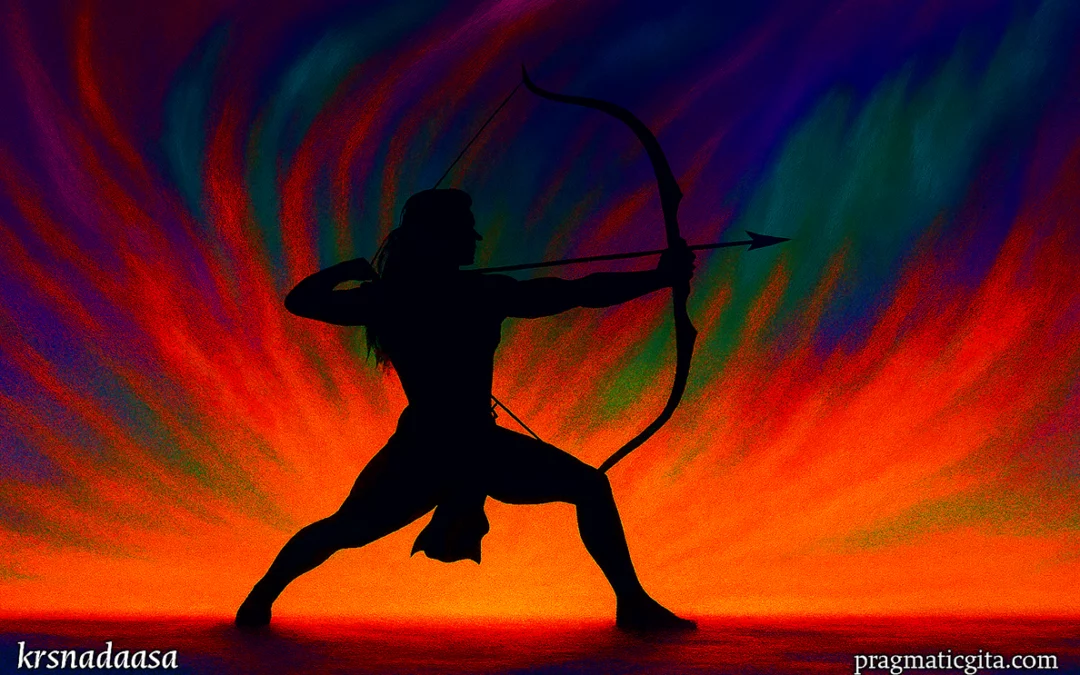
Yoga-sthaḥ means “established in yoga.” But what is this yoga in which we should be established? To be yoga-stha is to act from a place of centeredness and focus rather than scatteredness. Imagine an expert archer drawing a bow. If their stance is unstable, if their mind is agitated, if their breathing is erratic, the arrow will never find its mark. But when they are established in the proper state, with their body balanced, mind focused, and breath steady, the arrow does its job well. This is yoga-stha in action.
Kuru karmāṇi says to “perform actions.” Note that Shri Krishna doesn’t say “perform religious actions” or “perform only sattvic actions.” He says karmāṇi, which means actions in general. This includes everything from the most sacred rituals to the most mundane tasks. Every action, whether it is writing code or changing diapers, fighting a battle or washing dishes, can be performed in this state of yoga. This democratizes spiritual practice, making every action a stepping stone on our path to liberation.
Saṅgaṁ tyaktvā translates to “abandoning attachment.” The word saṅga literally means “sticking” or “clinging.” It is the quality of adhesiveness that makes experiences stick to our psyche, creating impressions (saṁskāras) that drive future actions. When we perform actions with saṅga, we are like a person walking through mud, where every step gets more mud sticking to us, leaving us more heavy and dirty.
Abandoning saṅga doesn’t mean becoming indifferent. A surgeon operating without attachment isn’t indifferent to the patient’s survival. Rather, they are so completely present to the task that there is no mental space for anxiety about outcomes or fantasies of success. The abandonment of attachment actually enables greater care and precision.
Siddhy-asiddhyoḥ samo bhūtvā is “being equal in success and failure.” This is perhaps the most challenging aspect of Krishna’s teaching. Our entire psychological apparatus seems designed to prefer success over failure. We are biologically programmed to seek pleasure and avoid pain, to celebrate victories and mourn defeats. How can we possibly be “sama” (equal) toward such opposites?
The key lies in understanding what Shri Krishna means by equality. He is pointing to a dimension of our being that remains stable regardless of outcomes. It is like the ocean floor that remains undisturbed even when storms rage on the surface.
Samatvaṁ yoga ucyate means “such equanimity is called yoga.” This is a radical redefinition. For most people, yoga means either physical postures or meditation techniques. But Shri Krishna says yoga is equanimity itself. It is not the practice that leads to equanimity, but equanimity as a lived reality.
This teaching directly addresses what modern psychology recognizes as one of the primary sources of human suffering, which is emotional dysregulation. We live on an emotional roller coaster, our mood entirely dependent on external circumstances. Good news sends us soaring; bad news sends us crashing. A compliment inflates us; criticism deflates us. We are like small boats on a stormy sea, completely at the mercy of every wave.
The neuroscience of emotional regulation reveals why this is so exhausting. Every emotional spike, whether positive or negative, triggers a cascade of physiological responses. Hormones are released, heart rate changes, and muscle tension increases. When we are constantly swinging between emotional extremes, our system never gets to rest and reset. This leads to chronic stress, burnout, and a host of physical and mental health issues.
Samatvam offers a different way of being. It is not emotional suppression or fake positivity. It is finding the stable ground of being from which we can respond rather than react. When established in samatvam, we still feel the full range of human emotions, but we are not controlled by them.
Two classical disciplines help cultivate this state. Śama is the practice of mental calmness, learning to quiet the constant chatter and reactivity of the mind. Dama is the practice of sensory regulation, learning to engage the senses without being enslaved by them. Together, they create the inner conditions for samatvam to naturally arise.
But Shri Krishna isn’t advocating withdrawal from the world to achieve this state. He is speaking to Arjuna on a battlefield, surrounded by the chaos of impending war. This is samatvam in the thick of life, equanimity under pressure, the eye of calm in the storm of engagement. It is what emergency room doctors cultivate to function effectively, what parents need when dealing with a toddler’s meltdown, and what leaders must embody during an organizational crisis.
In practical terms, developing samatvam might begin with small, daily practices. Before responding to a provocative email, take three conscious breaths. When stuck in traffic, use it as an opportunity to practice equanimity rather than frustration. When receiving praise or criticism, notice the internal weather without being swept away by it. These small moments of practice gradually build the capacity for equanimity in larger situations.
The Bhagavad Gita presents samatvam as a practical necessity for anyone who wants to live effectively in the world. Whether we are warriors on ancient battlefields or modern professionals navigating complex challenges, the need for a steady mind remains constant. In a world that seems designed to keep us off-balance, Krishna’s teaching of equanimity as yoga itself offers both a refuge and a powerful tool for engagement.
Buddhi-Yoga: The Mind That Has Awakened Guides the Hands
Now Shri Krishna introduces a crucial distinction that elevates the entire teaching to a new level.
दूरेण ह्यवरं कर्म बुद्धियोगाद्धनञ्जय |
बुद्धौ शरणमन्विच्छ कृपणा: फलहेतव: || 2.49||
dūreṇa hy-avaraṁ karma buddhi-yogād dhanañjaya
buddhau śharaṇam anvichchha kṛipaṇāḥ phala-hetavaḥ
O Arjuna, seek refuge in divine knowledge and insight, and abandon actions performed with the intention of seeking rewards, which are certainly inferior to works performed with intellect established in divine knowledge. Those who desire to enjoy the fruits of their works are considered to be miserly (kṛpaṇāḥ).
Now we come to 2.49, and the first half of it is easy to rush past.
दूरेण ह्यवरं कर्म बुद्धियोगात् (dūreṇa hy avaraṁ karma buddhi-yogāt), “action is far inferior to buddhi-yoga.”
Dūreṇa means by a long distance. Avaram means lower, inferior. So Shri Krishna is not making a small distinction here. He is saying the gap is wide.
But inferior in what sense? He does not say such work fails. He does not say it produces nothing. The commentators are agreed on the point. Both kinds of action produce results. The difference is where they take you. Action done with evenness of mind moves towards freedom. Action done with an eye fixed on the reward circles back into saṁsāra, and saṁsāra by its nature is the cause of birth and death and everything that follows from them.
So think of two people doing exactly the same job, sitting at desks side by side. Same hours, same output, same salary. One of them, at the end of thirty years, has a house and a pension and a very tired heart. The other has the same house and the same pension, and has also become steadier, kinder, less afraid. The work looked identical from outside. The direction was completely different.
Swami Mukundananda gives us a picture for this. Imagine a temple being built in Vrindavan. There are workers laying the stones. It is a sacred building and they are engaged in a sacred activity, but their attitude is ordinary. They are thinking about the wages. If another contractor offers more money next week, they will go. Standing nearby is a sādhu who sees this beautiful temple coming up, and he joins in and carries stones as kār-sevā, as service to God, taking nothing.
The stones being carried are the same stones. The muscles are doing the same work. From a photograph you could not tell them apart. But inwardly these two are in completely different worlds.
That is the whole of karma yoga in one picture. Shri Krishna is not asking Arjuna to change what he does. He is asking him to change the mindset while doing it.
Then he uses a sharp statement: कृपणाः फलहेतवः (kṛpaṇāḥ phala-hetavaḥ), “those whose motive is the fruit are kṛpaṇas.”
The word kṛpaṇāḥ is particularly striking. In ordinary usage it means “miserly,” someone who has great wealth but cannot enjoy or share it, who hoards compulsively out of fear. But there is a deeper meaning as well. Adi Shankaracharya takes the word straight to the Bṛhadāraṇyaka Upaniṣad, where Yājñavalkya tells Gārgī that whoever departs from this world without knowing the Imperishable is a kṛpaṇa, while the one who departs having known It is a brāhmaṇa (Bṛhadāraṇyaka Upaniṣad 3.8.10).
So the miserlyness or poverty being referenced here is that of a human birth that held the possibility of knowing the Imperishable but was instead spent entirely on mundane and meaningless things.
Shri Krishna applies this term to those who act only for results. They are spiritual misers, so focused on accumulating outcomes that they miss the wealth of the present moment and the joy of the action itself.
Think of a musician who plays only for applause, never hearing their own music. Or a writer who writes only for publication, never experiencing the flow of creation. Or a parent who raises children only for their future achievements, missing the miracle of their present being. These are the kṛpaṇāḥ, who are wealthy in opportunities for joy but impoverished in experience.
Buddhi-yoga offers the alternative. Buddhi comes from the root budh, meaning to wake up, to become aware, or to understand deeply. It is the faculty of awakened intelligence that can discriminate between the real and the unreal, the eternal and the temporal, the Self and the non-Self. When this awakened intelligence is yoked (yoga) to action, something transformative happens.
Regular action operates from the surface mind, driven by likes and dislikes, hopes and fears. Buddhi-yoga operates from a deeper place, where actions arise from clarity rather than compulsion. It is the difference between reacting and responding, between habitual patterns and conscious choice.
Then comes what many consider the most elegant definition of yoga in the entire Gita.
बुद्धियुक्तो जहातीह उभे सुकृतदुष्कृते |
तस्माद्योगाय युज्यस्व योग: कर्मसु कौशलम् || 2.50||
buddhi-yukto jahātīha ubhe sukṛita-duṣhkṛite
tasmād yogāya yujyasva yogaḥ karmasu kauśhalam
One who uses their wisdom to practice the science of work without attachment can get rid of both good and bad reactions in this life itself. Therefore, strive for Yoga, which is the art of working skillfully with proper consciousness.
This verse contains multiple revolutionary ideas. First is the transcendence of both good and bad karma. Most spiritual paths focus on accumulating good karma and avoiding bad karma. But Shri Krishna reveals that both create bondage. Good karma might result in a golden chain rather than an iron one, but it is still a chain. The goal is not to improve our prison but to achieve liberation.
This teaching challenges our fundamental assumptions about morality and spiritual progress. We are conditioned to see life as a moral accounting system where good deeds create a positive balance and bad deeds create negative balance. Shri Krishna doesn’t deny the relative truth of this, for actions do have consequences. But he points to a state beyond the entire system of karmic accounting.
How is this possible? योगः कर्मसु कौशलम् (yogaḥ karmasu kauśalam), “yoga is skill in works.”
This phrase has echoed through centuries, inspiring countless interpretations. What is this skill that Shri Krishna speaks of?
Kauśalam comes from kuśala, meaning skillful, expert, wise, or auspicious. But this isn’t mere technical proficiency. A master thief might be technically skillful but wouldn’t represent kauśalam in Shri Krishna’s sense. This skill has several dimensions.
First, it is the skill of acting from the right state of consciousness. Just as a plant grows best in the right soil, actions performed from the state of buddhi-yoga naturally flower into excellence. When the mind is clear, calm, and connected to deeper purpose, even simple actions carry a quality of grace.
Second, it is the skill of perfect timing and proportion. The buddhi-yogi develops an intuitive sense of when to act and when to wait, when to speak and when to remain silent, when to push forward and when to yield. This isn’t a calculated strategy but a spontaneous wisdom arising from attunement to the present moment.
Third, it is the skill of acting without creating new bondage. Every ordinary action creates impressions (saṁskāras) that drive future actions. But actions performed in the state of yoga, with awakened intelligence and without attachment, burn up karma rather than letting it create bondage. They are like lines drawn on water, leaving no trace.
A story from the Mahābhārata illustrates this perfectly. When Arjuna was training under Droṇa, the master set up a test. An artificial vulture was placed high on a treetop, and the princes were called to shoot at it. Before shooting, Droṇa asked each of them what they saw. Yudhiṣṭhira answered truthfully that he saw the tree, and Droṇa, and his brothers, and the bird. He was told to stand down. One by one the others were asked the same question, and every one of them gave the same answer.
Then Arjuna’s turn came, and he said, “I see the bird only, not the tree, and not you.” Droṇa pressed him further and asked him to describe the bird. Arjuna said, “I see only the head of the vulture, not its body.” This is single-pointed focus, which excludes all irrelevant details. In the epic there is no near miss. There is one person whose attention had gathered to a point, and a whole crowd whose attention had not.
His one hand grips the bow with steady strength and one pointed focus, this is the hand of skill (kauśalam). The other hand draws the string back and, at the perfect moment, releases the arrow. This is the hand of surrender (śaraṇāgati). Both are essential. If the grip is weak, the arrow wavers. If the release is hesitant, the arrow falls short. Shri Krishna is training Arjuna to perfect both hands, not just in archery but in the art of living itself.
The hand of skill (kauśalam) represents everything we can control, our preparation, our practice, our presence, our effort. This includes the following.
- Technical mastery, developing competence in our chosen fields
- Ethical clarity, understanding and following dharma
- Mental discipline, cultivating focus and clarity through practice
- Physical readiness, maintaining the body as a fit instrument for action
- Continuous learning, remaining students throughout life
But skill alone, no matter how refined, isn’t enough. The tighter we grip, the more tension we create. This is where the hand of surrender comes in. Surrender here doesn’t mean defeat or passivity. It means recognizing the limits of personal will and aligning with the larger flow of existence. This includes the following.
- Offering results, releasing outcomes to the Divine order
- Offering the ego, acting as an instrument rather than as the doer
- Trust in the process, faith that right action leads to right results
- Acceptance of what is, working with reality rather than against it
- Opening to grace, recognizing that our best efforts are empowered by something beyond ourselves
The beauty of Shri Krishna’s teaching is that these two hands work together. Skill without surrender becomes ego-driven striving. Surrender without skill becomes lazy fatalism. But when combined, they create action that is both excellent and liberating.
This transformation of work into yoga doesn’t require changing careers or abandoning worldly responsibilities. It requires changing the consciousness from which we act. This is why Shri Krishna’s message is so relevant to our times. In an era of unprecedented complexity and change, when traditional boundaries between work and life have dissolved, and when we are all required to juggle multiple roles and responsibilities, the teaching of karma yoga offers both sanity and sanctity.
Integration and Practice
The Unified Vision
Let us walk back through all three verses now, because they are not three separate teachings. They are one movement.
योगस्थः (yoga-sthaḥ). Stand somewhere steady first, because action taken from a scattered place will only scatter you further.
कुरु कर्माणि (kuru karmāṇi). Then work. All of it, the sacred and the ordinary alike.
सङ्गं त्यक्त्वा (saṅgaṁ tyaktvā). Let go of the sticking, both the clinging to what will come out of it and the deeper clinging to being the one who did it.
सिद्ध्यसिद्ध्योः समो भूत्वा (siddhy-asiddhyoḥ samo bhūtvā). Stay even when it works and when it does not, and stay even about your own progress too.
समत्वं योग उच्यते (samatvaṁ yoga ucyate). And understand that this evenness is not the preparation for yoga. It is yoga.
बुद्धौ शरणमन्विच्छ (buddhau śaraṇam anviccha). Live in the awakened intelligence, and from there comes fearlessness.
कृपणाः फलहेतवः (kṛpaṇāḥ phala-hetavaḥ). Otherwise we spend a human birth counting coins in a room full of treasure.
बुद्धियुक्तो जहातीह उभे सुकृतदुष्कृते (buddhi-yukto jahātīha ubhe sukṛta-duṣkṛte). And the one who lives that way sets down both the gold chain and the iron one, and sets them down here, in this life.
तस्माद्योगाय युज्यस्व (tasmād yogāya yujyasva). So commit yourself fully to this yoga.
योगः कर्मसु कौशलम् (yogaḥ karmasu kauśalam). Such Kaushalam (skill in action) is Yoga.
Now the cycle, and its reversal.
The cycle is this. I act in order to get something. Getting it gives me a moment of relief and leaves an impression. Not getting it gives me pain and leaves a deeper impression. Either way an impression is laid down, a saṁskāra. That impression becomes a tendency, the tendency drives the next action, and the next action lays down another impression. Round and round. Acquire and protect, acquire and protect. And the strange thing is that success speeds the wheel up rather than slowing it down, because the more we have, the more there is to lose.
And here is the reversal. Stand in yoga first. Act because it is yours to do. Let go of the fruit, and let go of being the doer. Then the action is completed and no impression is laid down, because there was no one standing there to be impressed. The wheel loses its momentum. Not by stopping the work. By taking the stickiness out of it.
Actions like lines drawn on water. The line is really made. The water is really moved. And a moment later there is no mark at all.
These verses answer the fundamental questions that every sincere seeker faces:
- How can I act in the world without being bound by it?
- How can I fulfill my responsibilities without losing my peace?
- How can I engage fully without being attached to outcomes?
- How can I succeed in worldly terms while progressing spiritually?
Krishna’s answer is radical in its simplicity: Change not what you do but how you do it. Transform not your actions but your relationship to action. The same life that binds the unconscious liberates the conscious. The same work that creates karma for the attached burns karma for the detached.
This is the alchemy of karma yoga – turning the lead of ordinary action into the gold of spiritual practice. Every moment becomes an opportunity. Every challenge becomes a teacher. Every action becomes an offering.
The Call to Practice: From Understanding to Embodiment
Shri Krishna knows that intellectual understanding alone doesn’t ensure transformation. Arjuna could memorize these verses, analyze their meaning, even teach them to others, and still remain in bondage. Transformation happens only when understanding becomes action, when philosophy becomes practice, when concepts become lived reality.
This is why Shri Krishna speaks to Arjuna on a battlefield rather than in a peaceful ashram. The teaching is meant to be applied under pressure, in complexity, amidst the full catastrophe of life. It’s one thing to maintain equanimity in a meditation hall and it’s another to maintain it when you are facing great life challenges.
When we can practice niṣkāma karma under pressure, we find true freedom.
The battlefield is wherever you stand right now. It might be any of these.
- A challenging relationship that triggers all your patterns
- A work situation that tests your integrity
- A health crisis that shakes your foundations
- A success that threatens to inflate your ego
- A failure that brings you despair
Whatever your battlefield, these teachings apply. The principles remain constant even as circumstances change. The path of karma yoga adapts to any situation, any culture, any era. It’s as relevant in a corporate boardroom as in an ancient court, as applicable to raising children as to ruling kingdoms.
The Promise and the Path Forward
Shri Krishna’s promise to Arjuna extends to every sincere practitioner. In the very midst of action, liberation is possible.
This path requires no special qualifications beyond sincerity. It doesn’t demand that we abandon our lives and retreat to mountains. It doesn’t require superhuman abilities or privileged initiations. It simply asks that we bring consciousness to action, that we act from our highest understanding, that we offer our efforts while releasing our grip on results.
The path is gradual but certain. Each time we choose skill over sloppiness, we strengthen buddhi-yoga. Each time we maintain balance in praise or blame, we deepen samatvam. Each time we act without attachment to fruits, we embody karma yoga. These small choices accumulate like drops of water that eventually carve canyons.
There will be failures along the way. The ego reasserts itself. Old patterns resurface. We forget the teaching and act from attachment. This too is part of the path. Shri Krishna isn’t asking for perfection but for practice. Not for immediate mastery but for patient persistence. Not for dramatic transformation but for steady evolution.
The choice is ours in each moment. Will we act from the small self with its fears and desires, or from the large Self with its wisdom and love? Will we grip tightly to outcomes, or offer our actions to the Divine? Will we be tossed about by the waves of success and failure, or remain steady in the depths of our being?
These are not philosophical questions but practical choices we face countless times each day. The email we’re about to send, the conversation we’re about to have, the decision we’re about to make, each is an opportunity to practice these teachings. Each is a chance to transform karma into yoga, bondage into freedom, work into worship.
As we close this exploration of these six revolutionary verses, the real journey begins. The journey from reading to practicing, from knowing to being, from understanding karma yoga to living it. It’s a journey that lasts a lifetime yet begins fresh each moment. It’s a path that leads through the world to that which transcends the world.
May you walk this path with Krishna’s wisdom as your guide, with Arjuna’s sincerity as your companion, and with the promise of freedom as your destination. May your actions flow from love rather than lack, from dharma rather than desire, from the Self rather than the ego. May you discover in your own experience the truth that Shri Krishna reveals. Yoga is not an escape from action but the highest skill in its performance.
The battlefield awaits. The choice is yours. What will you do with this knowledge? How will you transform your battlefield into a field of dharma? The answer is in your next action. Make it count. Make it conscious. Make it yoga.
kṛṣṇadaasa
Servant of Krishna