 Pragmatic Gita
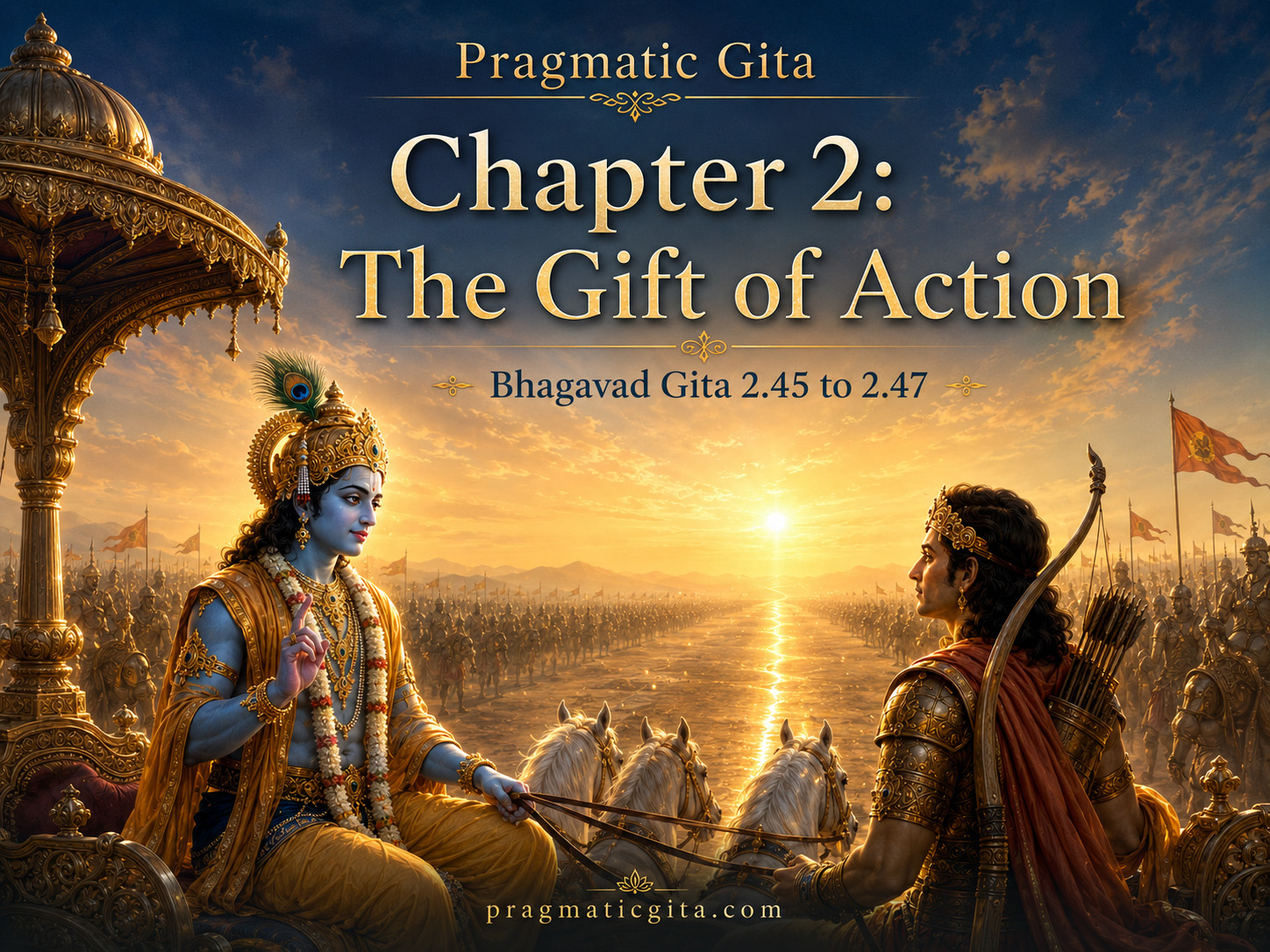

The Gift of Action – Acting without bondage
In a world obsessed with outcomes, our work often becomes a source of anxiety, and our relationships suffer under the weight of expectation. We give to get and love with conditions, measuring our self-worth by the results we achieve. The Bhagavad Gita offers a powerful way to heal this suffering by embracing The Gift of Action. This path of Karma Yoga teaches that the action itself, when offered freely without attachment, is the true reward. Embracing The Gift of Action turns every moment into a source of immense joy and liberation.
From Transaction to Transformation
The teaching begins by asking us to rise above the transactional mindset of the material world. Shri Krishna’s core instruction is revolutionary: you have a right to your action, but never to its fruits. This principle of selfless service is the very essence of The Gift of Action, a key that transforms every aspect of your life.
Your Relationship with Work
When you apply The Gift of Action to your career, you stop working for the paycheck, the promotion, or the praise. Your work is no longer a transaction; it becomes a sacred offering. This shift from “What can I get?” to “What can I give?” infuses your labor with a profound quality, turning even mundane tasks into a form of worship.
Your Relationship with Others
This is where The Gift of Action heals the most. Think of a mother tending to her infant; her action is pure love, not a calculation for future gain. When we act without expecting gratitude or a specific response, we liberate our relationships from the burden of disappointment. This practice of The Gift of Action allows us to love and serve freely, creating authentic, unconditional connections.
Your Relationship with Yourself
By detaching your self-worth from the unpredictable tides of success and failure, you find an unshakable inner freedom. Your value is no longer defined by external validation but by the sincerity of your efforts. You learn to find peace not in controlling the world, but in beautifully performing your part within it. This lasting peace is the ultimate result of mastering The Gift of Action.
If you have not already done so, I would request you to review the Chapter 1, Arjuna Vishada Yoga before studying chapter 2 as that would help set the right context.
You can find the explanation of shlokas 39 to 44 here. Please go through that to get better understanding of the context.
You can also listen to all the episodes through my Spotify Portal, Apple Podcast, and on YouTube as well.
Keywords: The Gift of Action, Selfless service, Inner freedom, Karma Yoga lifestyle, How selfless action improves relationships, Benefits of working without expectation, Transforming work into worship, Gita’s path to inner peace, How can I stop worrying about results?, Can my work make me a better person?, What does the Gita say about selfless love?
Verse 2.45 to 2.47
त्रैगुण्यविषया वेदा निस्त्रैगुण्यो भवार्जुन |
निर्द्वन्द्वो नित्यसत्त्वस्थो निर्योगक्षेम आत्मवान् || 2.45||
trai-guṇya-viṣhayā vedā nistrai-guṇyo bhavārjuna
nirdvandvo nitya-sattva-stho niryoga-kṣhema ātmavān
त्रैगुण्यविषया (Traigunya-viṣayā); Subject matter related to the three modes of material nature वेदाḥ (Vedāḥ); The Vedas निस्त्रैगुण्यः (Nistraiguṇyaḥ); Transcendental to the three modes of material nature भवार्जुन (Bhavārjuna); Arjuna, the son of Pritha निर्द्वन्द्वः (Nirdvandvaḥ); Without duality नित्यसत्त्वस्थः (Nitya-sattva-sthaḥ); Situated in pure goodness eternally निर्योगक्षेमः (Niryoga-kṣemaḥ); Free from the notions of gain and preservation आत्मवान् (Ātmavān); Self-realized.
Arjuna, the Vedas deal with the subject matter related to the three modes of material nature, but you must become transcendental to these modes. Be free from all dualities and situated in the pure goodness eternally, without being concerned with material gain and protection, and become self-realized.
यावानर्थ उदपाने सर्वत: सम्प्लुतोदके |
तावान्सर्वेषु वेदेषु ब्राह्मणस्य विजानत: || 2.46||
yāvān artha udapāne sarvataḥ samplutodake
tāvānsarveṣhu vedeṣhu brāhmaṇasya vijānataḥ
यावान् (Yāvān) – as much as; अर्थः (Arthaḥ) – object of sense enjoyment; उदपाने (Udapāne) – in a reservoir of water; सर्वतः (Sarvataḥ) – all around; सम्प्लुतोदके (Samplutodake) – completely merged in water; तावान् (Tāvān) – similarly; सर्वेषु (Sarveṣu) – in all; वेदेषु (Vedeṣu) – Vedic knowledge; ब्राह्मणस्य (Brāhmaṇasya) – of the Brahmana; विजानतः (Vijānataḥ) – one who knows well.
For a wise Brahmana who has realized the Self, the Vedas are as useful as a reservoir of water in a place flooded by water everywhere.
कर्मण्येवाधिकारस्ते मा फलेषु कदाचन |
मा कर्मफलहेतुर्भूर्मा ते सङ्गोऽस्त्वकर्मणि || 2.47 ||
karmaṇy-evādhikāras te mā phaleṣhu kadāchana
mā karma-phala-hetur bhūr mā te saṅgo ’stvakarmaṇi
कर्मणि (karmaṇi) – in prescribed duties; एव (eva) – only; अधिकारः (adhikāraḥ) – right; ते (te) – your; मा (mā) – do not; फलेषु (phaleṣu) – in the results; कदाचन (kadācana) – at any time; मा (mā) – do not; कर्मफलहेतुः (karma-phala-hetuḥ) – the cause of the results of action; भूः (bhūḥ) – become; मा (mā) – do not; ते (te) – your; सङ्गः (saṅgaḥ) – attachment; अस्तु (astu) – let there be not; अकर्मणि (akarmaṇi) – in inaction.
You have the right to perform your prescribed duties, but you are not entitled to the results of your actions. Never consider yourself the cause of the results of your activities, nor be attached to inaction.
These verses are meant to completely change the way Arjuna thinks. Until now, his mind has been focused on results, on what may happen, what he may gain, and what he may lose. Shri Krishna now begins to teach him how to focus instead on the action itself and on the right way to perform it. This becomes the foundation of Karma Yoga, the path of finding inner freedom while still living and working in the world.
Shri Krishna does not give Arjuna a way to escape from the battle. He gives him the clarity to face it. He does not give him a trick to win the war. He teaches him how to win over his own mind. This teaching has guided seekers for thousands of years because it answers a question that all of us face. How can we act fully in this world without becoming trapped by our own actions?
What Krishna Is and Is Not Rejecting
Shri Krishna begins with the words त्रैगुण्यविषया वेदा (traiguṇya-viṣayā vedā). In plain language, He is referring to those parts of the Vedas that deal with life within the three guṇas and promise particular results through particular actions.
This statement must be read in the flow of the earlier verses. Shri Krishna has just criticized people whose minds are carried away by flowery words and descriptions of ritual rewards, heavenly enjoyment, prosperity, power, etc. Therefore, He is not dismissing the Vedas as a whole. He is correcting a limited way in which we tend to use the Vedas.
We can approach Bhagavan in the same transactional manner even today. We may say, “I will perform this vrata so that my problem disappears. I will chant this mantra so that my business succeeds. I will make this offering so that my child gets admission. I will worship only as long as I receive what I asked for.” The prayer itself is not wrong. A distressed person naturally calls upon Bhagavan. In the seventh chapter, Shri Krishna even calls the distressed devotee and the seeker of prosperity sukṛtinaḥ, people of good action who turn toward Him. That is beginner level devotion and is also acknowledged by Shri Krishna.
The limitation comes when the relationship never deepens. A child may first go to the mother only for food, protection, and comfort. There is nothing shameful in that. But as the child matures, love grows beyond the things received. In the same way, bhakti may begin with “Bhagavan, please give me this,” but it should gradually grow into “Bhagavan, please guide me,” then into “Bhagavan, let my action please You,” and finally into “Bhagavan, may I just always be in constant remembrance of you.”
Swami Mukundananda explains the same movement in very practical language. Scriptural discipline may help a person rise from tamas to rajas and from rajas to sattva. But the Vedas also contain divine knowledge that directs the seeker toward the Absolute. Therefore, Shri Krishna is asking Arjuna to stop being attracted by the reward-centred portion and to use sacred knowledge for spiritual elevation.
This is very important for us. Karma Yoga does not begin after every selfish tendency has disappeared. Karma Yoga is the discipline through which those tendencies are slowly purified.
Suppose we volunteer for a spiritual programme. Part of us genuinely wants to serve. Another part wants the teacher to notice our effort. A third part becomes upset when someone else receives appreciation. We do not need to condemn ourselves or abandon the service. We need to see the mind clearly. Then we can tell the mind, “Yes, appreciation feels pleasant, but that is not why I am here. Let me focus on my spiritual practice. Let this become an offering.” Every such correction weakens the old samskara and while strengthening the new one.
The Three Guṇas and the Need to Go Beyond Them
Shri Krishna then says निस्त्रैगुण्यो भवार्जुन (nistraiguṇyo bhavārjuna), “Arjuna, become free from the hold of the three guṇas.”
The three guṇas are sattva, rajas, and tamas. They are the basic tendencies of prakṛti, and they shape the functioning of our body, senses, mind, and intellect.
Tamas appears as dullness, confusion, carelessness, resistance, sleep, neglect, and the refusal to face what must be faced. Rajas appears as restless activity, ambition, comparison, craving, fear of losing, and the constant need to become something more. Sattva appears as clarity, balance, self-control, kindness, truthfulness, and the ability to see a situation without immediately being carried away by it.
All three are present in us in changing combinations. The same person can wake up in tamas, work through the day in rajas, and become quiet and prayerful in sattva during the evening. Our food, company, habits, thoughts, sleep, work, and saṃskaras all affect which guṇa becomes stronger.
At first this sounds like a small puzzle. Shri Krishna says, निस्त्रैगुण्यो भव (nistraiguṇyo bhava), go beyond the three guṇas to achieve transcendence. Yet in the same verse He says, नित्यसत्त्वस्थः (nitya-sattva-sthaḥ), remain firmly established in sattva. How can we go beyond all three while remaining in one of them?
The answer is that sattva is the platform from which transcendence becomes possible. A muddy and violently disturbed lake cannot clearly reflect the moon. When the mud settles and the water becomes calm, the reflection becomes clear. Sattva does not create the Self, just as still water does not create the moon. It removes enough disturbance for truth to be recognized.
Therefore, the movement is not from tamas directly to transcendence. We move from tamas to disciplined activity, from restless activity to clarity, and from clarity to freedom. The ladder is good and we need it, but the ladder is not the destination. Sattva is the highest rung in the ladder. Even then, we must not get attached to the ladder or build a new ego around being pure, wise, or sattvik.
A person in tamas may say, “Nothing can be done. Let me avoid the issue.” A person in rajas may say, “I must win this argument and prove that I am right.” A person in sattva may say, “Let me understand what is true, what is fair, and what will help everyone.” The person who is growing beyond the guṇas can act from that clarity without building an identity around being the wise or good person.
Consider a workplace disagreement. Someone challenges our proposal in a meeting. Tamas may make us withdraw, stop contributing, and quietly hold resentment. Rajas may make us interrupt, defend every sentence, and think, “I must defeat this person in front of everyone.” Sattva allows us to listen, separate the useful criticism from the personal tone, respond firmly where needed, and change our position where the other person is right. Going beyond the guṇas means that even this sattvic response is not used to feed the ego. We do not go home thinking, “See how spiritually superior I was.” We simply do what the situation requires.
The same applies in family conflict. Tamas avoids the conversation. Rajas wants immediate victory. Sattva seeks truth, timing, compassion, and a workable resolution. Transcendence begins when we can use the sattvic mindset without becoming proud or feeling superior or even mistaking that to be our true self, because our true self is beyond even that.
Practically, how do we strengthen sattva in our life? We do it through truthful living, clean food, proper sleep, uplifting company, study, prayer, japa, meditation, selfless service, and the disciplined performance of duty. None of these automatically guarantees realization. They prepare the inner field. Just like that, we do not worship sattva as the final goal. We use sattva to discover the freedom that is deeper than all three guṇas.
Freedom From Duality and the Anxiety of Possession
After telling Arjuna to rise beyond the guṇas, Shri Krishna gives four closely connected instructions. Each phrase shows us how bondage works in daily life.
निर्द्वन्द्वो नित्यसत्त्वस्थो निर्योगक्षेम आत्मवान् || 2.45||
nirdvandvo nitya-sattva-stho niryoga-kṣhema ātmavān
निर्द्वन्द्वः (nirdvandvaḥ)
The word means freedom from domination by the pairs of opposites. Heat and cold, pleasure and pain, praise and blame, gain and loss, acceptance and rejection are all dvandvas.
Shri Krishna is not saying that the body will stop feeling heat and cold, or that the mind will never feel pleasure and pain. He is saying that these experiences should not decide our dharma. Earlier He told Arjuna to endure their passing contact. Here He asks him to become inwardly free enough that the pull of one side and the fear of the other do not control his actions.
Suppose our manager praises a report we prepared. We can receive the appreciation with gratitude. There is no need to become cold or pretend that praise means nothing. The bondage begins when the mind quietly changes the event into an identity. “I am valuable because my report was praised. I must receive the same response next time. If somebody else is praised more, I am becoming less important.”
Criticism produces the opposite movement. One difficult review becomes, “I am a failure. They do not respect me. My whole future is threatened.” In both cases, our focus has shifted from dharma to reaction. Praise pulls us in one direction and criticism pushes us in the other.
Nirdvandva means that we learn from both without becoming controlled by either. Praise can show us what worked. Criticism can show us what needs correction. Neither praise nor criticism has the authority to define us.
नित्यसत्त्वस्थः (nitya-sattva-sthaḥ)
Shri Krishna asks Arjuna to remain steadily rooted in sattva. The emphasis is not on an occasional spiritual mood. Anyone can feel peaceful for a few minutes after prayer. The test comes when the email arrives, the plan changes, someone speaks unfairly, or a result we wanted does not come.
To remain in sattva means to protect clarity before, during and after the crisis or challenge. We build this steadiness through discipline. A few minutes of daily japa may appear small, but it trains the mind. Speaking truth in small matters strengthens us for difficult decisions. Controlling one unnecessary reaction weakens an old saṃskara. Choosing good company changes what the mind repeatedly hears and gets attached to.
This is why spiritual life cannot be reduced to collecting ideas. We may know many Sanskrit words and still remain helpless before anger, jealousy, or fear. Knowledge must pass through shravana, attentive hearing, manan, careful reflection, and nididhyasana, deep assimilation until the teaching becomes the way we see and act.
निर्योगक्षेमः (niryoga-kṣemaḥ)
Here yoga means acquiring what we do not have, and kṣema means preserving what we already possess. Much of human anxiety moves between these two poles.
“I need to get that position.” and “I must not lose the position I have.”
“I need more money to feel secure.” and “I should not lose the money I already have”.
There is nothing wrong with earning, saving, maintaining a home, buying insurance, or planning responsibly. Shri Krishna is not teaching carelessness. The issue is not practical protection. The issue is inward dependence. When acquisition and preservation become the centre of life, the mind can never rest. Before getting something, we are anxious to obtain it. After getting it, we are anxious to protect it and not to lose it.
Shri Krishna will revisit this topic later in 9th chapter and by then, we will all hopefully be more sattvic and receptive to the teaching.
आत्मवान् (ātmavān)
The final word of the verse is ātmavān. Shankaracharya explains it as self-collected and vigilant. Other teachers bring out the sense of being established in the Self or governed by the higher self rather than by the restless mind.
An ātmavān is a person who is inwardly calm. Their senses do not pull them in five directions. Such a person remains very mindful of what is happening within themself.
A beginner on this path is able to realize the pull of a desire or craving or any negative emotions like envy, jealousy etc. only after they have already reacted based on them. Whereas, a person in the mode of ignorance doesn’t realize even after they have reacted, even after a lifetime of suffering based on such repeated reactions.
The sadhak or practitioner is usually able to become mindful during the process of reacting based on these emotions and desires. And sometimes they are able to course correct.
Whereas, an ātmavān is able to be mindful before they take control of their mind and before they impact their actions.
That is the movement from yoga-kṣema to ātmavān.
The Well, the Flood, and the Purpose of Scripture
Shri Krishna now gives the image of verse 2.46. यावानर्थ उदपाने (yāvān artha udapāne) means whatever use is served by a well or a limited reservoir. सर्वतः सम्प्लुतोदके (sarvataḥ samplutodake) means when water is abundant and has flooded everywhere.
The image is a limited source of water compared with water available all around. The well has not become false. It has not become an enemy. It has a purpose when the land is dry and it is the only source of water. However, when there is water everywhere, it loses its significance. For example, nobody will dig a well in the middle of a river.
Then Shri Krishna says तावान्सर्वेषु वेदेषु (tāvān sarveṣu vedeṣu), “that much is the use of all the Vedas,” ब्राह्मणस्य विजानतः (brāhmaṇasya vijānataḥ), “for the one who truly knows Brahman.” Here brāhmaṇa points to the knower of Brahman, not merely to a social label by birth.
The map helps us navigate towards our destination. The map is not the destination. And once we reach the destination, we no longer require the map. That’s all Shri Krishna is saying about the ritualistic aspects of the Vedas.
Verse 2.46 asks us to return to purpose. What thirst is scripture meant to quench? It is meant to remove ignorance, purify our vision, deepen devotion, and lead to direct recognition of truth.
Pause and reflect
Are we using scripture to transform our life, or are we using scripture to decorate the ego? Has our study made us more truthful, steady, compassionate, and responsible? When a difficult situation comes, do the words of the Gita become living guidance, or do they remain stored as information?
How to apply this today
- Study fewer teachings more deeply rather than collecting endless material.
- Revisit one teaching during a challenging situation in your life.
Our Rightful Sphere Is Action
After explaining the purpose of scripture, Shri Krishna turns directly to action. In what is probably the most popular verse from the Bhagavad Gita.
कर्मण्येवाधिकारस्ते मा फलेषु कदाचन |
मा कर्मफलहेतुर्भूर्मा ते सङ्गोऽस्त्वकर्मणि || 2.47 ||
karmaṇy-evādhikāras te mā phaleṣhu kadāchana
mā karma-phala-hetur bhūr mā te saṅgo ’stvakarmaṇi
कर्मण्येवाधिकारस्ते (karmaṇy-evādhikāras te) means, “Your adhikāra is in action alone.”
The word adhikāra is often translated as “right,” but it also means one’s rightful authority, and responsibility. Shri Krishna is telling Arjuna where his present responsibility belongs. A judge has authority over the fairness of the proceedings, but not over how every person reacts to the verdict. A cook can prepare a meal with skill and care, but cannot command every guest to enjoy it. A parent can give love, values, guidance, and discipline, but cannot control every choice the child will later make.
This does not mean we have no influence over outcomes. It means action is the field in which our choice can be directly exercised. Results arise through action, but they are not manufactured by our actions alone.
A surgeon has responsibility for careful diagnosis, preparation, hygiene, technical skill, communication, and sound judgment during an operation. The surgeon must study the case and act with full attention. Yet even excellent surgery cannot give absolute control over the patient’s recovery. The condition of the body, an unexpected complication, the patient’s faith in the treatment, and many other factors influence the outcome.
Karma Yoga does not ask the surgeon to say, “The result is not mine, so I need not care.” That would be negligence. The teaching is the opposite. Because the surgeon’s responsibility is action, every part of the action deserves attention. Freedom from attachment to results removes the mental noise that interferes with excellence. Letting go of the fruit purifies the action by reducing fear, vanity, and anxiety.
The trouble is when we try to feel the result before we have completed the action. The student repeatedly imagines the grade instead of studying. The employee repeatedly imagines promotion instead of improving their work. The musician imagines applause, criticism, and comparison instead of focusing on their music. Mental energy that belongs to action gets stolen by a future that has not yet arrived.
When attention is fully given to the work itself, performance and well-being improve. The Gita goes deeper, because it is not merely teaching a productivity technique. It is changing our identity and motive. Work becomes discipline, service, offering, and a means of purifying the mind.
Swami Vivekananda was very realistic about this. We do not suddenly become perfectly unselfish. We begin with the motives we actually have and slowly make them higher. Perhaps I work partly for salary, partly for pride, partly for family responsibility, and partly because the work genuinely helps people. Karma Yoga asks me to recognize the mixture and strengthen duty, service, truth, and excellence without pretending that practical needs do not exist.
Never Make the Fruit Your Inner Master
Shri Krishna continues with मा फलेषु कदाचन (mā phaleṣu kadācana), “never claim authority over the fruits.” The word kadācana means ‘at any time’ or ‘never’ as per the context. At no time should we claim ownership or adhikara of the results of our action.
This does not mean we should not care whether an action succeeds. Dharma is not indifference. A doctor should care whether the patient heals. A parent should care whether guidance helps the child. A teacher should care whether students understand. The difference lies between caring about a result and trying to control the result or making our self worth and peace dependent upon it.
Consider planting a seed. We must select it, prepare the soil, place it properly, water it, protect it, and give it suitable light. These actions matter. Yet the life within the seed, the weather, the soil, insects, disease, and many other conditions also matter. Detachment does not mean refusing to water the seed. It means giving full care without shouting at the earth because growth does not follow our timetable.
Much of our suffering comes not merely from expectation, but from fixed and possessive expectation. We decide that one particular result must occur, in one particular form, at one particular time, and that our happiness or worth depends upon it. When life does not obey that expectation, the mind feels betrayed.
Unexpected pain is part of life even for a wise person. Grief, illness, injustice, and loss can hurt deeply. Along with the pain, the mind says, “This must not have happened. I cannot be whole now. I am worthless.” Karma Yoga helps us face the actual pain without multiplying it through such inner noise.
Let us take a family example. We speak honestly to someone we love, apologize for our part, listen carefully, and try to repair the relationship. We naturally hope for reconciliation. But the other person has freedom, emotion, and saṃskāras of their own. We cannot force forgiveness. If our inner voice says, “I behaved well, so they must respond exactly as I want,” then even a sincere action has become a transaction.
The Karma Yoga based response says, “Let me do everything dharmic that is available to me. Let me remain open to repair. Let me also respect that the other person’s response is not mine to control.”
This is how buddhi protects action. It lets the result educate us without allowing the result to define us.
Do Not Claim to Be the Sole Cause
The third instruction in verse 2.47 is मा कर्मफलहेतुर्भूः (mā karma-phala-hetur bhūḥ). This phrase requires careful handling because it is often reduced to “Do not be motivated by results.” That is part of the practical meaning, but the phrase also addresses agency and doership.
Ramanujacharya brings out the devotional hurdle of, “I alone am the doer, and the fruit belongs to me.” Action can be performed as worship of Bhagavan. The capacities, body, mind, opportunity, and field of action are received within a larger divine order. Therefore, we take responsibility for our effort without claiming independent and absolute authorship.
The difference is subtle but very practical.
The ego says, “I alone am the doer. This success proves my greatness. This failure destroys me.”
Karma Yoga says, “I am responsible for the quality and intention of my participation. I am not the only cause and I am not the only doer. Let the action be offered, and let me accept with grace whatever results may come.”
This does not permit us to deny accountability. After causing harm, we cannot say, “The guṇas did everything, so I am not the doer, I am not responsible.” The Gita’s teaching on non-doership is not an excuse for carelessness or dishonesty. It clearly emphasizes ‘rightful action’ as the only action that we should engage in.
Do Not Escape Into Inaction
Some people have a tendency to misinterpret this teaching and say “Ok, then, I will just not perform any action at all, so then I don’t have to worry about what is rightful action, not depending on results etc etc…” 😀
Shri Krishna closes every escape route with मा ते सङ्गोऽस्त्वकर्मणि (mā te saṅgo ’stv akarmaṇi), “Do not become attached to inaction.”
This final phrase is essential. Without it, Arjuna could misunderstand the entire teaching. He could say, “If I should not seek the result, why should I fight? If action may cause bondage, it is safer to withdraw.”
For Arjuna, akarma would mean refusing the duty standing before him because its emotional cost is unbearable. His refusal may look peaceful from the outside, but Shri Krishna sees the fear, grief, and confusion within it.
We see the same thing in ordinary life.
A person avoids a necessary conversation and calls it “protecting my peace.”
A student does not submit their homework and says, “Grades should not matter.”
A devotee neglects family responsibility and says, “Everything is Bhagavan’s will.”
In all these cases, the mind is still attached to a result. It wants to avoid blame, discomfort, uncertainty, or failure. The result-hungry ego tries to control life by grabbing, while the frightened ego tries to control life by hiding. Inaction then becomes another strategy for protecting the same ego.
At the same time, we should not confuse rightful action with constant movement. Sometimes dharma requires silence, waiting, rest, restraint, or refusal. A surgeon may decide not to operate because the risk is too high. A family member may postpone a conversation until anger has settled. These are not attachment to inaction when they are aligned with dharma. The question is whether we are guided by buddhi or by our ego.
This is why Krishna’s four instructions have to remain together.
कर्मण्येवाधिकारस्ते (karmaṇy-evādhikāras te) gives us responsibility.
मा फलेषु कदाचन (mā phaleṣu kadācana) removes the possessive claim over the outcome.
मा कर्मफलहेतुर्भूः (mā karma-phala-hetur bhūḥ) weakens craving and egoic doership.
मा ते सङ्गोऽस्त्वकर्मणि (mā te saṅgo ’stv akarmaṇi) prevents escape from rightful action.
Take away any one of these, and the teaching becomes distorted.
- Action without detachment becomes bondage.
- Detachment without action becomes avoidance.
- Action without humility becomes ego.
- Humility without responsibility becomes helplessness.
If we reflect on our own lives, we will realize that most of our painful memories are based on either something unexpected happening or something expected not happening. ‘Expectation’ is always the cause.
Even in Buddha’s teachings, one of the Four Noble Truths is that “the cause of all sufferings is attachment”.
If you look at nature, you see such detached actions everywhere. The honey bees gather honey, but have you ever come across a honeybee which was looking depressed because someone else was enjoying the honey that it gathered? Have you ever come across a hummingbird which stopped singing because nobody was listening?
We can see that everything in Nature is practicing verse 2.47 🙂 The animals, trees, oceans, sunshine, rain etc. all are doing what they are supposed to be doing without worrying about the outcome.
So, the question is why is it so difficult for humans to perform our actions without attachment to results? The simple answer is our massive Ego 🙂 It is the Ego which makes us get attached to results because it wants us to believe that we are the doers and we are in control of everything. If we let it, the Ego will make us believe that we are in control of even God.
So why is this Ego bad? Basically we are a tiny spark of the supreme God. However, we cannot succeed in realizing the Supreme God as long as we are engrossed in our own self. We are too full of our small “i”. Once we remove our small “i”, we make room for the big “I”.
Shri Krishna’s teaching offers a radical cure. It doesn’t ask us to lower our standards or reduce our efforts. If anything, when we release attachment to results, the quality of our work improves dramatically.
The Bhagavad Gita is ultimately a handbook for warriors, not just military warriors but anyone who must act in the world while seeking freedom. Verse 2.47 provides the warrior’s fundamental code of engaging fully. It is a teaching that becomes more relevant, not less, as our world becomes more complex and interconnected. Every email we send, every decision we make, and every relationship we nurture can be an opportunity to practice this profound yoga of action.
Pragma 3: Always choose rightful action over inaction. Never be attached to the results of your work.
We can now see the cycle of bondage.
The guṇas influence the mind. The mind then becomes pulled by dualities. Duality strengthens craving for preya. Craving creates the restless movement of acquisition and preservation (yoga kshemam). The desired fruit then becomes tied to identity. The ego says, “I alone am the doer, and my worth depends upon the result.” Fear of failure produces anxiety, manipulation, or avoidance. Each reaction leaves another saṃskāra, and those saṃskāras keep the wheel of saṃsāra moving.
The reversal also becomes clear.
We cultivate sattva and observe the guṇas. We endure dualities without surrendering buddhi. We choose shreya over the immediate pull of preya. We replace anxious yoga-kṣema with rightful action and faith. We become ātmavān, inwardly gathered. We use scripture for transformation. We perform the action that belongs to us. We offer the fruit and loosen the claim of sole doership. We learn from whatever comes and continue without getting attached to inaction.
This is the reversal from bondage-producing karma to Karma Yoga. We engage fully, offer the results to Shri Krishna, and keep returning to the next rightful action.
Can there be anything more practical? We do not have to leave our family, profession, community, or responsibilities in order to begin. The workplace disagreement becomes practice. The difficult family conversation becomes practice. The surgeon’s operation becomes practice. The musician’s rehearsal becomes practice. Every action gives us the chance to examine motive, improve effort, offer ownership, accept the result, and take the next dharmic step.
This is how spiritual knowledge enters life. We do not wait for a perfectly pure mind before beginning. We begin with the mind we have. We bring awareness into our mixed motives. We strengthen sattva. We remember Bhagavan. We perform our duty as well as we can. When success comes, we receive it with gratitude rather than pride. When failure comes, we learn without collapsing. When the mind wants to escape, we return to the next right action.
Slowly, the centre changes. At first we work mainly for the fruit. Then we learn to value the quality of action. Then action becomes service. Service becomes offering. Offering purifies the doer. And through that purification, the knowledge we once heard begins to become the life we actually live.
kṛṣṇadaasa
Servant of Krishna